"We hope this conference will put the collective implementation of more ambitious measures to protect the climate back at the forefront," explains Isolda Agazzi, head of development policy at Alliance Sud.
"The average female driver thus spent 14.90 francs on gasoline to travel 100 kilometers in 1981, compared with 16.10 francs today. In the meantime, household disposable income has, however, been multiplied by 2.85," recalls Philippe Thalmann, professor of environmental economics at EPFL.
While strengthening its investments in the network, the national electricity transmission system operator significantly reduced its costs in the first half of 2026.
How the electrification of mobility reduces the fossil fuel crisis
"Each electric car in circulation reduces exposure to the volatility of oil markets," affirms Euam Graham in a report published by the think tank Ember.
If filling up with gasoline is weighing more and more on the budget, the situation could be worse without the electrification of mobility that began over the past decade. @Getty Images|CanvaPro
Filling up at the pump is enough to make teeth grind these days. Whether in Switzerland or in other countries, topping up with petrol is weighing increasingly on household budgets. Yet the situation could be worse without the electrification of mobility that began over the past decade. “Each electric car on the road reduces exposure to the volatility of oil markets,” says Euam Graham in a report published by the think tank Ember. According to this senior energy analyst, “countries that invested in electric vehicles before this crisis are now less exposed to oil market volatility and logically better protected against future supply shocks.”
In a context where Donald Trump’s United States are bowing once again to Vladimir Putin to obtain a few tens of millions of barrels of Russian diesel, it is all the more relevant to show how the switch to electric or hybrid cars gradually reduces the grip of the fossil fuel kings on our economic models. We break down Ember’s report for you in a few key points.
1️⃣
Millions of barrels saved. According to Ember’s estimates, over the six months since the start of the Hormuz energy crisis, electric car fleets in oil-importing countries have avoided the consumption of 200 million barrels of crude, worth $20 billion.
After exceeding $100 on more than 60 occasions in 2026, the price per barrel has remained above that symbolic threshold since the start of September. The amount of savings should therefore increase further in the second half of the year.
Another interesting finding of the study: the majority of the savings, some $16.5 billion, comes from 100% electric vehicles, the remainder being attributable to plug-in hybrids (PHEVs). This finding recalls the main controversy surrounding these models: “real-world data show that drivers rely more on their combustion engine than initially indicated by manufacturers,” the study states.
2️⃣
The “Strait of Hormuz” effect. The blockage of this strategic route for fossil fuels since the beginning of spring 2026 has accelerated the adoption of electric vehicles. “For countries dependent on oil imports, electric vehicles are the most powerful lever to reduce that oil demand,” Ember says, adding that those who made “the strategic choice to support their development are noticeably better protected against the current crisis.”
At the global level, electric vehicle sales thus increased by 11% in the first eight months of 2026 compared with the same period the previous year. This rise is notable for two reasons: sales are generally higher in the second half of the year, and this growth comes despite policy changes in the United States and China that could have slowed the market.
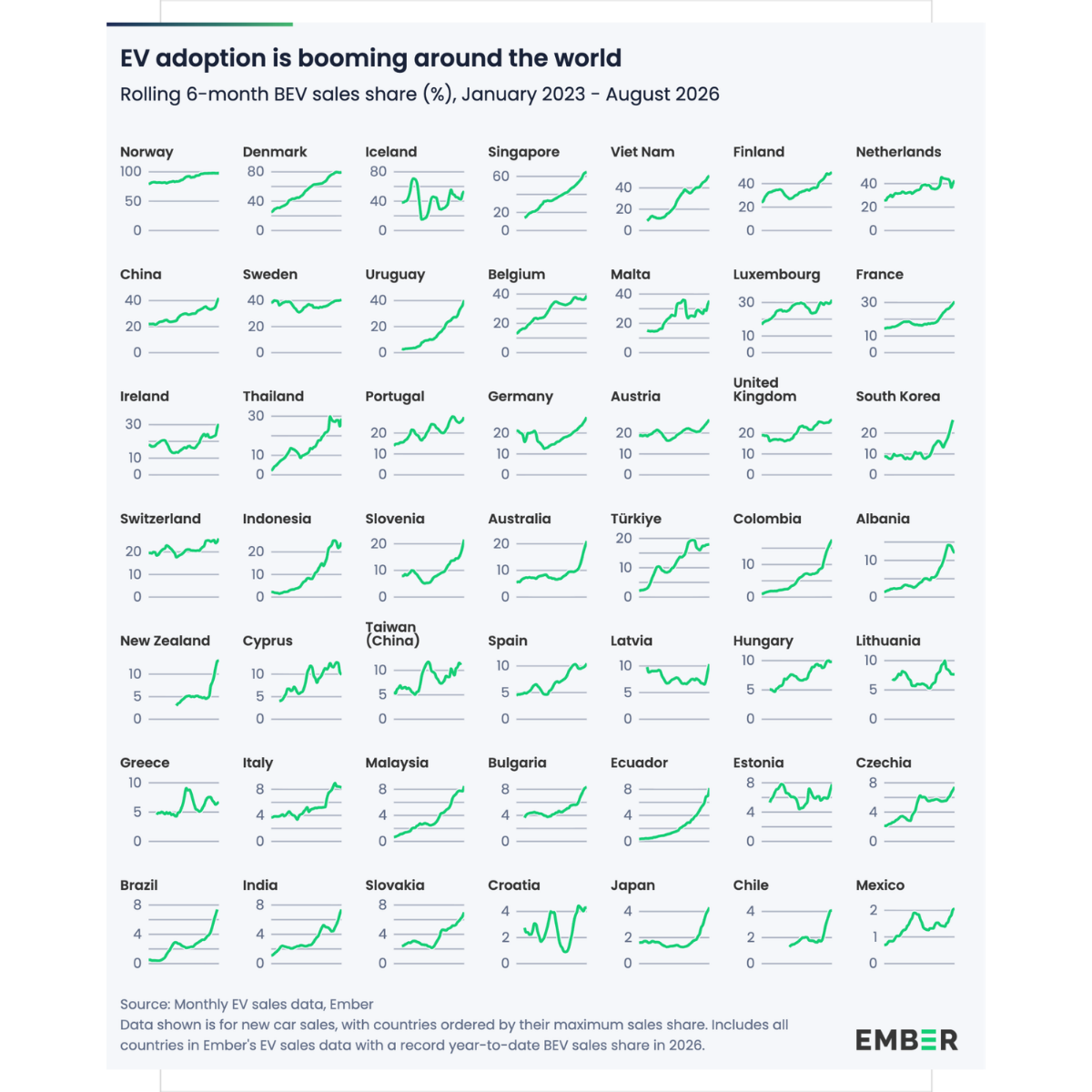
“Among the 56 countries covered in terms of monthly electric vehicle sales, 49 registered a record share of fully electric sales since the start of 2026,” reads Ember’s report. @EMBER
3️⃣
Europe and China lead. The transformation of China’s and Europe’s car fleets is paying off during this period of high oil prices. In China, Ember estimates that electric cars avoided the consumption equivalent to $14 billion of crude between March and August 2026. The study also notes that the phenomenon is broader since “two-wheelers, three-wheelers and road freight transport are also electrifying rapidly in China, which further contributes to reducing oil consumption.”
Unlike in the United States, where the electric vehicle market tends to falter, the growing electrification of mobility in the European Union avoided the consumption equivalent to $3.1 billion of crude over the same period. Germany and France show the highest amounts, with approximately $760 million and $560 million respectively.
Relative to national oil consumption, however, the crown goes to Denmark: “In August 2026, its fleet of electric cars avoids the consumption of 6.4 million barrels per year, the equivalent of 13% of the national oil consumption in 2025,” Ember says.
4️⃣
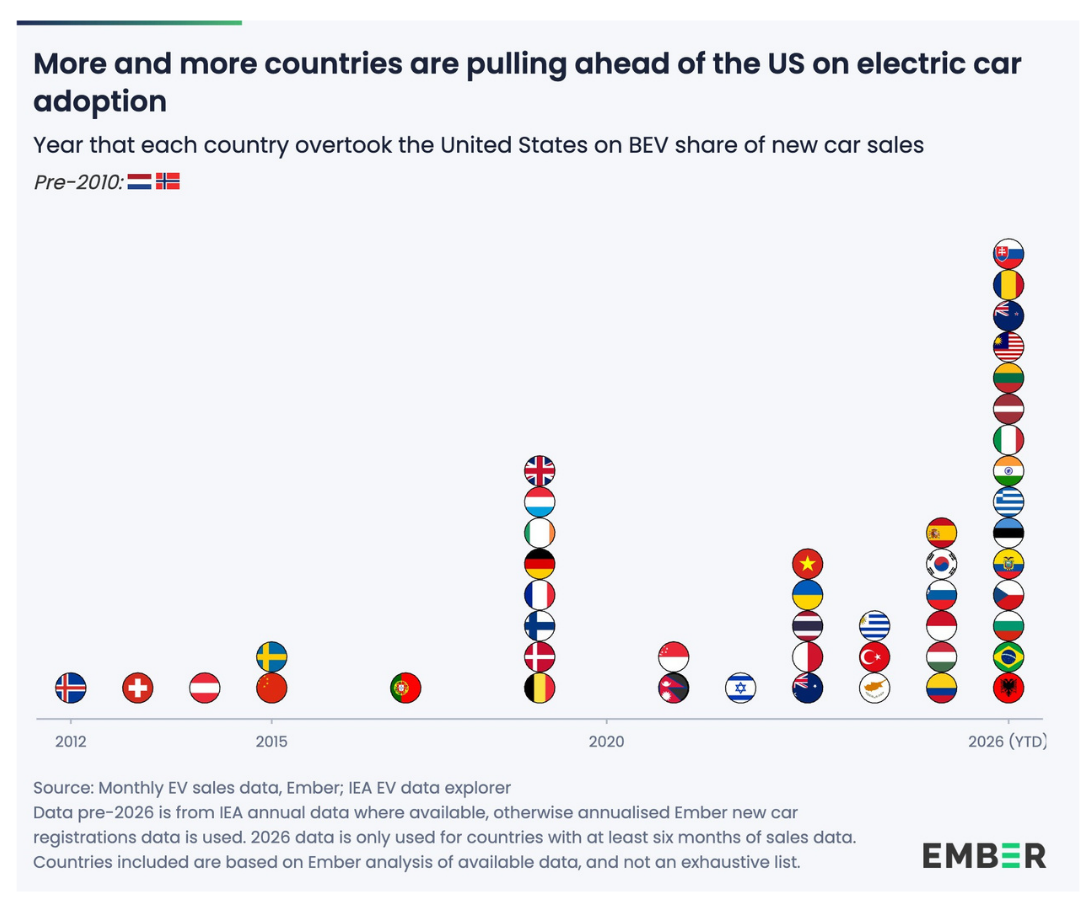
Record after record. “Among the 56 countries covered in terms of monthly electric vehicle sales, 49 registered a record share of fully electric sales since the start of 2026,” reads Ember’s report. Excluding the United States and China, electric vehicle sales even grew by 45% between January and August 2026 compared with the same period the previous year.
Even Norway, known for its lead over the rest of the world in electrifying its car fleet, reached a new record: fully electric vehicles accounted for 98% of sales in the first eight months of 2026 (compared with 95% for several months in 2025). The country is therefore among the twelve markets followed by Ember where electric cars have represented more than a third of sales since the start of the year.
In Switzerland too, the increase is notable, even if our country remains behind in the European comparison. The latest figures provided by Auto‑Suisse show that 100% electric cars accounted for 35.7% of new registrations, compared with just over a quarter one year earlier.
At the global level, electric vehicle sales thus increased by 11% in the first eight months of 2026 compared with the same period the previous year. @EMBER
In a time of crisis for the automotive industry, particularly in Europe, the electric car thus appears as a true lifeline. New models from Renault, Volkswagen and Škoda were among the best‑selling electric cars in Europe in July. But it is especially in several emerging countries that the shift is striking, with the added bonus of new production capacity being put in place. Ember cites the example of VinFast, the Vietnamese manufacturer that was already producing the best‑selling car in Vietnam in 2025 and expanded its industrial activities abroad by opening new factories in India and Indonesia in the same year.
This article has been automatically translated using AI. If you notice any errors, please don't hesitate to contact us.
"We hope this conference will put the collective implementation of more ambitious measures to protect the climate back at the forefront," explains Isolda Agazzi, head of development policy at Alliance Sud.
"The average female driver thus spent 14.90 francs on gasoline to travel 100 kilometers in 1981, compared with 16.10 francs today. In the meantime, household disposable income has, however, been multiplied by 2.85," recalls Philippe Thalmann, professor of environmental economics at EPFL.
While strengthening its investments in the network, the national electricity transmission system operator significantly reduced its costs in the first half of 2026.
"All installations of transmission, railway power-supply and distribution networks with a voltage exceeding 1 kV will henceforth be of national interest," says Jan Flückiger, head of public affairs at AES.