"Since our share of global greenhouse gas emissions is only one thousandth, our efforts would be doomed to remain insignificant. This argument expresses not a logical reasoning, but an attitude of defiance and denial," regrets René Longet, an expert in sustainable development.
Citing Nicholas Stern and his report on the economics of climate change, Dominique Bidou, the author of "Recivilisation", reminds that "action against global warming makes it possible to avoid expenditures at least five times greater than the initial cost."
"It is neither fair nor constructive to pit technologies against each other in a supposed race for funding: it's a false debate," says Eric Plan, secretary-general of the CleantechAlps association.
Windworks wants to revolutionize wind power using smart, vertical blades
Spin-off of EPFL, the start-up has set itself an ambitious mission: to make wind energy compatible with professional activity zones thanks to smaller, quieter turbines equipped with vertical-axis blades.
The story begins with Al Gore’s film "An Inconvenient Truth." At 11, Sébastien Le Fouest discovered there the scale of the climate crisis and the gap between scientific urgency and political inertia. "I immediately felt a weight on my shoulders. We’ve been talking about it for decades and yet no one moves. It seemed obvious to me that we had to start acting," he says.
This feeling never left him. Passionate about science, he decided very early that he wanted "to be among those who will contribute to accelerating the energy transition." Off to London, to Imperial College, to study engineering. There he took his first steps as an entrepreneur by founding CommuniTech, a non-profit association whose ambition was to help elderly people master digital tools. Objective: restore their autonomy in a world where everything is becoming digital.
This first experience gave him a taste for concrete, impactful projects. But to play a role in the energy sector, he lacked a firmer scientific foundation. He therefore returned to Switzerland and joined EPFL to work on a niche but promising topic: vertical-axis wind turbines.
An age-old technology
Compared with large conventional horizontal-axis wind turbines — a technology that is now mature, where advances are mostly fine tuning — turbines with vertical-axis blades remain marginal. "Yet the idea is old: the first windmills in history, used by the Persians as early as the 9th–10th centuries to grind grain, were already vertical-axis. In regions of turbulent and shifting winds, this geometry made it possible to capture the wind whatever its direction," says Sébastien Le Fouest.
Scientifically, the subject had everything to attract him. It combined his passion for fluid mechanics and his obsession with the energy transition. And above all, he saw a real problem to solve: these "vertical" turbines suffer from aerodynamic limitations that reduce their efficiency and lifespan. His doctorate focused precisely on these phenomena.
In the Laboratory for Diagnosis of Unsteady Flows at EPFL, led by Professor Karen Mulleners, everything is based on experimentation rather than numerical simulations. "We build small physical wind turbines, place them in a wind tunnel, subject them to gusts, observe where and when the flow stalls, where destructive vibrations originate, how performance collapses," the young researcher explains.
"The first windmills in history, used by the Persians as early as the 9th–10th centuries to grind grain, were already vertical-axis," says Sébastien Le Fouest.
Making the blades "intelligent"
The second phase of the doctorate shifted into a search for solutions. Rather than endure these phenomena, why not control them? The analogy comes from the maritime world: a sailboat constantly adjusts its sails to maximize lift, depending on the wind and its course. The principle is transposed to the vertical turbine thanks to a motor that allows the blade orientation to be adjusted in real time according to actual wind conditions.
Using an optimization algorithm, the machine "searches" for configurations that maximize production while minimizing loads on the structure. "The results proved spectacular, with efficiency multiplied by three and loads halved, offering a potentially extended lifespan of two to eight times," says Sébastien Le Fouest. It was the entrepreneurial spark: what had been a thesis subject became an industrializable technology.
Founding a start-up
With Daniel Fernex (CTO) and Eric Sayag (COO), Sébastien Le Fouest founded Windworks, a start-up driven by the conviction that their vertical turbine has a major role to play where large conventional turbines cannot be installed. In Switzerland, sites suitable for the latter are indeed rare and, when they exist, they face considerable social and political resistance. Between impact studies, appeals procedures, referendums and the relocation of high-voltage lines, it often takes between 20 and 25 years to realize a project.
In the longer term, the start-up even plans to develop 100 kW wind turbines, still under the regulatory threshold of 30 meters in Switzerland — and even beyond in countries where this limit is higher. @Windworks
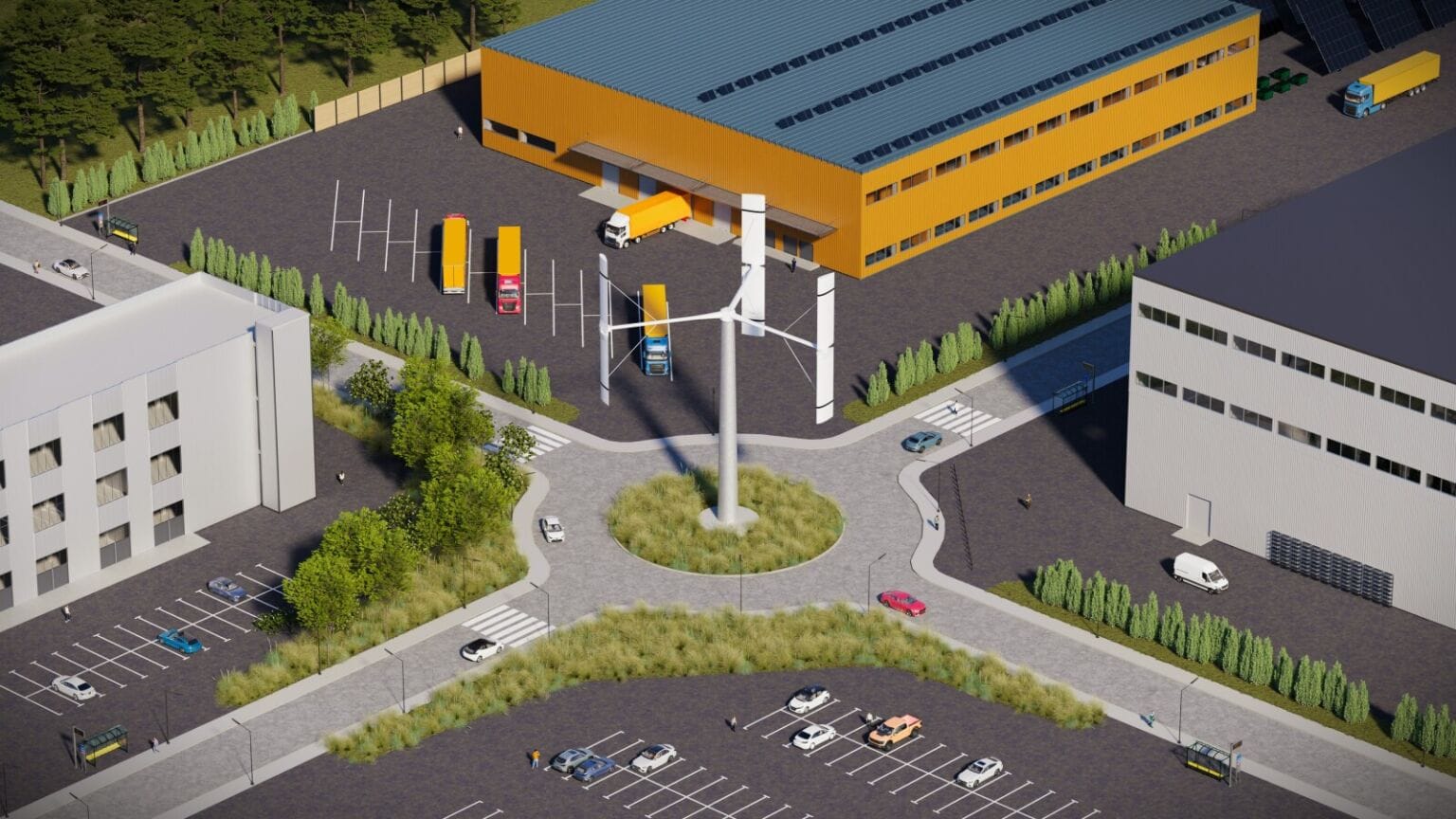
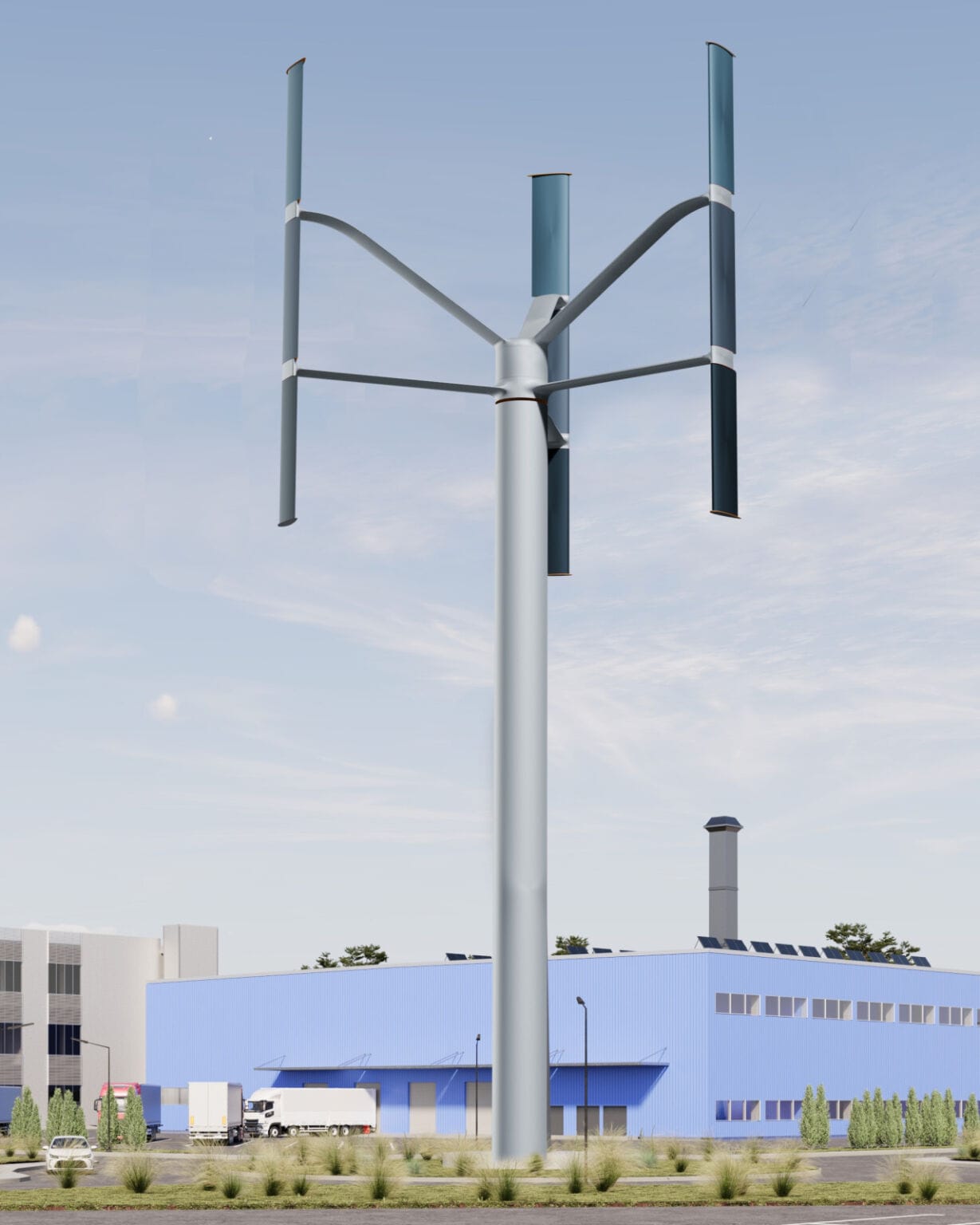
"Small-scale installations, with minimal visual impact due to their dimensions, are de facto more likely to appeal to customers and thus help democratize the technology and its deployment," estimated the jury of the "Best Innovation Award" given to Windworks by The Ark foundation in 2024. Turbines 15 to 30 meters high, installed directly where electricity is consumed: that is the niche targeted by the young company. Below 30 meters, Swiss regulation is more flexible since a simple municipal building permit is usually sufficient, with shortened timelines of a few months.
Technically, the machine is optimized for a complex environment: if the wind is weaker at 30 meters in height, it is mainly more turbulent there, frequently changes direction and is deflected by terrain or buildings. It is precisely under these conditions that the vertical axis and real-time blade control make sense: the turbine captures wind coming from all directions, does not require laminar flow and handles gusts very well.
On the noise and visual fronts, Windworks aims for discretion. "At three diameters away — about 20 meters for a 10 kW machine — the calculated noise level is around 40 to 45 dB," specifies its CEO. As for visual impact, it remains limited, with heights incomparable to those of the large white masts often contested.
"Anywhere consumption is significant and where one can directly absorb the production, the vertical turbine is relevant," assures Sébastien Le Fouest.
A diversified clientele
The first market targeted by the start-up is farmers. Their electricity bills have exploded in recent years, sometimes up to 80% in five years. "While many have already covered their roofs with solar panels, a vertical turbine would be a winter complement," says Sébastien Le Fouest. According to him, some farmers even spontaneously contacted the young company to "preorder" machines, despite a longer return on investment than with solar.
The start-up also intends to convince other sectors and industrial sites of the potential of its technology. "Anywhere consumption is significant and where one can directly absorb the production, the vertical turbine is relevant," assures its co-founder. Windworks is also in talks with energy players — grid operators or project developers — who see in these machines a way to produce electricity locally in winter, without facing decades of procedures.
Planned scaling up
On the technical side, Windworks chose a gradual scaling-up, beginning with a 300 W demonstrator. This reduced-scale prototype, already equipped with three blades and the control system, made it possible to test in the laboratory all the wind conditions encountered outdoors. Thanks to it, the team was able to validate the efficiency gain as well as the reduction in structural loads.
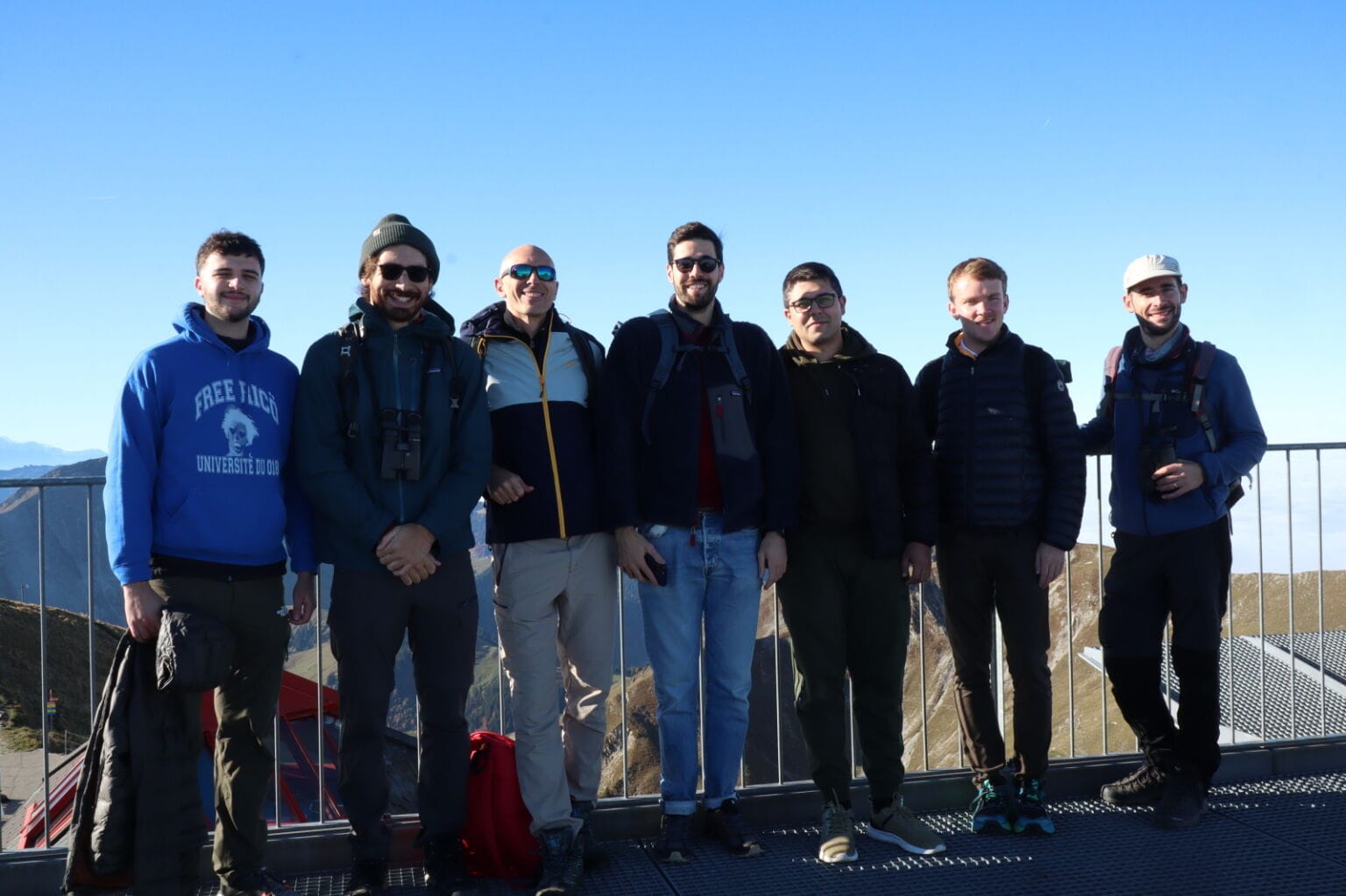
The Windworks team with Sébastien Le Fouest (center), Daniel Fernex (far right) and Eric Sayag (to the CEO’s left). @Windworks
The young company is now focusing its efforts on its first 10 kW installations, with commissioning planned for next year. "The objective is not to produce a perfect object, but machines that run, produce electricity and hold up over time," says Sébastien Le Fouest. In the longer term, Windworks' flagship product will have to go further by reaching 50 kW. "Where the 10 kW version offers appreciable energy independence but a limited return on investment, the 50 kW changes the scale," explains the co-founder.
In the longer term, the start-up even plans to develop 100 kW turbines, still under the regulatory threshold of 30 meters in Switzerland — and even beyond in countries where this limit is higher. It has already received around twenty expressions of interest for these machines by 2029.
To finance such an action plan, Windworks has already raised about half a million Swiss francs from business angels. The logistics inherent to an industrial start-up being heavy, it is now seeking additional funds. "They will be essential to absorb the development costs of the 50 kW and our first pilot installation, as part of a project already labeled by the European Commission," adds Sébastien Le Fouest.
This article has been automatically translated using AI. If you notice any errors, please don't hesitate to contact us.
"Since our share of global greenhouse gas emissions is only one thousandth, our efforts would be doomed to remain insignificant. This argument expresses not a logical reasoning, but an attitude of defiance and denial," regrets René Longet, an expert in sustainable development.
Citing Nicholas Stern and his report on the economics of climate change, Dominique Bidou, the author of "Recivilisation", reminds that "action against global warming makes it possible to avoid expenditures at least five times greater than the initial cost."
"It is neither fair nor constructive to pit technologies against each other in a supposed race for funding: it's a false debate," says Eric Plan, secretary-general of the CleantechAlps association.