Climate change: a risk soon unsustainable for insurers and policyholders?
A worrying phenomenon has been growing for several years: the gradual withdrawal of insurance companies from the most at-risk areas.
A worrying phenomenon has been growing for several years: the gradual withdrawal of insurance companies from the most at-risk areas.
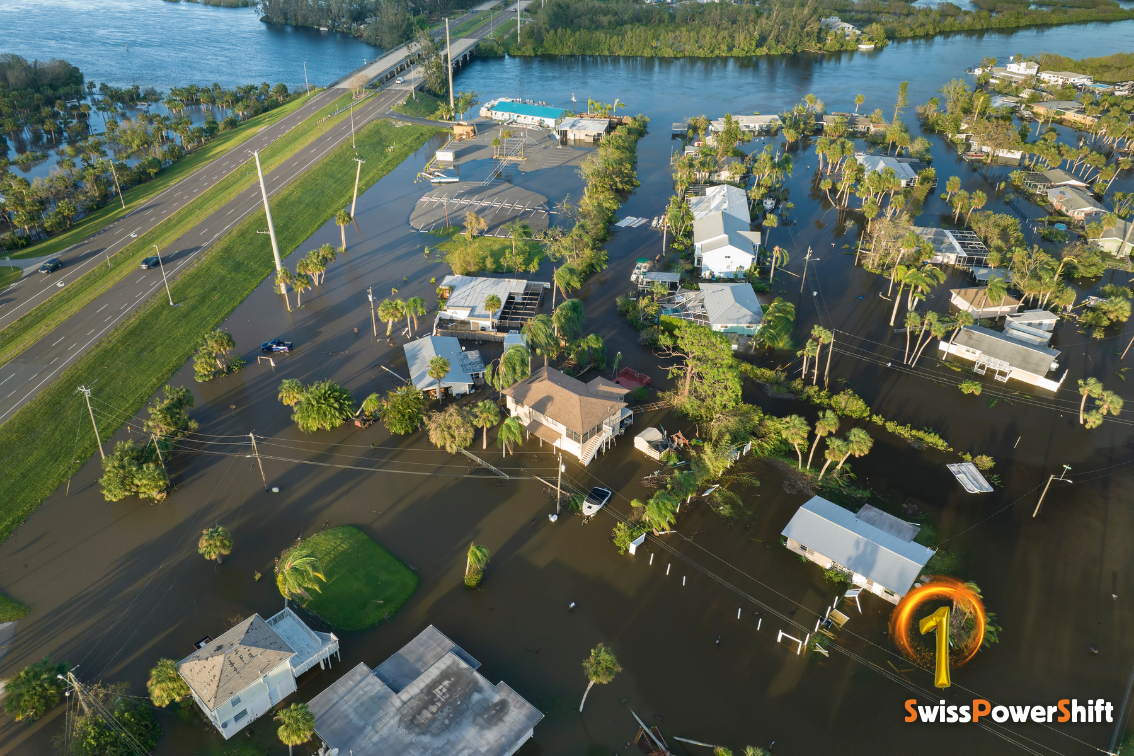
Entire areas covered with water: since the beginning of the year, floods and inundations have struck France. With a total of forty consecutive days of rain, the Hexagon experienced the longest rainy sequence recorded since the start of measurements dating back to 1959. While this type of disaster is not unprecedented, scientists and meteorologists agree on one point: they will tend to recur more regularly, as a consequence of the climate disruption affecting the planet.
At this stage, the extent of the damage caused by the waters remains difficult to assess. Experts nevertheless mention a bill that should amount to several billion euros, especially since floods are among the most costly climate disasters, due to the significant material damage they cause as well as the sometimes total paralysis of economic activity.
Once the waters have receded, it will be time for estimates — and, with them, for insurers. At least for the moment, because a worrying phenomenon has been growing for several years: the gradual withdrawal of insurance companies from the most at-risk areas. This is notably the case in the United States, where two of the country's largest companies, Allstate and State Farm, refused to insure new homeowners or commercial premises following the devastating fires that occurred in California in 2023.
"From a purely technical and mathematical point of view, climate change is making the insurance of risks related to extreme events increasingly complex," explains scientist Stefano Ceolotto in a CMCC report.
At the national level, according to research conducted by the Euro-Mediterranean Center on Climate Change (CMCC), more than 1.9 million home insurance contracts have had their renewal refused in recent years in the United States. "From a purely technical and mathematical point of view, climate change makes the insurance of risks related to extreme events increasingly complex, because these events are becoming more destructive, more frequent and more unpredictable," explains scientist Stefano Ceolotto in a CMCC report.
In the 2023 report "Interconnected Disaster Risks" published by the United Nations University (UNU-EHS), the sixth tipping point, called "an uninsurable future", refers to the risk that the rapid increase in climate disasters (fires, floods, storms, heat waves) will exceed the capacity of the insurance sector to absorb losses. It implies a withdrawal of insurers from certain regions, or the inability for policyholders to cope with sharply rising premiums. By domino effect, this withdrawal leads to a decrease in property values, a worsening of inequalities and a weakening of economic activity.For the record, the five other tipping points are: "the acceleration of species extinctions", which threatens global biodiversity; "the depletion of groundwater", which sustainably compromises access to drinking water and food security; "the melting of mountain glaciers", which also reduces vital freshwater reserves; "the accumulation of space debris", increasing the risk of collisions in orbit and disrupting satellite services that are now essential; and finally "extreme heat", a real threat to human health. O.W.
Although the withdrawal of insurance companies is not entirely new across the Atlantic — notably in states like Florida, regularly hit by hurricanes — it is now reaching the Old Continent, including France, where "a number of municipalities are now struggling to find insurers". Authorities have also promised, for over a year, the publication of the first national map listing the areas where individuals encounter difficulties in obtaining insurance.
In Switzerland, the situation seems less tense on the ground. The current insurance system indeed covers all regions of the country, even sites that are classified in red zones due to the risks of floods, landslides or avalanches. In 2026, the case of Blatten was naturally emblematic in terms of damage. Following this tragedy, Samuel Gétaz, claims representative for French-speaking Switzerland at Axa, said on RTS that "it is not a question today of ceasing to cover certain regions in Switzerland."
The fact that premiums related to natural damage are strictly regulated by law, with uniform and mandatory rates, should prevent some Swiss households from being unable to pay their premium, as is now the case in other countries where they become unaffordable.
"The Swiss system guarantees affordable premiums and the sustainability of coverage for natural risks, even in areas where the risk is above average," explains Eduard Held, director of ASA.
Aware that their reality is likely to be heavily disrupted in the decades to come, insurance companies are seeking to reinvent their business model and propose new solutions. In Switzerland, insurers are particularly active in preventing future damage. Unable to adjust premiums according to risk level, they seek to avoid — or at least significantly reduce — their losses, for example by getting involved in adapting building standards. Overall, the public and private sectors together devote around 3 billion francs per year to prevention measures against natural damage.
If Switzerland shows a relatively low "protection gap" in international comparison, it is also due to the creation of a common fund bringing together all private market actors. Since 1936, the country's main insurers have been able to mutualize costs among themselves: 80% are distributed according to their market share, while the remaining 20% remain the responsibility of the insurer that provided the coverage. "This system guarantees affordable premiums and the sustainability of coverage for natural risks, even in areas where the risk is above average," explains Eduard Held on Swissinfo.
The search for new pricing mechanisms is at the heart of insurance companies' concerns in this context of climate upheaval. This paradigm shift implies the establishment of a coherent and collaborative system. "We often talk about a multi-layered approach," explains Stefano Ceolotto. "For example, policyholders take on an initial part of the risk. Up to a certain threshold, private insurance covers it; beyond that, insurers transfer it to reinsurers, who then spread it across international financial markets, better able to absorb it. Finally, the most catastrophic risks are left to governments or supranational entities, such as the European Union Solidarity Fund, intended to cover major damages, although it is currently underused," summarizes the CMCC researcher.
"So that at-risk areas remain insurable, it is necessary to recognize nature as our main ally and to promote it on a large scale," explains Regula Hess, deputy head of the Sustainable Finance department at WWF Switzerland.
Among the avenues currently being explored, the idea of "integrated solutions" stands out. "We need global approaches combining risk monitoring, modeling, financial tools and local knowledge," says Guido Rianna, another researcher at the CMCC. "The insurance sector should promote the protection of territories, strengthen public awareness and integrate advanced monitoring systems. For example, insurers could grant premium reductions to policyholders who invest in risk reduction, notably through better soil management. Such an approach would be advantageous both for the insured and for the insurer."
In a brand new report on this topic, WWF experts advocate the idea of nature-based solutions, notably forests. "Around four billion francs per year: such is the estimated value of the protective function of Swiss forests," the NGO states in a press release. Located in high-risk areas, often on hillsides, forests protect homes and surrounding infrastructure from avalanches, landslides, but also from floods and erosion. "So that at-risk areas remain insurable, it is necessary to recognize nature as our main ally and to promote it on a large scale," says Regula Hess, co-author of the report and deputy head of the Sustainable Finance department at WWF Switzerland.
This article has been automatically translated using AI. If you notice any errors, please don't hesitate to contact us.

As this Thursday marks the official creation of a Swiss entity of the World Sufficiency Lab, we revisit the question of sufficiency with its cofounder and director, Yamina Saheb.

Let's be at least minimally honest with ourselves. Moving thousands of athletes and spectators to one or more regions of the world will never result in a 100% virtuous and eco-friendly outcome.

"The abandonment of the green hydrogen plant project by Romande Energie above all illustrates the conjunctural difficulties facing the hydrogen sector, particularly in Switzerland, and, to a lesser extent, in Europe and the United States," explains Simon Siggen for the Nomads Foundation.

Relying on a new methodology, a recent study aims to address a shortcoming: the insufficient amount of empirical evidence allowing a systematic link to be established between ESG criteria and financial performance in real estate.