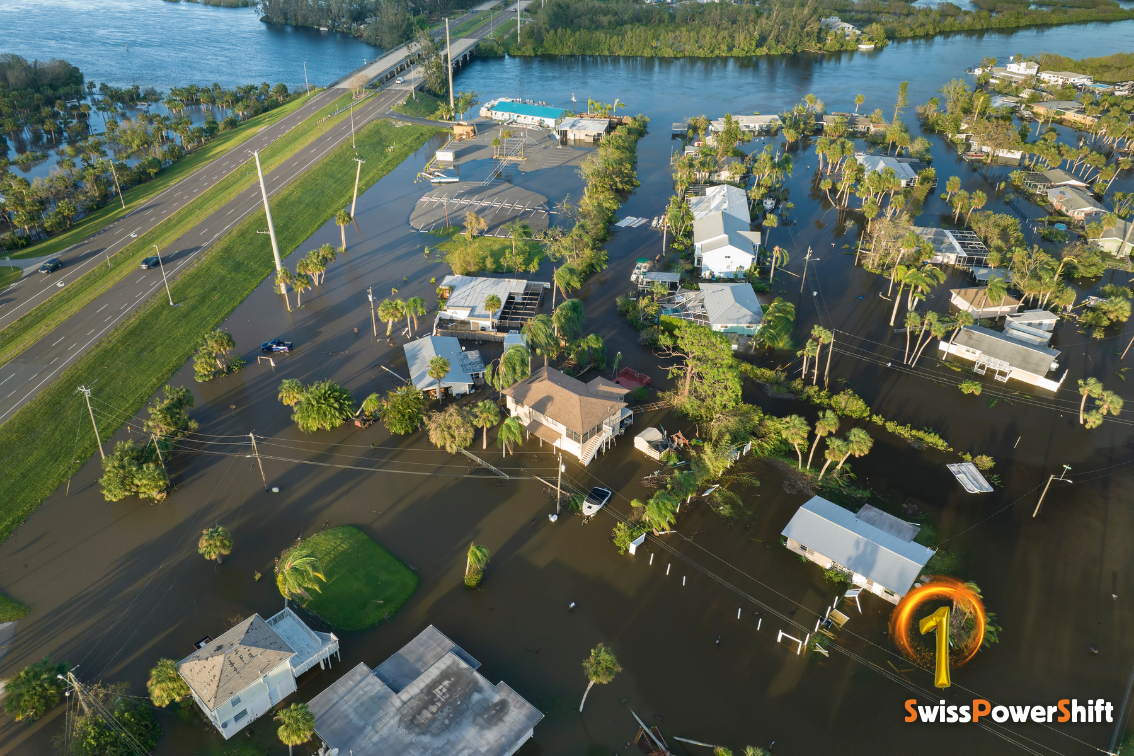
"Since our share of global greenhouse gas emissions is only one thousandth, our efforts would be doomed to remain insignificant. This argument expresses not a logical reasoning, but an attitude of defiance and denial," regrets René Longet, an expert in sustainable development.
Citing Nicholas Stern and his report on the economics of climate change, Dominique Bidou, the author of "Recivilisation", reminds that "action against global warming makes it possible to avoid expenditures at least five times greater than the initial cost."
"It is neither fair nor constructive to pit technologies against each other in a supposed race for funding: it's a false debate," says Eric Plan, secretary-general of the CleantechAlps association.
COP30: what it will change for Switzerland and its companies
"Beyond the widely discussed diplomatic deadlocks, COP30 revealed that the transition will no longer be played out in final communiqués, but in the ability of economies to measure, finance and deploy real transformations," explains Sarah Perreard, co-director of Earth Action.
After a decade marked by commitments, innovation is no longer defined by technological novelty alone, but by the demonstration of its concrete impact. The world no longer waits for intentions: it demands measurable results. In a country where 99% of companies are SMEs integrated into European value chains, the signals sent to Belém are explicit for the Swiss entrepreneurial fabric.
From now on, the carbon footprint of imported materials becomes a strategic risk and European regulation imposes increased traceability and life-cycle analysis requirements. The financial center must therefore integrate these transition risks as capital shifts toward assets aligned with tangible emission reductions. Swiss competitiveness will depend less and less on volumes or reputation, and more and more on its ability to document quality and to transform the carbon constraint into an industrial advantage.
The blind spots of COP30
COP30 unfortunately did not provide the expected operational clarity regarding measurement methods, the standards to adopt or the criteria to evaluate this traceability. It is precisely in this blind spot that urgent action is needed.
On the ground, we observe that organizations no longer seek generic models, but concrete tools to understand where their impacts actually lie. Developing robust methodologies, public databases and science-based impact trajectories will transform these global issues into operational, measurable and reproducible decisions.
Pressure will come from the markets. European customers increasingly demand verifiable data, banks are gradually incorporating risk criteria related to real carbon trajectories, and calls for tenders now often include quantified impact requirements.
A Swiss SME can no longer be satisfied with general estimates: it must prove, document and compare. Transformation can no longer be postponed, because value chains are evolving faster than regulation. The notion of "Swiss quality" now encompasses environmental rigor, in a measurable and demonstrable way. Competitiveness depends on transparency, material sobriety, energy efficiency and methodological soundness.
A concrete example in Switzerland
Recently a Swiss manufacturer of precision components exporting to the EU carried out a complete life cycle analysis (LCA) to meet the growing demands of its customers. This revealed that its environmental impact did not stem from production in Switzerland but from the use phase, and that certain standard alloys generated a disproportionate share of its total carbon footprint.
By acting on these two levers — choice of alloys and process optimization — the company reduced its impacts across the entire product life cycle by up to 40%. This transparency allowed it to secure new contracts. This type of data-driven approach is becoming decisive for Switzerland’s export sectors.
In the face of this changing landscape, three levers can strengthen Switzerland’s position. To reiterate, these are not theoretical ideas, but immediate actions already observed on the ground and expected by the markets.
1. Help SMEs measure their impacts by facilitating access to reference data, training and measurement tools. The objective is not to add bureaucracy, but to clarify priority areas for action.
2. Align finance and the real economy by encouraging financial institutions to support industrial projects capable of demonstrating real material-energy efficiency gains. Measured impact must become a genuine investment signal.
3. Make material and energy efficiency a national priority. The Swiss context — low electricity footprint, strong dependence on imported materials — requires targeting a form of material sobriety, promoting eco-design and the longevity of equipment.
In each of these areas, the role of support structures — institutes, specialized offices, data platforms — will be to provide the technical clarity necessary to turn such an ambition into an operational trajectory.
A unique card to play in Switzerland
COP30 should therefore not be seen as a failure. It reminds us that the transition no longer depends on the pace of international negotiations, but on the ability of economies to demonstrate what they are actually accomplishing. For Switzerland, the historical strengths of its economy — precision, rigor, quality — can become a major competitive advantage, provided they are now also applied to environmental measurement and transparency.
In a world that values what can be demonstrated rather than what is proclaimed, our country has a unique asset. The success of its transition will be decided less in Belém, in Baku or elsewhere than on its own territory, in the way its companies transform their ambitions into concrete results.
This article has been automatically translated using AI. If you notice any errors, please don't hesitate to contact us.
"Since our share of global greenhouse gas emissions is only one thousandth, our efforts would be doomed to remain insignificant. This argument expresses not a logical reasoning, but an attitude of defiance and denial," regrets René Longet, an expert in sustainable development.
Citing Nicholas Stern and his report on the economics of climate change, Dominique Bidou, the author of "Recivilisation", reminds that "action against global warming makes it possible to avoid expenditures at least five times greater than the initial cost."
As this Thursday marks the official creation of a Swiss entity of the World Sufficiency Lab, we revisit the question of sufficiency with its cofounder and director, Yamina Saheb.