"A look at the numbers illustrates the scale of the transformation, and these are not passing fads but indicators of a structural investment cycle," says Christian Rom, manager of the DNB Renewable Energy fund.
"Since our share of global greenhouse gas emissions is only one thousandth, our efforts would be doomed to remain insignificant. This argument expresses not a logical reasoning, but an attitude of defiance and denial," regrets René Longet, an expert in sustainable development.
In Europe, solar and wind relegate fossil fuels to the background
According to the latest report from the think tank Ember, the combined output of these two renewable energy sources accounted for about 30% of electricity produced in Europe in 2025, compared with 29% for all fossil fuels.
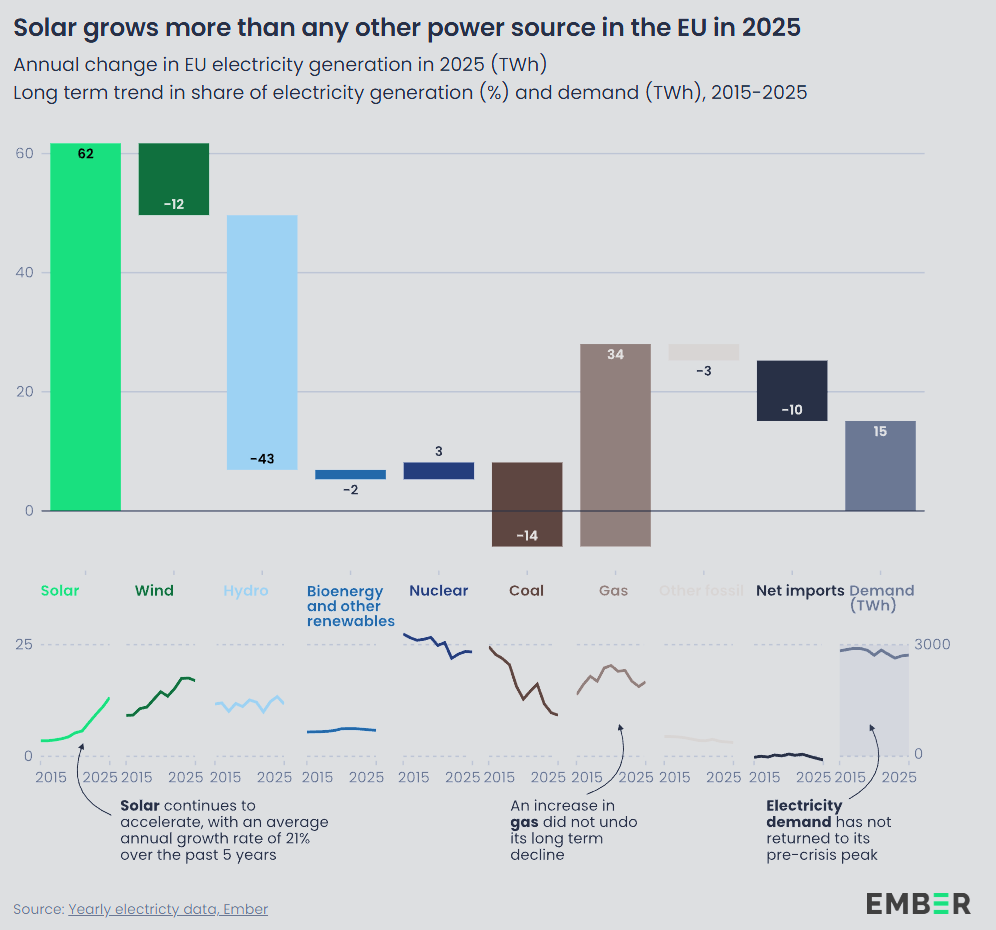
A historic turning point! The European electricity system experienced an unprecedented shift last year: combined wind and solar generation surpassed that from fossil fuels. Together, these sources supplied about 30% of electricity produced in Europe in 2025, compared with 29% for all fossil fuels. By contrast, the two other main low-carbon energy sources — hydropower and nuclear — have remained stable or slightly declined over the past five years.
This shift is part of a long-term trend that has been unfolding for a decade, with a very marked acceleration over the past five years. It already concerns 14 of the 27 member states. “This important milestone illustrates the speed of the transformations underway in the European Union’s energy sector,” says Dr. Beatrice Petrovich, senior analyst at Ember, the think tank behind this new study.
Solar growth: In 2025, solar electricity generation in Europe reached a record level of 369 TWh, up more than 20% compared with 2024 — a rise equivalent to the annual output of several nuclear reactors. This dynamic is explained by the rapid expansion of installed capacity (+65 GW in one year), distributed almost equally between large plants and rooftop installations.
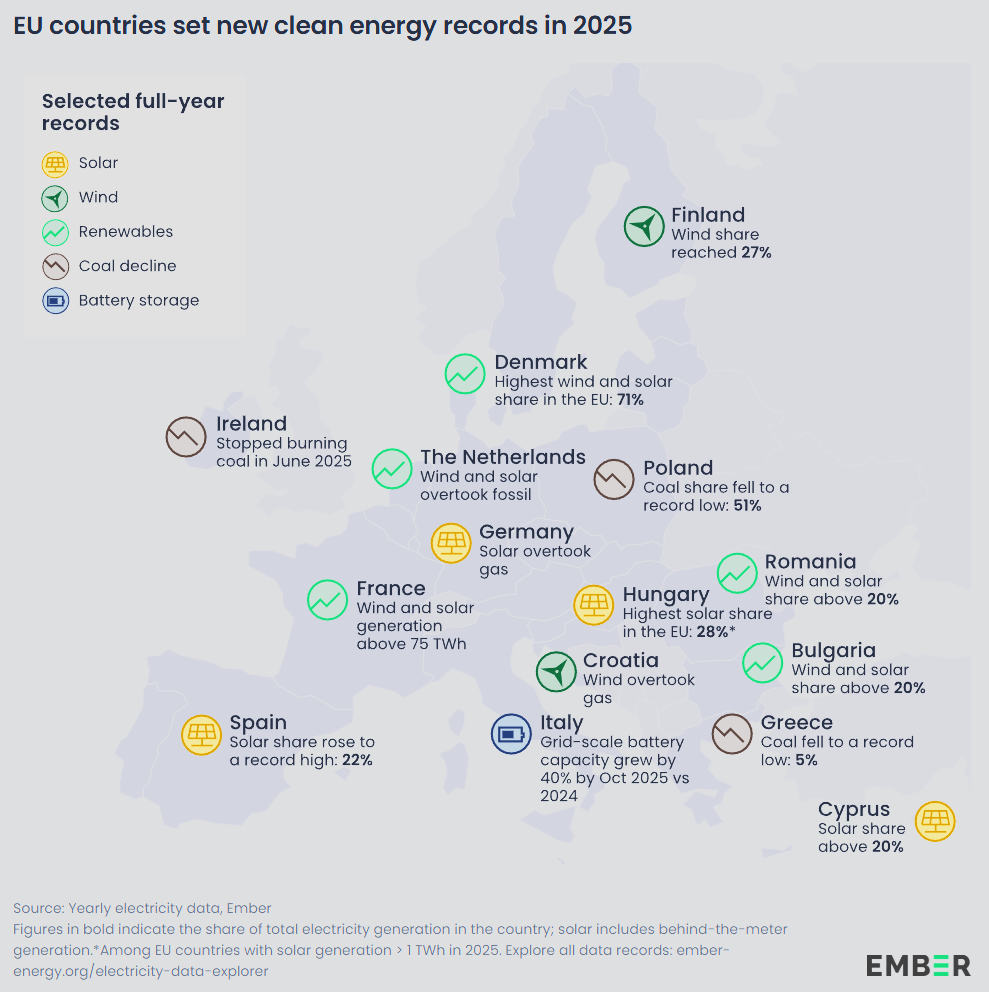
All European Union countries recorded an increase in their solar generation and, in several of them (Hungary, Spain, Greece, the Netherlands, Cyprus), solar now accounts for more than 20% of electricity produced each year.
2️⃣
Good performance despite the weather: In a context of atypical weather conditions at the beginning of the year — marked by low precipitation and reduced winds that penalized hydropower and wind — renewables maintained a stable share, close to 48% of European electricity generation. The decline in wind and hydropower was largely offset by exceptional sunshine, notably in Northern Europe, which boosted solar generation.
This complementarity between renewable sources illustrates the growing resilience of the European electricity system to climatic hazards. “The increase in solar energy production came at the right time to meet the peak electricity demand from air conditioning during summer heatwaves,” the report also notes.
3️⃣
Coal now plays a marginal role: Coal continues its rapid decline and reached a historically low level in 2025, representing only 9.2% of electricity produced in Europe. “This is a remarkable change considering that ten years ago coal supplied nearly a quarter of the European Union’s electricity generation (24.6%), or 705 TWh,” the report emphasizes. In the majority of member states, it is now marginal or nearly eliminated.
Gas, however, remains a point of vulnerability. Its generation increased in 2025 to compensate for the decline in hydropower, causing a 16% rise in Europe’s gas import bill and contributing to price spikes on electricity markets. Although it remains below pre-crisis levels, gas thus continues to weigh on costs and energy security.
4️⃣
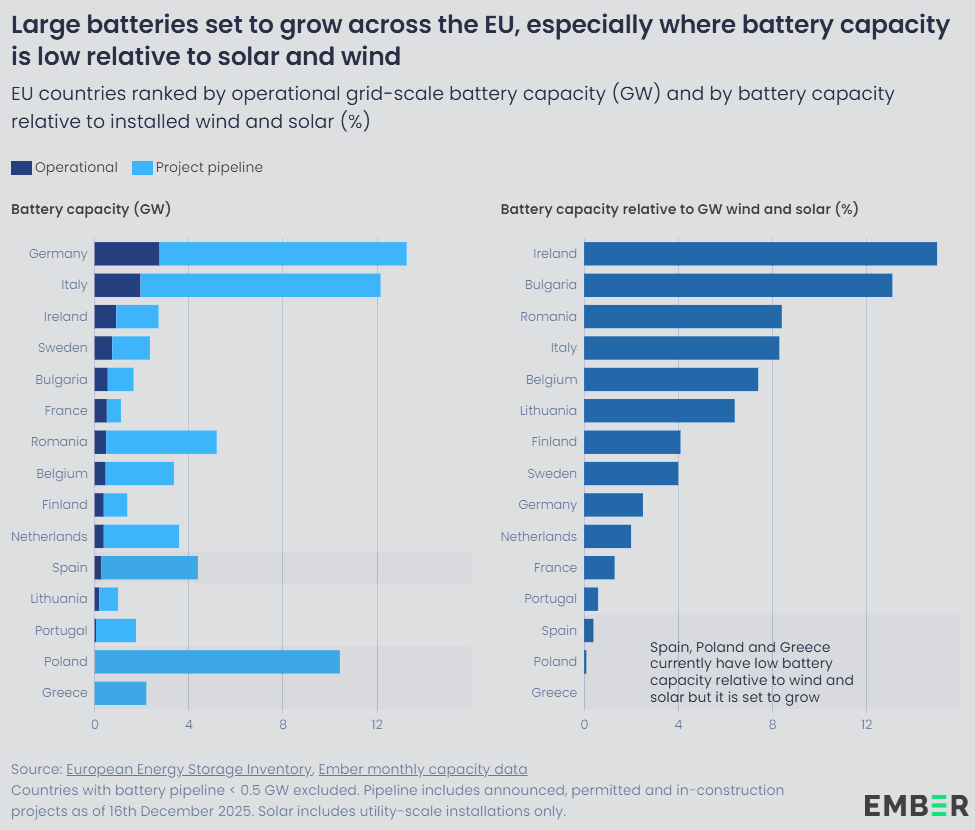
Battery boom in Europe: The study highlights the first positive effects of the rapid deployment of batteries across the continent. While nearly half of grid-scale battery capacity in the European Union remains concentrated in just two countries — Italy and Germany — 2025 was marked by clear signs of acceleration across the bloc. Battery projects were launched or announced in most member states.
In 2025, storage capacity grew strongly and a record pipeline of projects points to a major acceleration in the years to come. “The average annual 20% fall in battery costs over the past decade, combined with large and growing intraday price spreads, made investment in battery storage more financially attractive than ever in 2025,” the report authors note.
5️⃣
Batteries to replace gas : Drawing on the Californian example, Ember’s experts estimate that batteries could seriously compete with gas during peak hours by storing excess solar and wind power and reducing waste caused by network constraints.
Last year, Californian batteries helped cut the share of fossil fuels in evening peak demand from 44% in September 2021 to 34% in September 2025, while the contribution of batteries jumped from 3% to 22% over the same period. “This development suggests that EU countries deploying batteries to store abundant clean energy could also reduce their dependence on costly gas,” the authors note.
Overall, to avoid any risk of network overload, Germany voluntarily curtailed about 9.6 TWh of its wind and solar generation in 2025, or nearly 4% of the total generation from these sources. In the future, this waste could be avoided thanks to batteries, as the Ember report authors point out.
“Locally produced wind and solar energy is set to become the backbone of the European electricity system.” Ember’s study stresses that the development of storage, the strengthening of electrical interconnections and the activation of demand flexibility are now essential to stabilize prices, reduce dependence on imported fuels and sustainably consolidate the transition to a predominantly renewable electricity system.
This article has been automatically translated using AI. If you notice any errors, please don't hesitate to contact us.
"A look at the numbers illustrates the scale of the transformation, and these are not passing fads but indicators of a structural investment cycle," says Christian Rom, manager of the DNB Renewable Energy fund.
"Since our share of global greenhouse gas emissions is only one thousandth, our efforts would be doomed to remain insignificant. This argument expresses not a logical reasoning, but an attitude of defiance and denial," regrets René Longet, an expert in sustainable development.
Citing Nicholas Stern and his report on the economics of climate change, Dominique Bidou, the author of "Recivilisation", reminds that "action against global warming makes it possible to avoid expenditures at least five times greater than the initial cost."