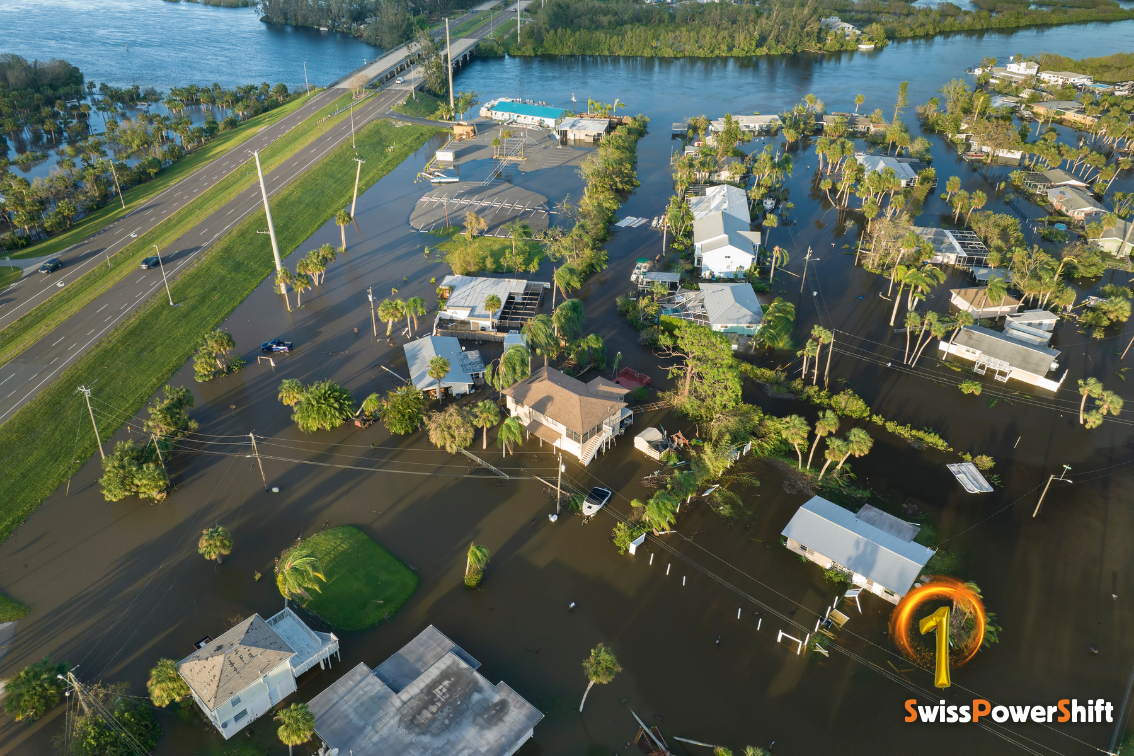
"Since our share of global greenhouse gas emissions is only one thousandth, our efforts would be doomed to remain insignificant. This argument expresses not a logical reasoning, but an attitude of defiance and denial," regrets René Longet, an expert in sustainable development.
Citing Nicholas Stern and his report on the economics of climate change, Dominique Bidou, the author of "Recivilisation", reminds that "action against global warming makes it possible to avoid expenditures at least five times greater than the initial cost."
"It is neither fair nor constructive to pit technologies against each other in a supposed race for funding: it's a false debate," says Eric Plan, secretary-general of the CleantechAlps association.
"Hydrogen: the state of the market does not justify major investments"
"In the current economic climate, we could not take on the role of driving this sector forward on our own," explains Jérémie Brillet. Head of strategic developments at Romande Energie, he nevertheless assures that the DSO remains "attentive to its evolution."
In early January, Romande Energie announced the abandonment of its green hydrogen plant project in Montcherand. Launched in 2021 with an estimated budget of nearly 12 million francs, this project had long been presented as a first in French-speaking Switzerland. It was to produce hydrogen intended primarily for heavy goods vehicles, in order to reduce CO₂ emissions from road transport. The increasing electrification of heavy mobility over the past 2–3 years has, however, reshuffled the cards and forced the DSO to review its strategy.
For the hydrogen sector, whose future is very uncertain, this news is naturally not good and prompts us to question once again the real potential of hydrogen as a vector for the energy transition in Switzerland, between climate ambitions, economic constraints and markets that are shrinking rapidly. We discuss this with Jérémie Brillet, head of strategic developments at Romande Energie.
What are the reasons that led Romande Energie to abandon this project for the first green hydrogen plant?
When the project was launched, market forecasts suggested a rapid development of hydrogen uses, particularly in heavy mobility and certain industrial processes. However, this growth has yet to materialize. In a context where demand remains uncertain, Romande Energie considers that an investment of this magnitude can no longer be justified at this stage.
Did the lack of political ambition, notably in terms of support, for this energy vector have an impact on this decision?
Switzerland published its hydrogen strategy late and without financial support mechanisms comparable to those implemented in several European countries. This absence of incentives complicates the emergence of viable business models for private actors, despite their willingness to contribute to regional innovation and decarbonization. This context weighed on our decision to abandon the Montcherand site.
The absence of federal incentives complicates the emergence of viable business models for private actors, despite their willingness to contribute to regional innovation and decarbonization.
Concretely, what does this cancellation mean for Romande Energie’s hydrogen strategy? Do you still believe in this sector in the current political and economic context?
Renewable hydrogen still has a relevant role to play in the decarbonization of certain applications. It is, however, in competition with other solutions, sometimes less sustainable in the long term but easier to deploy quickly. The massive electrification of heavy mobility and freight transport, for example, will require significant investments in the electricity network and will put increased pressure on electricity markets—costs that would be borne by all consumers.
Conversely, the importation of renewable hydrogen would allow the cost of decarbonization to be borne directly by the users of the sector concerned, thereby creating a potential incentive for sobriety. If the use of hydrogen in heavy mobility remains, for society, a desirable option, the levers we have to accelerate its adoption remain limited.
In the current economic context, Romande Energie cannot assume alone the role of initial driver of this sector. The company nevertheless remains attentive to its development and continues monitoring activities.
What other projects and investments do you have planned in this energy vector, and could they also be threatened?
We continue to closely monitor the possibilities for local production of energy vectors intended for decarbonized industrial ecosystems. We are also interested in hydrogen as a tool for flexibility and convergence between electricity, heat and gas networks.
With the rise of intermittent renewable energies, the conversion from one form of energy to another will likely become indispensable for storage and system optimization. hydrogen-related technologies, such as fuel cells, will play a central role in these developments.
For Romande Energie, what markets still remain for hydrogen?
Current hydrogen users can already replace molecules of fossil origin with versions produced from renewable sources. Even if the Swiss market remains limited, it deserves to be addressed, especially since production on the site of consumption avoids emissions related to transport.
The federal strategy also identifies other potential uses, notably in district heating networks—a field in which we are active—as well as in industrial processes requiring high temperatures.
Romande Energie’s reflection on hydrogen aims to determine how this sector can contribute to its mission of regional decarbonization and what role the company can play. While the desire to encourage relevant uses of renewable hydrogen remains, the current state of the market no longer allows major investments to be justified.
This article has been automatically translated using AI. If you notice any errors, please don't hesitate to contact us.
"Since our share of global greenhouse gas emissions is only one thousandth, our efforts would be doomed to remain insignificant. This argument expresses not a logical reasoning, but an attitude of defiance and denial," regrets René Longet, an expert in sustainable development.
Citing Nicholas Stern and his report on the economics of climate change, Dominique Bidou, the author of "Recivilisation", reminds that "action against global warming makes it possible to avoid expenditures at least five times greater than the initial cost."
"It is neither fair nor constructive to pit technologies against each other in a supposed race for funding: it's a false debate," says Eric Plan, secretary-general of the CleantechAlps association.