Climate change: a risk soon unsustainable for insurers and policyholders?
A worrying phenomenon has been growing for several years: the gradual withdrawal of insurance companies from the most at-risk areas.
Interview with Nadine Brauchli, Nadine Brauchli, Head of Energy at the Association of Swiss Electricity Companies (AES).

At the beginning of the week, the Swiss Association of Electricity Companies (AES) published for the first time its index dedicated to the country's future energy security. By reaching only 82 points in 2035 and 69 points in 2050, a result far below the target set at 100 points, the picture painted by this tool therefore appears more than critical. Without rapid action on several levels, Switzerland could face a real and growing risk of shortage within a quarter of a century.
Following our first article published at the beginning of the week, we continue on this theme with an interview with Nadine Brauchli, Head of Energy at the Swiss Association of Electricity Companies (AES).
Why not publish this index earlier?
Until now, the AES published roughly every six years a forward-looking scenario on the country's energy future ("Energy Future 2050"). The index is a new instrument, published for the first time in 2026. Its objective is to monitor and illustrate, in a simple and understandable way, where Switzerland stands — since the entry into force of the Electricity Act in 2025 — in the transformation of its energy system. It aims to strengthen transparency, to stimulate the public debate by serving as a basis for discussion for politics, the economy and society, and to allow the continuous evolution of the methodology.
With the index, we are now moving to a steering logic: it is about measuring whether we are indeed on the right trajectory and identifying the gaps that appear. Political decisions still open — such as the electricity agreement, the "Netzexpress" project or the wind initiatives — will have a direct influence on the future evolution of the index.
Complete decarbonization remains the goal, but it is probably not achievable in the short and medium term and will therefore have to be compensated for by other measures.
An index that indeed talks about security of supply and not about shortage... An important nuance?
Yes, this is an essential difference. We are indeed talking about electricity supply security. This means that the system has enough electricity at all times. The emphasis is on prevention and early detection of risks.
A power shortage, on the other hand, corresponds to an acute emergency situation, characterized by a lack of electricity over a prolonged period or by outages. Insufficient supply security can lead to such a shortage situation.
Our index therefore constitutes an alert system that makes it possible to identify risks in time and to act upstream in order to avoid situations of scarcity, or even shortage.
Is your index your way of denouncing political inaction and putting pressure on Bern to act?
The goal of the index is to provide a simple and understandable tool that enables anticipating risks and guiding decisions. It is aimed at all actors in order to initiate coordinated action.
The emphasis is on concrete measures, such as the development of renewable energies, the expansion of grids, the conclusion of the electricity agreement, the extension of the lifespan of existing nuclear plants and, if necessary, the use of gas-fired power plants.
It is not about denouncing, but about awakening consciences and promoting constructive solutions. Switzerland must take action.
Currently, isn't the cost-cutting policy pursued in Bern going in the wrong direction, raising fears of an even greater deterioration of the country's energy situation?
It's not about increasing spending, but about creating appropriate framework conditions as well as effective and targeted support mechanisms. In particular during winter, supply security is threatened. Support should therefore be directed towards winter production (flexibility and storage) in order to sustainably strengthen system stability.
The implementation of the electricity agreement does not seem to satisfy the sector... Isn't it nonetheless fundamental by 2050 in your view?
The electricity agreement with the EU is central to supply security and to the use of cross-border capacities. However, its internal implementation still needs to be adapted and it is appropriate to refrain from national add-ons (a form of « Swiss finish »).
With the agreement, the index rises strongly to 84 points, but by itself it does not allow reaching 100 points. In addition, a massive deployment of renewable energies, reinforcement of the grid as well as additional production capacities are necessary.
In your scenario, gas-fired power plants are mentioned. Is the complete decarbonization of our energy needs illusory?
Complete decarbonization remains the objective, but it is probably not achievable in the short and medium term and will therefore have to be compensated by other measures. Renewable energies alone are not sufficient to cover winter demand.
Gas-fired power plants constitute a backup solution, both flexible and transitional, cost-effective for securing supply. The more Switzerland develops wind power — which produces abundantly in winter — the more the need for gas will decrease. This is a societal choice requiring a balancing of interests.
This article has been automatically translated using AI. If you notice any errors, please don't hesitate to contact us.
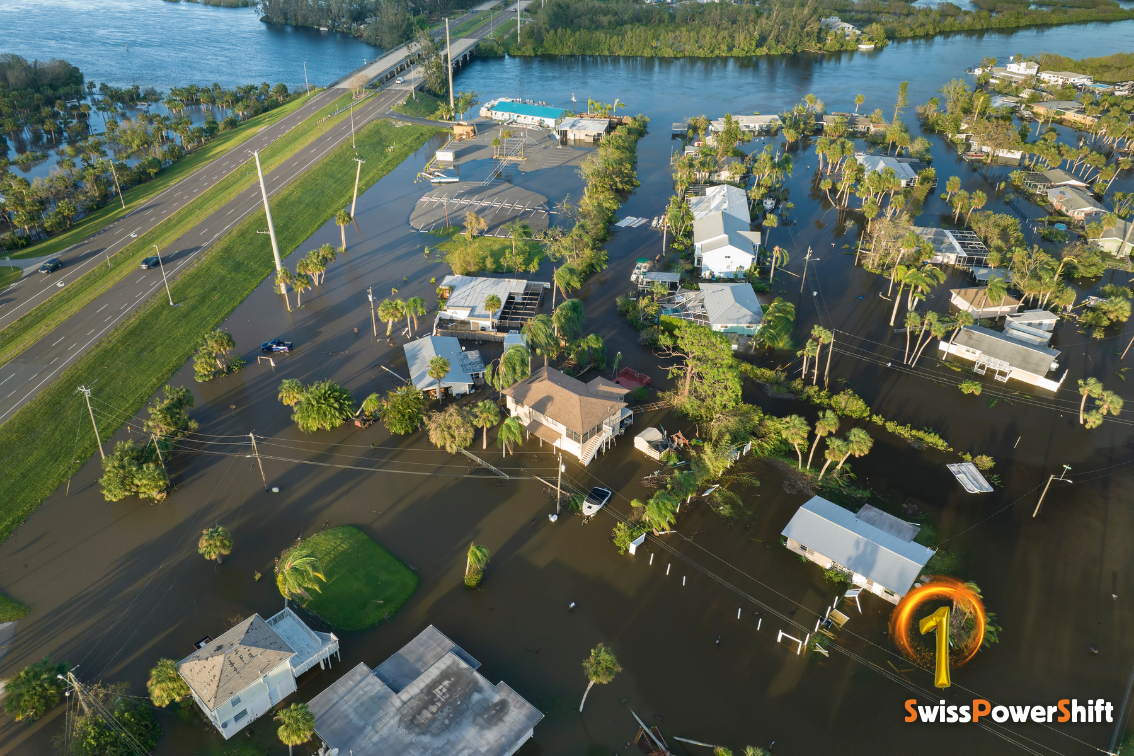
A worrying phenomenon has been growing for several years: the gradual withdrawal of insurance companies from the most at-risk areas.

As this Thursday marks the official creation of a Swiss entity of the World Sufficiency Lab, we revisit the question of sufficiency with its cofounder and director, Yamina Saheb.

Let's be at least minimally honest with ourselves. Moving thousands of athletes and spectators to one or more regions of the world will never result in a 100% virtuous and eco-friendly outcome.

"The abandonment of the green hydrogen plant project by Romande Energie above all illustrates the conjunctural difficulties facing the hydrogen sector, particularly in Switzerland, and, to a lesser extent, in Europe and the United States," explains Simon Siggen for the Nomads Foundation.