By naming their first edition "Wind farms are taking shape", the industry's players want to show a certain optimism despite a context that remains complicated for the sector. A look by Benoist Guillard, president of the Groupe romand pour l’énergie éolienne (GREE).
Since its founding in 2021, the young startup has made it its mission to find a good compromise between energy production and plant growth. The solution is called "spectral filtering".
"Despite expectations, substantive discussions could not begin for lack of operational arrangements for the panel. Moreover, in the absence of a dedicated international body, the regulation of pollutants remains fragmented," worries Henri Klunge, chemical engineer and founder of Alcane Conseils.
A new algorithm to optimize costs and efficiency of heat pumps
With its OPERA project, CSEM sought to improve the energy management of multi-family residential buildings by coordinating three elements: photovoltaic production, the heat pump, and the heat distribution system (radiator valves or underfloor heating).
In the building sector, to decarbonize heat production, one outstanding solution stands out: heat pumps, also called HPs by professionals. They are indeed particularly suited to low- and medium-temperature uses, up to about 70 °C, which corresponds to most residential needs.
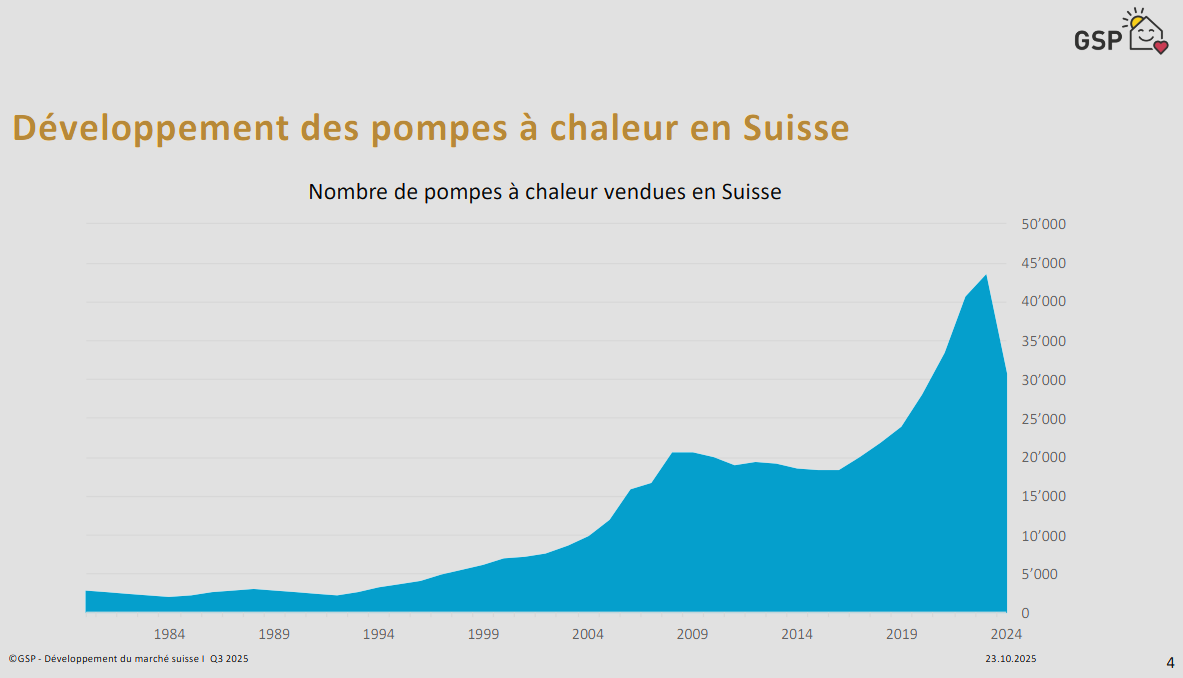
Despite their potential, this solution still struggles to establish itself, with some 20% of single-family homes equipped with a heat pump (compared with 5% in 2000). Estimates are even lower for multi-family residential buildings since the rate is currently around 12%. "This difference is explained by several factors: renovations are less frequent there, systems are more complex and often require several separate heat pumps (for example for heating and for domestic hot water), and there are few solutions on the market to effectively coordinate their operation," explains Tomasz Gorecki, senior R&D engineer at the Swiss Center for Technological Innovation (CSEM).
Identified as a factor hindering the deployment of heat pumps in Switzerland, this technical complexity was the starting point of a project launched at CSEM a few years earlier and called OPERA. At the heart of this project: the development of a simplified and replicable energy management approach on a large scale, without adding complex hardware, in order to facilitate its adoption by installers and operators.
Current solutions outdated
To understand the added value of CSEM’s approach, a step back is necessary. Traditionally, in conventional systems, the operation of the heat pump and that of the building act independently of one another. The heat pump is controlled by a "heating curve" that defines the temperature of the water produced according to the outdoor temperature. The rooms, meanwhile, are regulated by radiators (or underfloor heating) that open or close valves according to the indoor temperature.
"The problem is that these two control levels do not communicate: the heat pump does not know whether the building actually needs heat, and the thermostats ignore how the heat is produced," says Tomasz Gorecki, adding that this lack of coordination is particularly problematic when one wishes to make use of locally produced photovoltaic electricity.
According to the researcher, existing solutions often try to "consume solar electricity" by forcing the heat pump to produce more heat, for example by increasing the temperature of the hot water tank. But this strategy degrades the efficiency of the heat pump. "The more it produces hot water at high temperature, the more its coefficient of performance decreases," explains Tomasz Gorecki.
Furthermore, storage tanks are generally small (200 to 300 liters) and are not designed to store large amounts of energy, but only to ensure the availability of domestic hot water. Increasing their temperature by 5 to 10 °C would certainly store a little more energy, but at the cost of an efficiency loss that can reach 10 to 20%.
"Depending on the conditions of the day, it can favor the use of solar electricity or decide that it is more advantageous to shift consumption to low-tariff periods," explains Tomasz Gorecki, senior R&D engineer at CSEM.
Achieving better coordination
The OPERA project proposes a different approach: store energy directly in the building by slightly modulating the indoor temperature, for example by a few tenths of a degree, rather than in the hot water tank. This strategy preserves better heat pump efficiency while increasing self-consumption of photovoltaic electricity. It relies on optimal coordination between three elements: photovoltaic production, the heat pump, and the heat distribution system (the radiator or underfloor heating valves).
This coordination is ensured by an energy management algorithm integrated into an EMS (Energy Management System). Unlike classical rule-based algorithms, the OPERA algorithm continuously evaluates the different possible options and chooses the one that minimizes costs. "Depending on the conditions of the day, it can favor the use of solar electricity or decide that it is more advantageous to shift consumption to low-tariff periods. It therefore has an adaptability that represents a break with static approaches," summarizes Tomasz Gorecki.
From an implementation point of view, the solution is deliberately simple: it mainly involves adding an EMS capable of executing the algorithm and sending the right signals to the equipment. The main difficulty lies in the interface with heat pumps. On recent installations (less than five years old), most brands offer sufficient connectivity. However, for older heat pumps, their operation generally does not allow action on their internal controller. "The most delicate situation concerns those installed ten to fifteen years ago because they are too recent to be replaced, but not connected enough to be effectively controlled," laments Tomasz Gorecki.
Non-negligible cost reductions
After being developed at CSEM, the solution was tested on a pilot building in Neuchâtel, a renovated rental building. A full winter of measurements made it possible to compare standard operation with that managed by OPERA under equivalent weather conditions. The results showed a reduction of about 12% in electricity costs related to heating. This reduction comes notably from shifting part of consumption from high-tariff hours to low-tariff hours, as well as from a better match with photovoltaic production.
Based on a licensing system, the algorithm can be acquired and used by companies active in EMS production. In the case of OPERA, commercial integration is notably handled by the partner company Soleco. The latter pays license fees based on sales. The ambition is not to create a company dedicated to selling EMS, but to transfer the technology to industry, in accordance with CSEM’s mission. Other partners can thus adopt the technology according to their needs and business model.
This article has been automatically translated using AI. If you notice any errors, please don't hesitate to contact us.
By naming their first edition "Wind farms are taking shape", the industry's players want to show a certain optimism despite a context that remains complicated for the sector. A look by Benoist Guillard, president of the Groupe romand pour l’énergie éolienne (GREE).
Since its founding in 2021, the young startup has made it its mission to find a good compromise between energy production and plant growth. The solution is called "spectral filtering".
"Despite expectations, substantive discussions could not begin for lack of operational arrangements for the panel. Moreover, in the absence of a dedicated international body, the regulation of pollutants remains fragmented," worries Henri Klunge, chemical engineer and founder of Alcane Conseils.
While some regions of the planet are now no longer insurable, our country has a pool unique in the world dedicated to climate damage. Explanations from Martin Steinauer, responsible for claims things for La Mobilière in French-speaking Switzerland.