Climate change: a risk soon unsustainable for insurers and policyholders?
A worrying phenomenon has been growing for several years: the gradual withdrawal of insurance companies from the most at-risk areas.
Published for the first time by the AES, this tool dedicated to the security of the electricity supply paints a potentially critical picture of the country's situation within a quarter of a century.

"A decisive turning point!" That is the situation in which Switzerland would find itself in terms of energy, according to Martin Schwab, president of the Association of Swiss Electricity Companies (AES). The association highlights the growing scale of the threats to the country's electricity supply over the next two decades, through an index published for the first time at the beginning of this year.
According to this tool, designed as an early warning signal for the country's future energy security, Switzerland is expected to reach only 82 points in 2035 and 69 points in 2050, a result well below the target set at 100 points. "Without resolute energy decisions, without concrete investments in new production capacities and without a significant acceleration of authorization procedures, we risk compromising our security of supply," warns Martin Schwab. The AES thus points to a marked deterioration of the index from 2040 onwards.
This situation is explained by several structural factors: a rapid increase in demand, notably due to the rise of electromobility and data centers; the gradual phase-out of nuclear power; a too slow development of renewable energies; as well as significant delays in the expansion of the power grid. Added to this are insufficient seasonal storage and flexibility capacities, which limit the system's ability to cope with consumption peaks and periods of low renewable production.
The issue is particularly critical in winter, a period during which Switzerland already has to import part of its electricity. According to the AES, by 2045 winter needs should increase by nearly 50%, mainly due to the closure of the last nuclear power plants and the continued rise in consumption. The actual scale of this demand increase remains uncertain, however, in a context of a boom in artificial intelligence. According to some experts, data centers alone already consume between 6 and 7% of national electricity, a proportion that could reach 15% by 2030.
"These results are a wake-up call: if we do not act quickly, Switzerland risks experiencing a supply shortage, especially in winter," warns Michael Frank, director of the AES.
This fragility would be further accentuated in the absence of an electricity agreement with the European Union. In principle, this agreement enjoys very broad support within the sector. The AES nevertheless emphasizes that it would be wise for Switzerland to preserve a certain independence from its neighbors, insofar as electricity imports cannot and should not be increased at will.
It should be recalled, however, that the national implementation of the agreement, as presented by Bern at the end of last year, has raised many concerns within the energy sector. " leads to an increase in costs and risks. For the electricity sector, the proposed national implementation would be more complex, more costly and less attractive," warned Michael Frank, director of the AES. "Under these conditions, its implementation is not acceptable," he insists.
In order to prevent this coming energy insecurity, the AES calls for rapid decisions on political, economic and societal levels. It proposes, as initial courses of action, focusing on several priority axes: the massive development of hydropower, wind and alpine photovoltaics; the acceleration of authorization procedures; as well as the modernization and expansion of the power grid. These measures are complemented by significant investments in new storage and flexibility capacities.
On reading this study, the gap between what the AES describes as the "actual state" and the "desired state" foreshadows colossal challenges to secure the country's energy supply. "These results are a wake-up call: if we do not act quickly, Switzerland risks experiencing a supply shortage, especially in winter," warns its director.
This article has been automatically translated using AI. If you notice any errors, please don't hesitate to contact us.
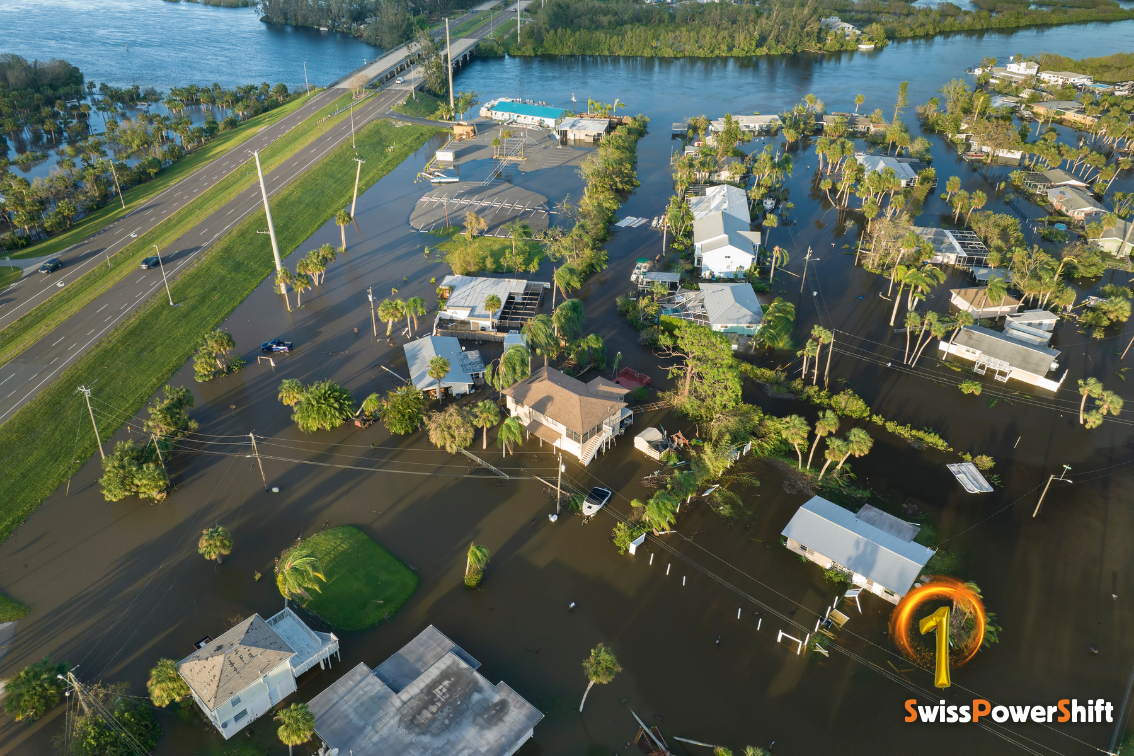
A worrying phenomenon has been growing for several years: the gradual withdrawal of insurance companies from the most at-risk areas.

As this Thursday marks the official creation of a Swiss entity of the World Sufficiency Lab, we revisit the question of sufficiency with its cofounder and director, Yamina Saheb.

Let's be at least minimally honest with ourselves. Moving thousands of athletes and spectators to one or more regions of the world will never result in a 100% virtuous and eco-friendly outcome.

"The abandonment of the green hydrogen plant project by Romande Energie above all illustrates the conjunctural difficulties facing the hydrogen sector, particularly in Switzerland, and, to a lesser extent, in Europe and the United States," explains Simon Siggen for the Nomads Foundation.