"A look at the numbers illustrates the scale of the transformation, and these are not passing fads but indicators of a structural investment cycle," says Christian Rom, manager of the DNB Renewable Energy fund.
"Since our share of global greenhouse gas emissions is only one thousandth, our efforts would be doomed to remain insignificant. This argument expresses not a logical reasoning, but an attitude of defiance and denial," regrets René Longet, an expert in sustainable development.
Deal with the EU or not, EDF CEO says he's ready to supply Switzerland with electricity
In his speech at the last Swiss Electricity Congress, Bernard Fontana said that the group he leads will be ready to meet Switzerland's needs for electricity imports, particularly during the winter period.
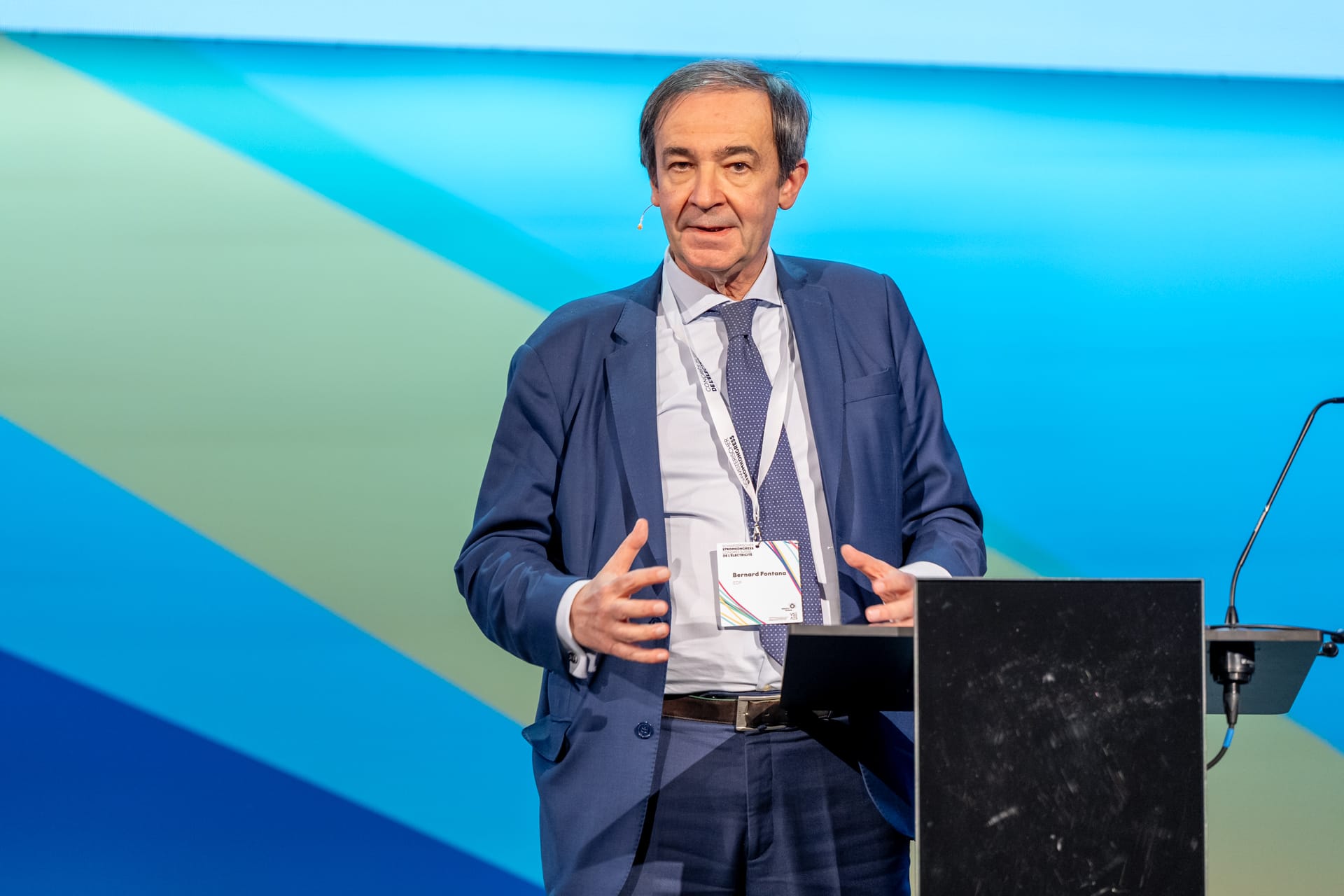
"We currently export to your country between 10 and 12 TWh per year, an amount that could still be increased as part of a clear cooperative agreement," said Bernard Fontana, CEO of EDF @Foto Basler
About a hundred terawatt-hours (TWh): that is the reserve France would currently have and of which it would be ready to sell an additional share to Switzerland. “We currently export to your country between 10 and 12 TWh per year, an amount that could still be increased under a clear cooperative agreement,” said Bernard Fontana, CEO of EDF, on the sidelines of his address last week to all sector stakeholders gathered for the Swiss Electricity Congress.
Even more interesting, he says this could be done with or without the agreement currently being negotiated with the European Union. “Let us remember that, while there may be a European optimum, there is also room for bilateral cooperations, sometimes even more efficient.”
Electricity as a lever of sovereignty
His remarks concluded a long speech devoted to the ongoing electrification of Europe, presented as a response to one of its main structural vulnerabilities: its dependence on imported fossil fuels. The example of imported liquefied natural gas (LNG) illustrates this perfectly, with prices estimated by the French CEO to be “three to four times higher for Europeans than those charged in the United States.”
This all naturally takes place in a context of multiple crises — geopolitical, climatic and economic. “Electricity, whether from nuclear, hydroelectric or other renewable sources, is at the heart of the responses to these challenges. It is a common thread of our independence, an engine of our industrialization — or of our reindustrialization, depending on the point of view — and an essential vector of our energy transition,” Bernard Fontana said.
An entire industry under pressure
At the last Swiss Electricity Congress, Martin Schwab expressed cautious optimism about the future. In his address, the AES president highlighted the sensitive issue of profitability within the sector. “With an average return of 3.4%, some might consider it high. But, in reality, this level reflects our capacity to invest in maintenance and, even more, in the development of the infrastructure necessary for the ongoing transition to renewable energies.” He also recalled that each drop in the WACC has direct repercussions on the ability of sector players to invest in development, adaptation and maintenance of the grid.
This financial pressure was also evident in the remarks of Cristina Pastoriza. Director of Multidis, an association bringing together around twenty multi-utility distributors, she notably pointed out the administrative burden generated by the new regulations related to the Electricity Act (Mantelerlass). “Using a very conservative estimate, each distribution network operator (DNO) in Switzerland had to invest about 50,000 francs to adapt to these new rules. When you relate that to the roughly 600 DNOs in the country, I’ll let you imagine what that ultimately represents for the end consumer,” she explains.
The implementation of these new regulations therefore leads to a sharp rise in costs, some of which Cristina Pastoriza described as “surprises,” arising from provisions considered contradictory. “For example, the new law requires distribution network operators (DNOs) to have a structured, long-term supply for base procurement, a requirement consistent with best practices in professional procurement. Except that the regulator considers that re-sales, which are nevertheless necessary in such a system, are not attributable to the base offer,” she explains, describing an existential financial problem that DNOs absolutely must solve.
A message that seems to have struggled to get across, judging by the intervention of ElCom president Werner Luginbühl. In his speech, he merely recalled that the energy transition requires distinct and adapted instruments and mechanisms: “Base procurement is in any case not designed to finance the development of renewable energies,” he specified. It is therefore hard not to notice how much the misunderstanding between regulators and industry players persists at the start of 2026. O.W.
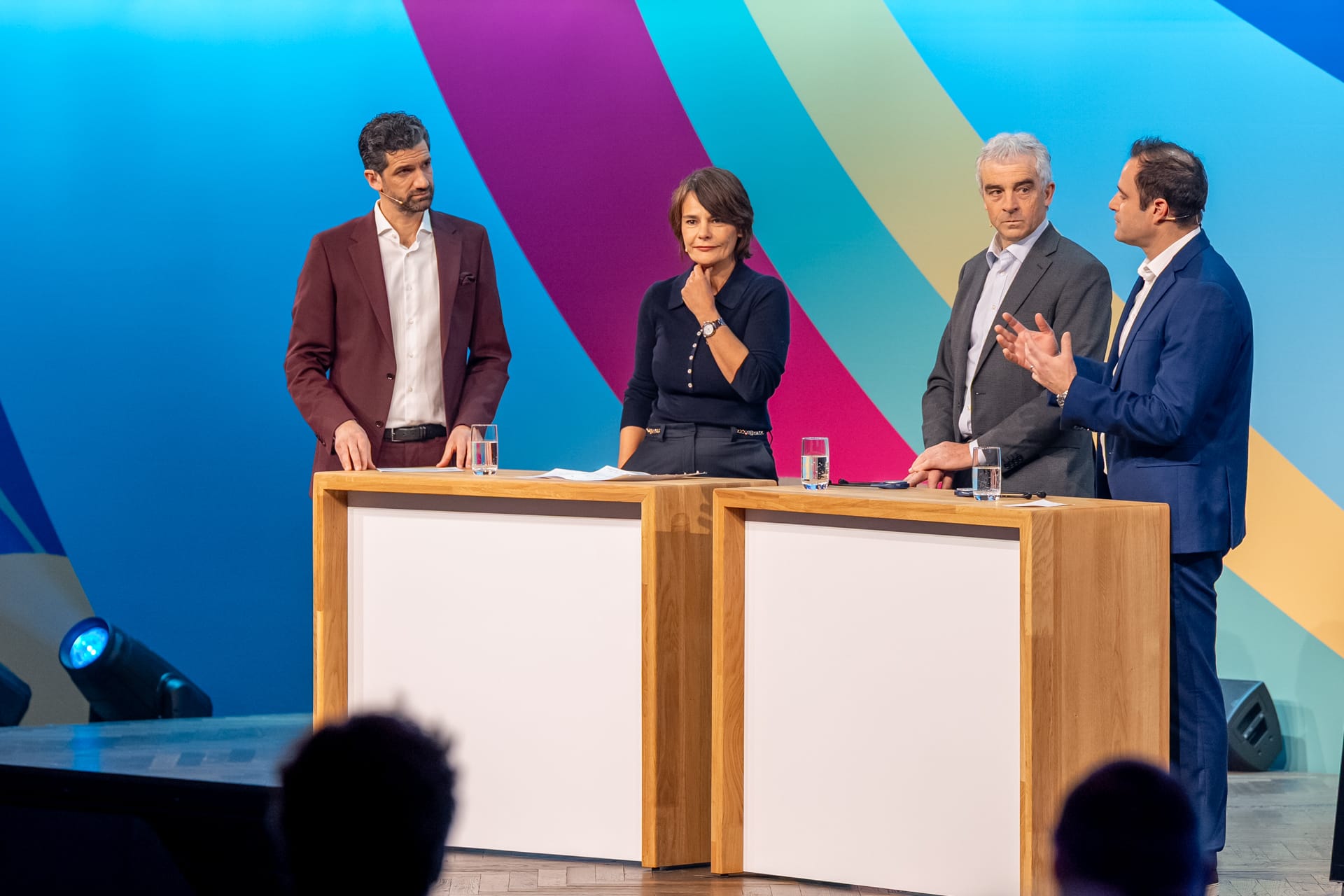
During a debate, Cristina Pastoriza, director of Multidis, warned about the financial situation of the DNOs. “An existential issue that must be resolved.” @Foto Basler
Any source of decarbonized energy constitutes a lever of sovereignty and energy efficiency. “Each additional electron produced in Europe is a step toward energy autonomy,” Bernard Fontana asserts. However, he also stresses the need to preserve grid stability in a context where the rules are evolving. “We have experienced several alerts in southern Europe (referring to the blackout that began in Spain in April 2025, ed.) and it is essential to invest in our grids and work on that stability, because the laws of physics are what they are.”
“In France, in what we call our waste, we have a potential corresponding to a thousand years of operation of our nuclear reactors,” estimates Bernard Fontana, CEO of EDF.
The place of nuclear power
It is no great surprise coming from a representative of the French energy sector that nuclear will occupy a central place in the European electrification process. In France as in Switzerland, the EDF CEO highlights a complete industrial sector, recognized skills, a strong safety culture, but also long-term potential, notably thanks to fuel recycling and the development of future technologies.
“The work carried out on closing the fuel cycle allows us to consider promising prospects. In France, in what we call our waste, we have a potential corresponding to a thousand years of operation of our nuclear reactors,” he explains.
Referring to a construction program of 14 EPR reactors in France — rolled out in two stages, with six reactors first, then eight additional ones — he also recalls the importance of this industry in terms of jobs: 250,000 employees currently work in the country’s reactors, while the entire sector recruits nearly 10,000 new employees each year.
This article has been automatically translated using AI. If you notice any errors, please don't hesitate to contact us.
"A look at the numbers illustrates the scale of the transformation, and these are not passing fads but indicators of a structural investment cycle," says Christian Rom, manager of the DNB Renewable Energy fund.
"Since our share of global greenhouse gas emissions is only one thousandth, our efforts would be doomed to remain insignificant. This argument expresses not a logical reasoning, but an attitude of defiance and denial," regrets René Longet, an expert in sustainable development.
Citing Nicholas Stern and his report on the economics of climate change, Dominique Bidou, the author of "Recivilisation", reminds that "action against global warming makes it possible to avoid expenditures at least five times greater than the initial cost."