"We no longer have any choice but to adapt to climate change"
Interview with Vincent Kaufmann, director of the Ethos Foundation.
The scientists of the GlaMBIE project estimate that between the beginning of the 21st century and today, glaciers have lost between 2% and 39% of their ice mass at the regional scale, and about 5% at the global scale.

“Glaciers are remarkable indicators of climate variability, and this is particularly true for those in a mountain range as iconic as Mont Blanc,” says Sylvain Coutterand, PhD in geography and specialist in glaciology and geomorphology.
From December 4 to 7, 2025, glaciers will be in the spotlight at the 9th International Glacier Film Festival. Held at the Maison des Arts du Grütli in Geneva, this event aims to “raise public awareness of the effects of climate change through the screening of films from different countries.” This was the perfect opportunity to republish some of the key points from this landmark study on glaciers.
Update of a publication dating back to February 26, 2025.
In the High Arctic, encountering an orca used to be a rare event. Even for the powerful killer whale, this icy region of the planet represented too great a danger, one of the few places it dared not venture. But with the retreat of the sea ice, the Arctic now offers new hunting grounds suitable for orcas.
"With the rapid retreat of sea ice in the Arctic, orcas are gaining new access routes to regions such as Hudson Bay and the High Arctic," explains Steve Ferguson on Yale Environment 360. According to this scientist from Fisheries and Oceans Canada, "alongside the polar bear, they have become the main predators of the region."
"In a spirit of collaboration, we analyzed the strengths and weaknesses of each method and made the necessary adjustments to make the data comparable," explains Enrico Mattea, a researcher in the Department of Geosciences at the University of Fribourg.
The melting of the ice not only affects sea level, it also disrupts marine ecosystems. Hence the need to closely monitor its evolution. Until now, the data were disparate and difficult to compare. To remedy this, scientists created an international alliance, grouped around the GlaMBIE (Glacier Mass Balance Intercomparison Exercise) project.
"In a spirit of collaboration, we analyzed the strengths and weaknesses of each method and made the necessary adjustments to make the data comparable," summarized Enrico Mattea, a researcher in the Department of Geosciences at the University of Fribourg, for ATS.
According to the members of the GlaMBIE project, "our results provide a more accurate baseline, essential for better understanding differences in observation and calibrating models. This advance will help reduce uncertainty in projections for the 21st century."
Published in the journal "Nature", their study does not merely improve monitoring of glacier evolution: it also offers a refined view of their transformation over the past two decades (2000-2023).
Here are some key elements:
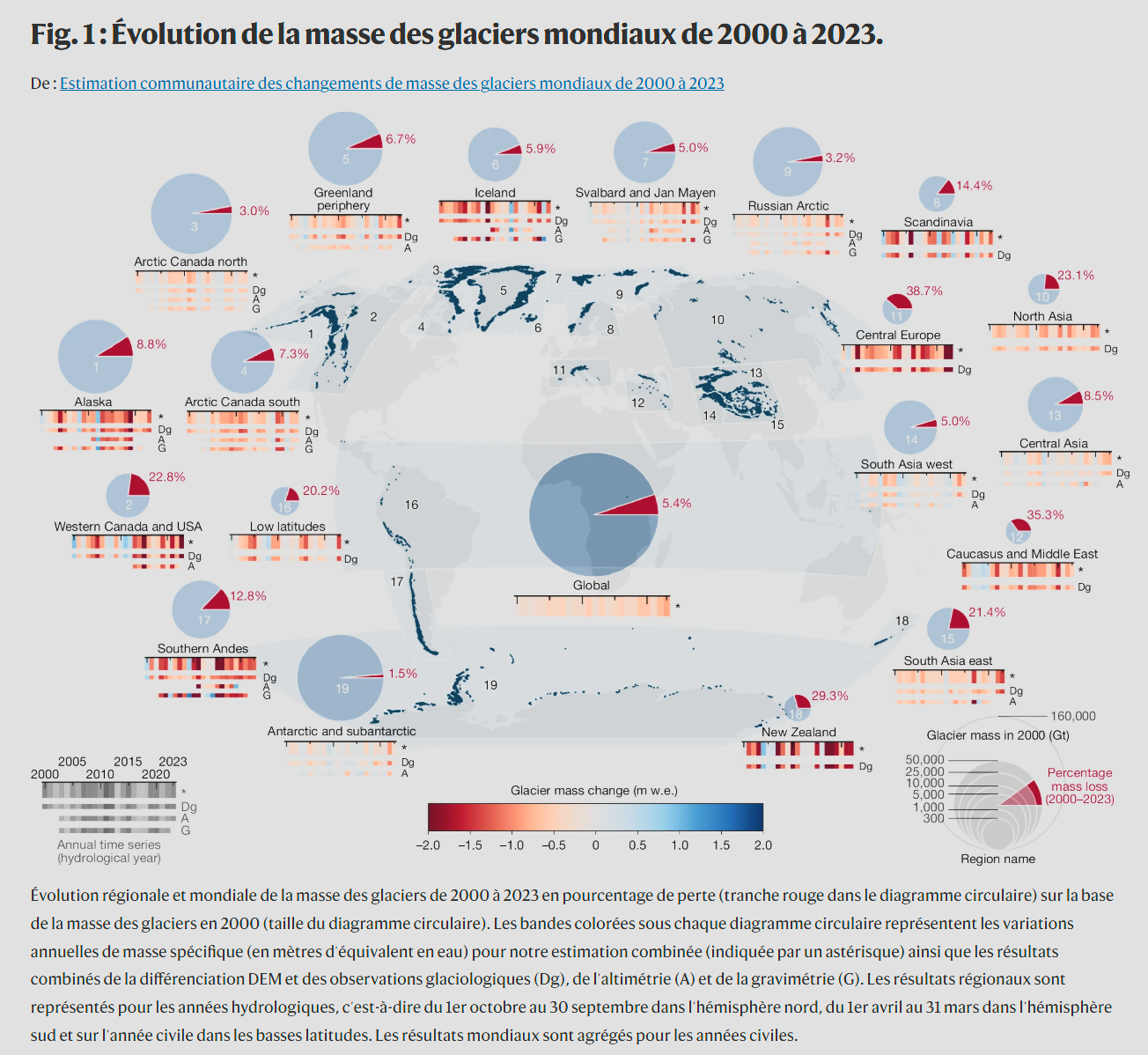
This vast work of data harmonization constitutes a further advance in understanding climate evolution. The first conclusions of GlaMBIE should prompt the world's major powers to deep reflection. Yet the reality is quite different: in recent days, we have witnessed the first political dissensions around the IPCC and the publication of its seventh report.
This article has been automatically translated using AI. If you notice any errors, please don't hesitate to contact us.

Interview with Vincent Kaufmann, director of the Ethos Foundation.

"The summer of 2026 showed what inaction costs; the courts, for their part, have begun to say who must be held responsible for it," emphasize François de Cambiaire and Lydia Méziani, lawyers at de Cambiaire & Méziani Associates.

Interview with Mélanie Beyeler, Global Head of Sustainable Investing at EFG.

A recent Harvard study highlights close links between the rise of data centers and clean energy. Behind the algorithms lies a purely material reality: a demand for electricity that is skyrocketing and disrupting grids and the energy transition.
Already a member or subscriber? Simply enter your email address to receive instant access to the article. Enjoy!