"Initiatives like Swiss Impact & Prosperity show that, beyond growth, an economy's ability to create sustainable value and to preserve its resources is also becoming a performance indicator," explains Simone Pedrazzini, CEO of Earth Action.
"Members of the 'Swiss Electricity Agreement Alliance' will closely monitor parliamentary debates and provide factual information about the agreement," summarizes Annalisa Job, communications manager for the Association of Swiss Electricity Companies (AES).
"By constantly looking at the surfaces that could still accommodate solar installations, we may be overlooking one possibility: roofs that are already equipped," points out Alban Bitz, director of SI-REN.
With its factory truck, Proxipel is betting on ultra-local pellet production
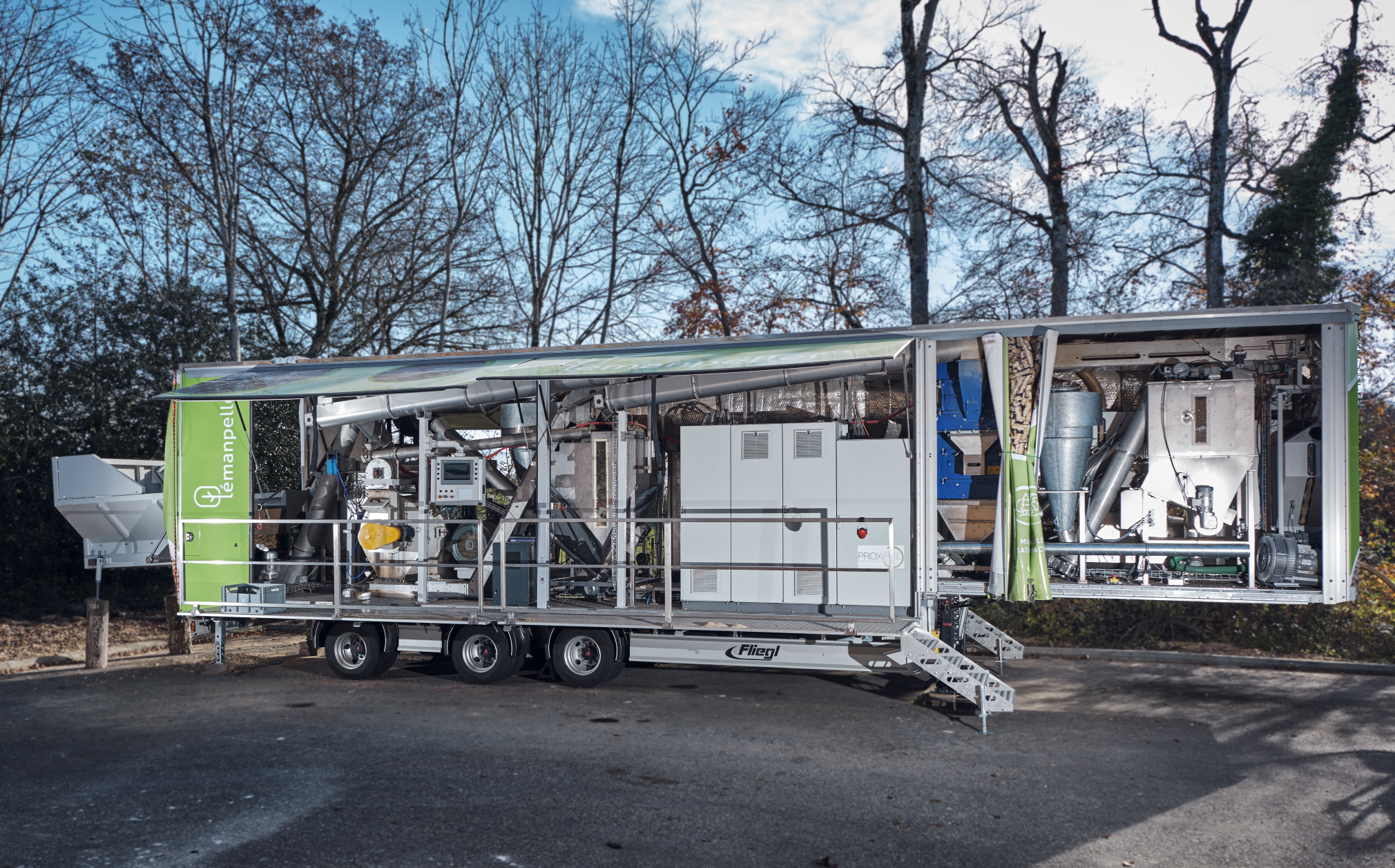
After more than ten years devoted to the design and industrialization of its technology, the company is now entering a new phase: the commercialization of its very first factories installed on a truck.
"The very design of this mobile factory represents a technical feat, as it was necessary to rethink the arrangement of the various pieces of equipment in order to integrate them into the truck," explains Richard Pfister, founder and CEO of Proxipel. @Proxipel
Good ideas sometimes spring up in unlikely ways. The one behind Proxipel was born during a walk through the vineyards, about fifteen years earlier. Trained as an oenologist-engineer, Richard Pfister then noticed how much agricultural residue remained unused in the vineyards. “Rather than burning the prunings or letting them decompose, I wondered whether it wouldn't be wiser to turn them into pellets,” he says.
This reflection led him to André Corthay, who was already working in the field of biomass and on a concept for a modular machine made up of several containers. The two men decided to combine their skills and developed their project within Praxis Energia, an initial start-up founded by the entrepreneur and specialized in renewable energy consulting as well as in the development of new technology companies.
In 2013, convinced of the economic and environmental potential of their concept, they officially founded Proxipel. The two men were quickly joined by François Vuille, then a consultant and future director of EPFL's Energy Center. His expertise enabled them to carry out the technical, economic and market studies that reassured them about the feasibility of the project and the development of a first prototype. From the start, the objective remained unchanged: to build a factory mounted on a truck so they could process the biomass directly where it is produced.
The challenge of mobility
The development of the first model was far from easy. Unlike fixed industrial installations, no equipment available on the market was designed to operate on a semi-trailer. The shredders, for example, had to be modified to meet the constraints of the structure. Other elements were developed entirely in-house, such as the dryer, an innovation patented by Proxipel. “The very design of this mobile plant represents a technical feat, as it was necessary to rethink the layout of the different pieces of equipment to integrate them into the truck,” explains Richard Pfister.
The young company also developed its own system for measuring the moisture of the material. The probes available on the market are not designed to continuously measure biomasses of variable nature and must be recalibrated each time. The company therefore designed a specific device capable of ensuring reliable measurements without permanent recalibration, a considerable time saving in the production process. This technological mastery allows it to meet the requirements of international standards regarding sustainability, moisture content and mechanical strength of the pellets.
From wood to miscanthus
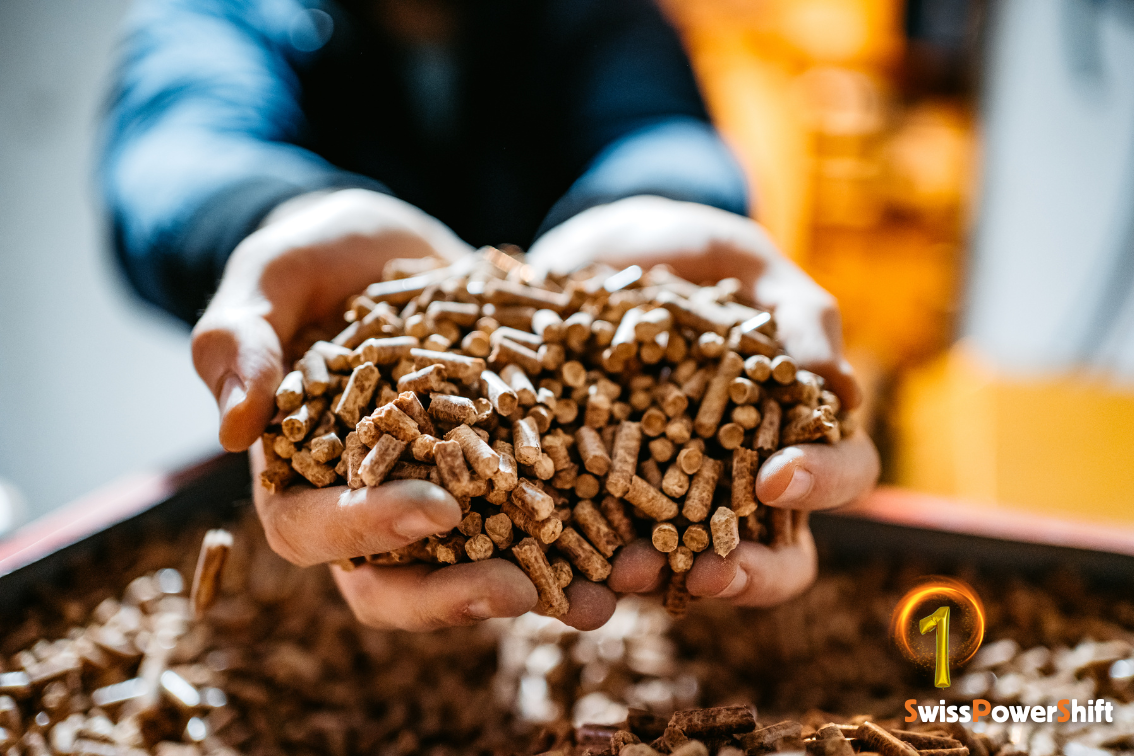
In addition to wood, other biomasses can now be valorized to produce a quality fuel. Among the most promising raw materials is miscanthus, a fast-growing plant already used in some energy sectors. Its low density makes it an excellent candidate for pellet production.
Cereal residues also present strong potential. Dust and by-products recovered in storage silos, still little valorized today, can be transformed into fuel. The volumes available are particularly large in major ports and on cereal storage platforms.
Proxipel's technological mastery allows it to meet the requirements of international standards regarding durability, moisture content and mechanical strength of the pellets. @gettysignature/CanvaPro
In Switzerland, this sector is still underdeveloped, particularly regarding agro-pellets, made from agricultural residues or other non-woody biomasses. “France, by contrast, is a pioneer. In Paris, for example, the La Défense district is supplied by heat networks running on agro-pellets,” explains Richard Pfister.
Proxipel considers itself among the first players to explore this market in Switzerland and is currently working to convince operators and manufacturers that these biomasses constitute a credible alternative, provided the settings of the installations are adapted.
The other challenge is above all to valorize biomasses today considered as waste or by-products, rather than to mobilize crops intended for construction or food. This circular-economy logic makes it possible to produce energy from resources already available, without competing with agricultural uses, notably those intended for human food.
Second model to come
After more than a decade of technological development, Proxipel is therefore entering a new stage of its history: that of industrialization and commercialization. Its first machine will be operated by Léman Pellet, a company created jointly by SEFA and two forestry groups. Proxipel also holds a 20% stake in this company, alongside SEFA, which is the principal shareholder.
While several sales are being finalized, notably in Switzerland and France, Proxipel is already developing a second machine model as part of a partnership with TotalEnergies. “As one of the main distributors of pellets in France, this group wanted to find a solution to valorize the pellet dust generated during handling in its port facilities,” specifies Richard Pfister.
The CEO stresses, however, that he does not intend to multiply bespoke models, but to stabilize his range around these two references in order to industrialize production and ensure the company's economic viability.
An undervalued resource
Beyond its mobile nature, Proxipel also claims a measurable environmental advantage. The company commissioned an independent life cycle analysis (LCA) to evaluate the carbon footprint of its technology. The first results show that using conventional diesel to power the machine, pellet production generates about 30% less CO₂ emissions than more traditional manufacturing processes.
According to the company, the potential for reduction is far from exhausted. By replacing diesel with a second-generation biodiesel, produced from waste rather than dedicated crops, the carbon footprint of manufacturing could be reduced by a factor of four. While not achieving absolute carbon neutrality, the process would come very close.
For comparison, most renewable energy sectors display a carbon footprint of about 50 grams of CO₂ per kilowatt-hour produced. The technology developed by Proxipel would currently be between 30 and 35 gCO₂e/kWh. Powered with second-generation biodiesel, it would fall below the 10 gCO₂e/kWh threshold. These performances would place pellets among the lowest-carbon heating solutions available today, while strengthening the appeal of local production, as close as possible to the resource.
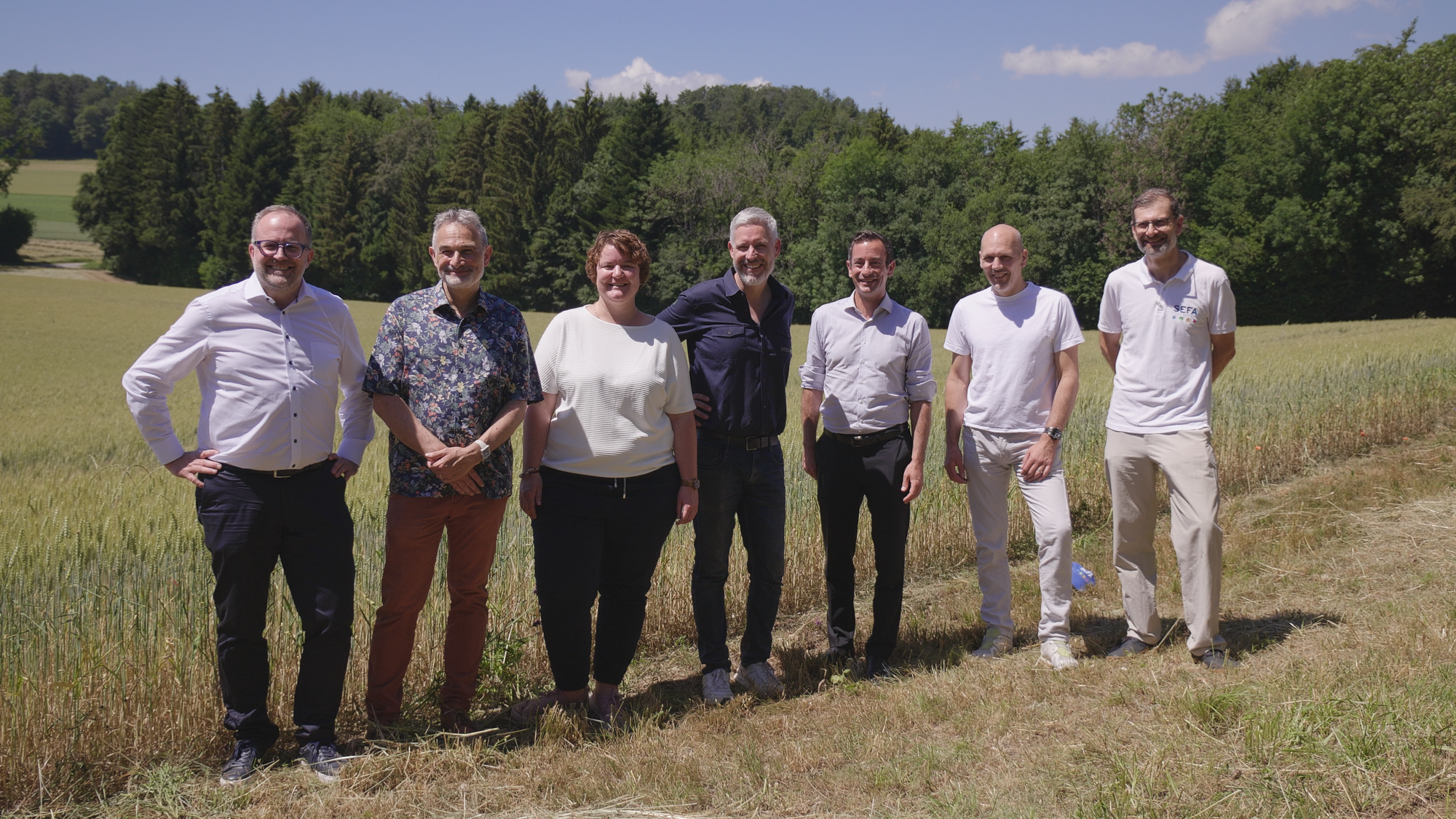
On June 18, Richard Pfister (center) celebrated the sale of his first machine alongside, notably, State Councillor Vassilis Venizelos and SEFA director Laurent Balsiger (on the right). @Proxipel
Industrial and commercial phase
In the long term, the head of Proxipel is convinced that the pellet market will continue to grow. Consumption is currently increasing by 10 to 15% per year, in Switzerland as in the rest of Europe. His solution is thus intended to be complementary to fixed plants. “These sites are necessary to meet market needs and ensure large-volume production. However, a mobile infrastructure like ours will make it possible to exploit all those dispersed biomass deposits that are too modest to justify transport,” assures Richard Pfister.
While the Swiss market offers real potential, development prospects are naturally greater on a European scale. This orientation is not explained by a lack of interest in pellets in Switzerland, but by the smaller size of the market and the lag accumulated compared with several neighboring countries. This situation also explains why Switzerland remains heavily dependent on imports.
Official statistics indicate that 20 to 30% of the pellets consumed are imported, but Proxipel estimates that this proportion is actually close to 40% if one takes into account the sawdust imported and then transformed locally into pellets. According to the company, this dependence confirms that there is still significant potential for the development of new production capacities in Switzerland, notably thanks to mobile solutions capable of valorizing resources directly at their place of production.
For the next stage of its journey, Proxipel is currently conducting a fourth fundraising. These new funds are intended to finance the ramp-up of production until reaching the break-even point, expected by the end of the year or the beginning of next year. According to the company's projections, the sale of five to six machines should be enough to reach this goal.
This article has been automatically translated using AI. If you notice any errors, please don't hesitate to contact us.
"Initiatives like Swiss Impact & Prosperity show that, beyond growth, an economy's ability to create sustainable value and to preserve its resources is also becoming a performance indicator," explains Simone Pedrazzini, CEO of Earth Action.
"Members of the 'Swiss Electricity Agreement Alliance' will closely monitor parliamentary debates and provide factual information about the agreement," summarizes Annalisa Job, communications manager for the Association of Swiss Electricity Companies (AES).
"By constantly looking at the surfaces that could still accommodate solar installations, we may be overlooking one possibility: roofs that are already equipped," points out Alban Bitz, director of SI-REN.
The ambition to continue the development of green, reliable and cost-effective energy sources gave rise to new and numerous discussions at the seventh edition of Building Bridges in Geneva.