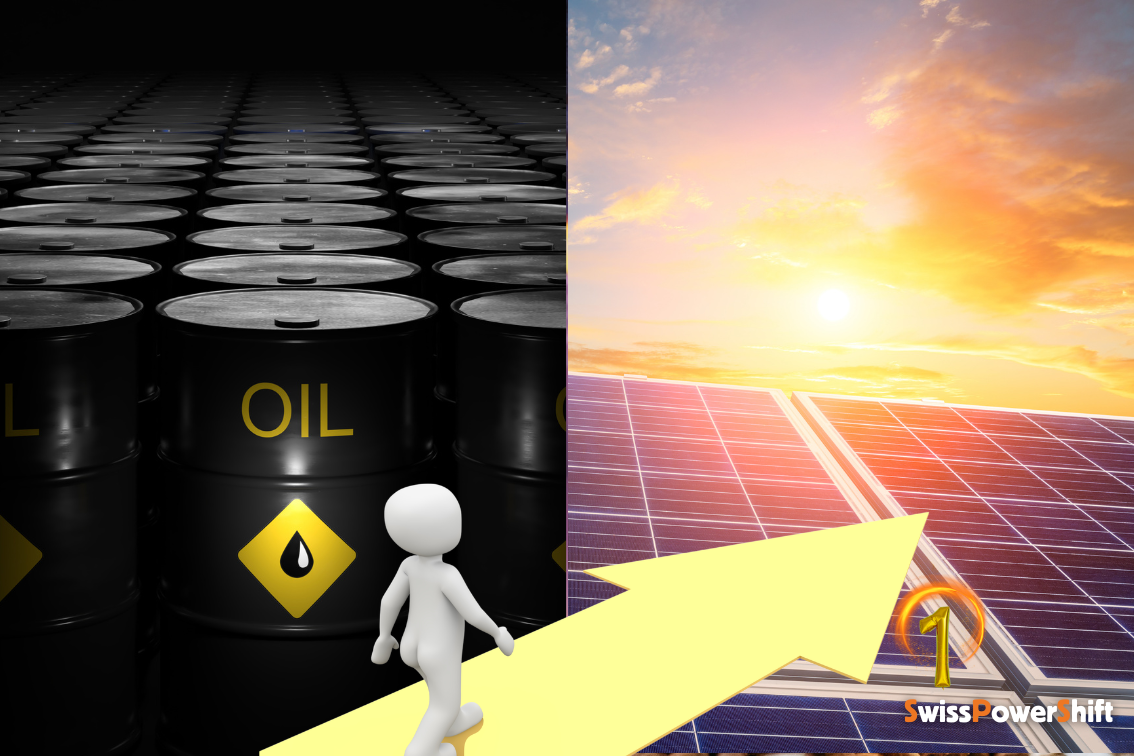
The ambition to continue the development of green, reliable and cost-effective energy sources gave rise to new and numerous discussions at the seventh edition of Building Bridges in Geneva.
Based in a laboratory at the EPFL Innovation Park, the start-up is behind a technology capable of destroying methane when it is present at concentrations too low to be recovered and valorized.
How the financial sector is adapting to the new challenges of the energy transition
The ambition to continue the development of green, reliable and cost-effective energy sources gave rise to new and numerous discussions at the seventh edition of Building Bridges in Geneva.
Ensuring reliable, affordable and lower‑carbon electricity without compromising growth. In short, achieving a pragmatic energy transition that strengthens supply security and offers a stable framework for investors. This quest for the Holy Grail is among the ambitions openly declared by financial and industrial circles. In recent days, it has fed new discussions within Building Bridges, that large gathering of sustainable finance organized each year in Geneva.
From these exchanges a few interesting points emerged, starting with the issue of the energy instability in which we find ourselves plunged in 2026 against a backdrop of growing geopolitical tensions. “In reality, for fifty years we have been living on a roller coaster. Energy supply, supply and demand, tensions, speculation, innovations... Energy is a particularly turbulent field of human activity, and it will remain so,” says Francesco Starace. A partner at EQT, he believes that we will need “to understand its drivers in order to be able to live and invest in a more reasonable and more predictable energy environment.”
“Energy is a particularly turbulent field of human activity, and it will remain so,” says Francesco Starace, partner at EQT.
One of these drivers naturally lies in the electrification of end‑uses. The evolution of demand is taking a central place in financing the energy transition, to the point of surpassing the issues related to production. “Thanks to technology, it is the way we use energy that is changing. On the supply side, we still observe a massive and continuous wave of investments in renewables, but the most marked evolution is on the side of our energy uses,” explains Francesco Starace. He speaks of an “age of electricity,” where annual investments should increase by 50% over the coming years to reach some $600 billion.
The ambiguous position of the oil giants
While these forecasts could still be revised, the amounts at stake remain colossal. They have indeed given fossil fuel producers cause for concern in recent years. Enough to make them all review their priorities and their commitments made in Paris in 2015. This is the case with TotalEnergies which, like its competitors, readjusted its strategy three years ago, restoring a prominent place to its oil and gas activities. Donald Trump's famous “drill, baby, drill” clearly had its little effect within the boards of the oil kings.
“If we see an acceleration of the electrification of end‑uses, it will lead us to change the allocation of our capital,” says Aurélien Hamelle, Director General Strategy and Sustainable Development at TotalEnergies.
Present in Geneva, Aurélien Hamelle said that the oil giant is still seeking to anticipate the transformation of uses and that the deployment of new renewable capacities remains on the agenda. The group's director general in charge of strategy and sustainable development, he highlights the many uncertainties surrounding energy needs in fifteen or twenty years, which is the group's investment horizon. “If we see an acceleration in the electrification of end‑uses, it will lead us to change the allocation of our capital between the two main forms of energy we produce today,” he says.
For Manuel Losa, senior manager at Pictet Asset Management, the energy transition cannot be summed up “as simply increasing the share of renewables in electricity generation.” It also relies on the electrification of uses and the efficiency gains that accompany it. “A megawatt‑hour of gas, coal or oil does not offer the same possibilities as a megawatt‑hour of electricity,” he stresses. According to him, for the same amount of energy, electricity allows you to travel up to four times more kilometres than with oil, or to heat a building with efficiency up to five times higher than that of gas.
“A megawatt‑hour of gas, coal or oil does not offer the same possibilities as a megawatt‑hour of electricity,” recalls Manuel Losa, senior manager at Pictet Asset Management
Between public and private funds
These energy efficiency gains open up significant investment prospects, provided they translate into tangible economic advantages, notably in a context of rising energy prices. Like Aurélien Hamelle of TotalEnergies, Manuel Losa however believes that the pace of adoption remains difficult to anticipate: “We tend to think in a linear way. Yet such an evolution goes through tipping points,” he reminds.
This transition to renewable energy sources also cannot happen without investment in grids and storage. “Some projects are currently losing money because they cannot inject their electricity into the grid,” warns José Sainz, chief financial officer of Iberdrola. Funds that are counted in the billions. In Switzerland, Swissgrid alone plans around 5.5 billion francs of investments between 2025 and 2040 to adapt the very high voltage grid.
“We need an appropriate regulatory framework to attract capital to these investments,” emphasizes José Sainz, chief financial officer of Iberdrola.
To mobilize the necessary financing, public authorities will continue to play a decisive role. “We need an appropriate regulatory framework to attract capital to these investments,” emphasizes José Sainz. This observation is shared by Mélanie Beyeler, global head of sustainable investment at EFG. “We are indeed seeing a shift towards an increased role for private capital, but that does not mean that public policies have become less important,” she explained in a recent interview published on SwissPowerShift.
According to the EFG expert, one of Building Bridges' great strengths would lie in its ability to “bring together around challenges that no component of society can solve alone.” Let us hope that this is indeed the case for an energy transition currently mired between geopolitical tensions and numerous macroeconomic constraints.
This article has been automatically translated using AI. If you notice any errors, please don't hesitate to contact us.
Based in a laboratory at the EPFL Innovation Park, the start-up is behind a technology capable of destroying methane when it is present at concentrations too low to be recovered and valorized.
"While it puts manufacturers under pressure, the fall in costs benefits project developers, electricity producers and suppliers, as well as consumers," explains Christian Rom, manager at DNB Asset Management.