Based in a laboratory at the EPFL Innovation Park, the start-up is behind a technology capable of destroying methane when it is present at concentrations too low to be recovered and valorized.
"While it puts manufacturers under pressure, the fall in costs benefits project developers, electricity producers and suppliers, as well as consumers," explains Christian Rom, manager at DNB Asset Management.
Sixteen44, the startup that wants to destroy methane directly at its source
Based in a laboratory at the EPFL Innovation Park, the start-up is behind a technology capable of destroying methane when it is present at concentrations too low to be recovered and valorized.
Methane! Its impact on the climate is very often underestimated, sometimes reduced to the mere “cows that fart.” According to the International Energy Agency (IEA), its emissions would nonetheless be responsible for nearly 30% of the rise in global average temperatures since the pre-industrial era. Its concentration in the atmosphere is today about 2.7 times higher than before the industrial revolution. “Atmospheric measurements show that methane concentrations, just like those of CO₂, continue to increase year after year,” warn the experts of the international agency.
As with carbon, it is therefore necessary to find solutions to reduce methane emissions, two thirds of which are due to human activity. One of these solutions could come from Sixteen44, a startup founded in 2024 at the initiative of its three co-founders: William Ramsay, Mario Michan and Nelson Dumas. Based in a laboratory at the EPFL Innovation Park, the startup is behind a technology capable of destroying methane directly at its source, when it is present at concentrations too low to be recovered and valorized.
Accelerating its conversion into CO₂
The challenge is precisely to tackle emissions for which traditional solutions reach their limits. When methane concentration is high enough, this gas can be recovered and valorized as an energy source or burned in a flare. Sixteen44 therefore targets concentrations “100 to 1000 times lower,” for which gas recovery is generally no longer economically relevant. This is notably the case on a farm, a wastewater treatment plant or a mine, examples of places where methane is often present at ambient temperature and at very low concentrations.
The startup's name sums up its founders' ambition: “16” corresponds to the molecular mass of methane (CH₄), and “44” to that of carbon dioxide (CO₂). Rather than capturing methane, the scientists want to accelerate its conversion into CO₂ thanks to a catalytic process. This approach may seem counter-intuitive at a time when many climate technologies are precisely aimed at capturing carbon dioxide or removing it from the atmosphere.
“According to our calculations, the accelerated conversion of methane into CO₂ allows us to eliminate about 98% of methane's climate effect,” explains William Ramsay.
However, the two gases do not have the same warming power. “If you emit a tonne of methane, that is equivalent to about 80 tonnes of CO₂,” summarize the founders of Sixteen44. With their process, the scientists accelerate a reaction that occurs naturally in the atmosphere: methane oxidizes and ends up transforming into CO₂. This process, however, takes many years, whereas the startup intends to cause it immediately, before the methane is released. “Its accelerated conversion makes it possible, according to our calculations, to remove about 98% of methane's climate effect,” explains William Ramsay.
Markets and business model
The agricultural world is one of the first markets targeted by the Vaud-based startup, in particular cattle farming. However, the model imagined by the startup would be to treat emissions without passing the cost of the installation on to the farmers. To achieve this, Sixteen44 is betting on a model financed by the sale of carbon credits. It would thus remain the owner of the equipment and be remunerated thanks to the credits generated by the emission reductions, while sharing revenues with the farm operator.
The agricultural world is one of the first markets targeted by Sixteen44, particularly cattle farming. @Sixteen44
“Destroying one tonne of methane allows the accounting of several tens of tonnes of CO₂ equivalent avoided. This multiplier effect could allow us to approach an abatement cost on the order of 100 francs per tonne of CO₂ equivalent,” explains Nelson Dumas. This level of cost could make the process competitive compared with other technologies for removing carbon from the atmosphere that are much more expensive.
The second priority market is wastewater treatment and biogas valorization. Because the decomposition of organic matter in the absence of oxygen generates methane. Large facilities can recover this biogas and valorize it as an energy source, but this solution is not always profitable, and part of the emissions can persist despite recovery systems. Note that landfills also present potential for Sixteen44.
Potential in fossil fuels
A third outlet could gradually open in the coming years, under the effect of new European regulations: the treatment of methane emissions from the fossil fuel sector. This market, which concerns oil, gas and mining activities, should moreover largely go beyond European borders. “For this clientele, the economic model would then be different from that imagined for agriculture: companies would buy the equipment directly in order to reduce their emissions and comply with new regulatory constraints,” adds William Ramsay.
The mining sector perfectly illustrates the potential of the technology developed by Sixteen44. Methane must be evacuated there by ventilation to prevent it from reaching concentrations that could present a real explosion risk. Once diluted in large volumes of air, it is generally discharged directly into the atmosphere. The startup wants to install its system at the outlet of these ventilation devices to destroy the methane.
“About two thirds of methane emissions from the mining sector would be in the range of concentrations that our technology intends to treat,” assures Mario Michan.
It is precisely at these low concentrations that the startup believes it has a technological advantage. To be burned in a flare, methane must be present in the air at a sufficient concentration. Below this threshold, flaring is no longer suitable. “About two thirds of methane emissions would be in the range of concentrations that our technology intends to treat,” specifies Mario Michan.
Financing and commercialization
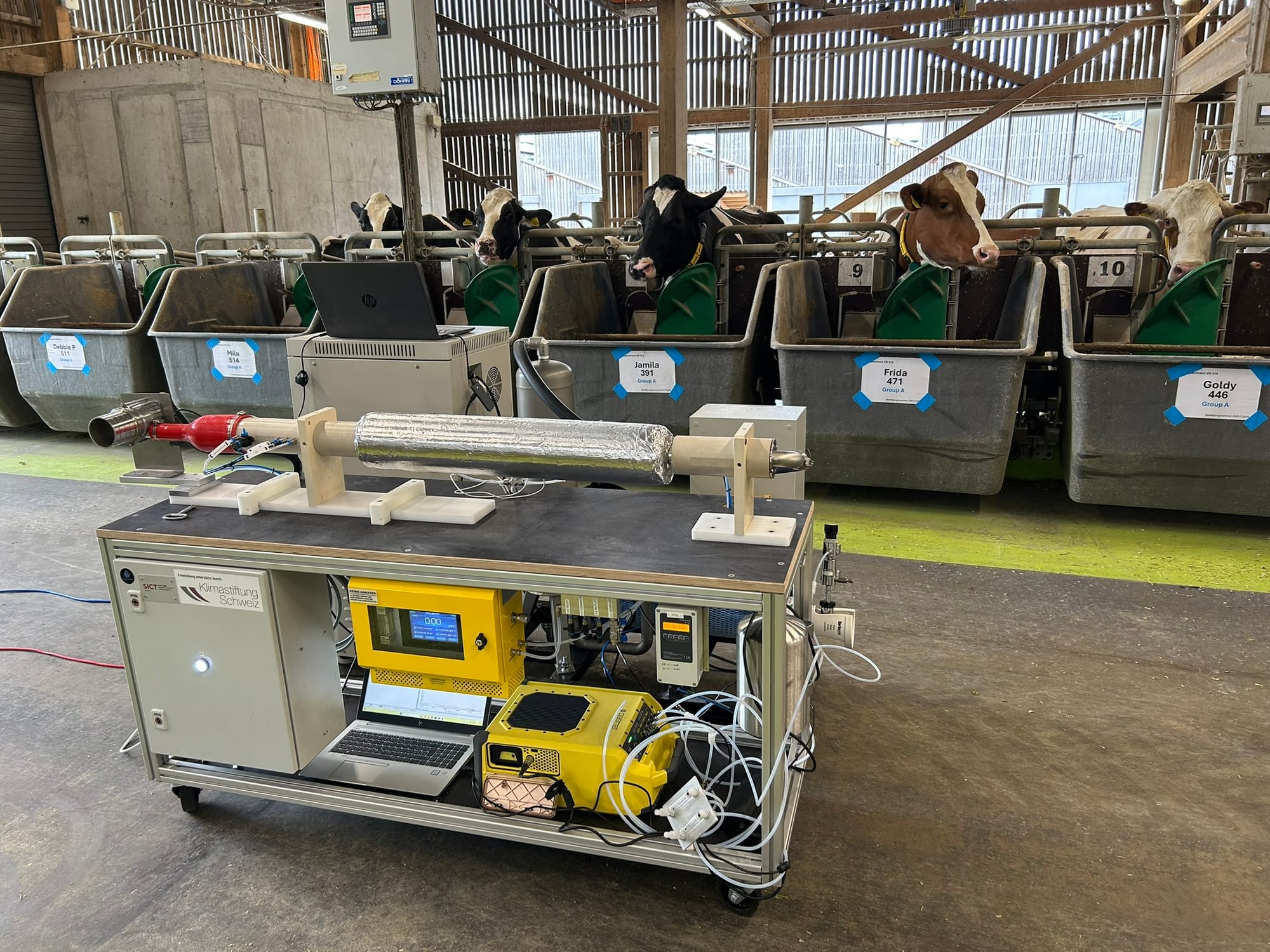
Sixteen44 has already demonstrated the operation of its system on a cattle farm linked to ETH Zurich. The next step will be to install it in a wastewater treatment plant in order to evaluate its effectiveness in this new environment. Integrated since March 2026 into the Tech4Regen acceleration program, the company hopes to begin marketing its technology as early as next year.
But to realize their ambitions, the three founders will have to convince new investors. So far, they indicate having raised about 750,000 francs, in the form of dilutive and non-dilutive financing. “We are looking to raise an additional one million francs in order to be able to begin installing our first methane elimination systems next year in Swiss farms and wastewater treatment plants, while expanding the team,” specifies Nelson Dumas. Their participation in the Venture Leaders Cleantech trip to Munich, in November, will allow them to meet many European investors and, perhaps, convince some of them to support their project.
This article has been automatically translated using AI. If you notice any errors, please don't hesitate to contact us.
"While it puts manufacturers under pressure, the fall in costs benefits project developers, electricity producers and suppliers, as well as consumers," explains Christian Rom, manager at DNB Asset Management.
"The summer of 2026 showed what inaction costs; the courts, for their part, have begun to say who must be held responsible for it," emphasize François de Cambiaire and Lydia Méziani, lawyers at de Cambiaire & Méziani Associates.