Energy and architecture: A little lightness as an antidote to the heaviness of the world
Raphaël Ménard recounts in his book "Vers la légèreté" how available resources determine the forms of architecture and planning. Interview.
Raphaël Ménard recounts in his book "Vers la légèreté" how available resources determine the forms of architecture and planning. Interview.

" Seeing energy differently ," that is the point Raphaël Ménard makes in his recent book "Vers la légèreté, Petite histoire énergétique des sociétés humaines" (Wildproject, 2025). Traumatized by the binge on materials and resources consumed by humanity since the Industrial Revolution — which threatens to cause its downfall — the engineer-architect rereads human history through the lens of its energy needs.
These needs were prehistoricly very low, but have only grown over the millennia, rising from the 100 watts of our metabolism to the more than 2,500 watts average today (with huge disparities depending on where one lives on Earth). He describes our "extractivist appetite" which became exponential and seems insatiable since we began exploiting the fossil resources under our feet.
These were prehistorically very low, but have only grown over the millennia, rising from the 100 watts of our metabolism to the more than 2,500 watts average today (with huge disparities depending on where one lives on Earth). He describes our "extractivist appetite" which became exponential and seems insatiable since we began exploiting the fossil resources under our feet.
This book continues a long-term body of work. The author admits with a touch of irony that it is "perhaps first of all a bit of self-persuasion, in the current climate," but stresses above all that it is the culmination of his thesis devoted to the energy-material regimes of architecture (2018). The work also follows on from the "Light Energies" exhibition, presented at the Pavillon de l'Arsenal in Paris in 2023-2024, and concludes with an epilogue in the form of a dialogue with Philippe Bihouix.
To "see energy differently," Raphaël Ménard goes back very far: to the Big Bang! This choice is not incidental. It is about "placing us back within the energy-matter duality, which appeared 13.8 billion years ago" and recalling that the conditions for life on Earth — the sun, gravity — deeply shape our way of living and housing ourselves. "The first chapters of the book recall these fundamental notions and the orders of magnitude that frame our sustainability," explains the author.
The example of solar energy is striking. The Earth's surface receives on average 169 watts per square meter. Yet only a very small fraction of this flux is captured by photosynthesis, and an infinitesimal part is stored long-term as fossil fuels. "This 'fossil savings,' accumulated over tens of millions of years, represents about 900 billion tonnes of oil equivalent — that is the equivalent of the solar energy received at the Earth's surface... in five days," calculates Raphaël Ménard. Yet today our energy regime remains nearly 80% dependent on fossils. "This energy intoxication fuels climate runaway and accelerates biodiversity collapse," the author points out.
"We have shifted our metabolism to the geological depths — and we are choking while taking the living world with us."
In this captivating overview, the director of the AREP group focuses on housing and on the energy-matter pair which, over the ages, imposes architectural forms and uses. The Native American tipi illustrates a frugal metabolism, directly connected to surface resources. The 17th-century thatched cottage consumed about 200 kg of wood per week; the 19th-century Parisian Haussmann apartment burned nearly 30 kg of coal weekly; the 20th-century skyscraper embodies the peak of an abundant and concentrated fossil regime. As for the contemporary passive house, it is far less energy-hungry than its ancestors, but of extreme complexity and made of composite materials often difficult to recycle.
The current impasse is therefore not only energetic: it is also material. The mass of artifacts produced by humanity — buildings, infrastructure, objects — now approaches 1,100 billion tonnes. "Each year, we extract on average 13 tonnes of material per person, and this dynamic continues to grow by 2.3% per year," details Raphaël Ménard.

"For two centuries, our energy-material regime has literally plunged below the Earth's surface: we have dug, drilled, pumped, sometimes hundreds of meters deep, to extract coal, oil, metals and minerals. We have shifted our metabolism to the geological depths — and we are choking while taking the living world with us," he adds.
Against this trajectory, lightness is not merely an aesthetic: it is a trajectory. It is about switching from a fossil metabolism based on finite stocks to a renewable and circular metabolism. "Before the extractivist parentheses, our metabolism was 'pellicular': we drew the bulk of our resources from the world's surface, mostly derived from photosynthesis," Raphaël Ménard recalls.
Recovering this logic first requires "working with what is already there" — transforming, adapting, reusing — and, when new construction is necessary, favoring bio- or geo-sourced materials, reversible, demountable, repairable, and adaptable systems.
In construction, reuse is progressing but remains marginal, held back by standards, insurance, and industrial inertia. "Our descendants will probably consider that we were still in prehistory," he laments. Within AREP, the goal is to make it common practice, even though, "in bulk, its share remains still minor."
"Those who think wind turbines disfigure the landscape forget that in the mid-19th century, France had nearly 10,000 windmills."
This transition also involves accepting what the architect calls the visibility of renewable energies. Fossil-origin sources belong to a "stock logic": a dense, concentrated energy, often imported from afar. Renewables refer to a "flow logic": local, diffuse and potentially more visible. And Raphaël Ménard points out that "those who think wind turbines disfigure the landscape forget that in the mid-19th century, France had nearly 10,000 windmills, an order of magnitude comparable to the current onshore wind farm."
The question then becomes: how to integrate the new infrastructures into an "aesthetic of lightness"? "We explored this avenue with a prototype with a vertical axis, 'Wind-it' , as well as with prospective images created for the exhibition, depicting lightened wind turbines, conceived as multifunctional infrastructures," recounts the designer.

As for the dilemma between sobriety and techno-solutions, Raphaël Ménard acknowledges a personal evolution: "Twenty years ago, I dreamed of 'zero energy' buildings. These buildings were real Formula 1s: sophisticated, complex, difficult to develop, maintain, and repair. I understood — somewhat late — the virtues of simplicity: accepting less on-paper performance to gain in robustness and repairability."
This new lightness is part of the triptych advocated by the négaWatt association — sufficiency, efficiency, renewables — as well as the concept developed in Switzerland of the "2,000-Watt Society" which profoundly marked the researcher: "And my Swiss atavism does not stop there: after having taught at EPFL in 2015-2016, I return there in autumn 2026 for the 'Master in Urban Systems' of Vincent Kaufmann, in order to train engineer-designers more aware of planetary limits in project development."
Inevitably, under pressure from the climate crisis and the depletion of easily accessible resources, our frenzied extractivism will have to decline rapidly in the coming decades, whether we like it or not. For the planner, the challenge is therefore to imagine a nearly carbon-neutral world, energetically and materially lighter.
This article has been automatically translated using AI. If you notice any errors, please don't hesitate to contact us.

"Since our share of global greenhouse gas emissions is only one thousandth, our efforts would be doomed to remain insignificant. This argument expresses not a logical reasoning, but an attitude of defiance and denial," regrets René Longet, an expert in sustainable development.

Citing Nicholas Stern and his report on the economics of climate change, Dominique Bidou, the author of "Recivilisation", reminds that "action against global warming makes it possible to avoid expenditures at least five times greater than the initial cost."

"It is neither fair nor constructive to pit technologies against each other in a supposed race for funding: it's a false debate," says Eric Plan, secretary-general of the CleantechAlps association.
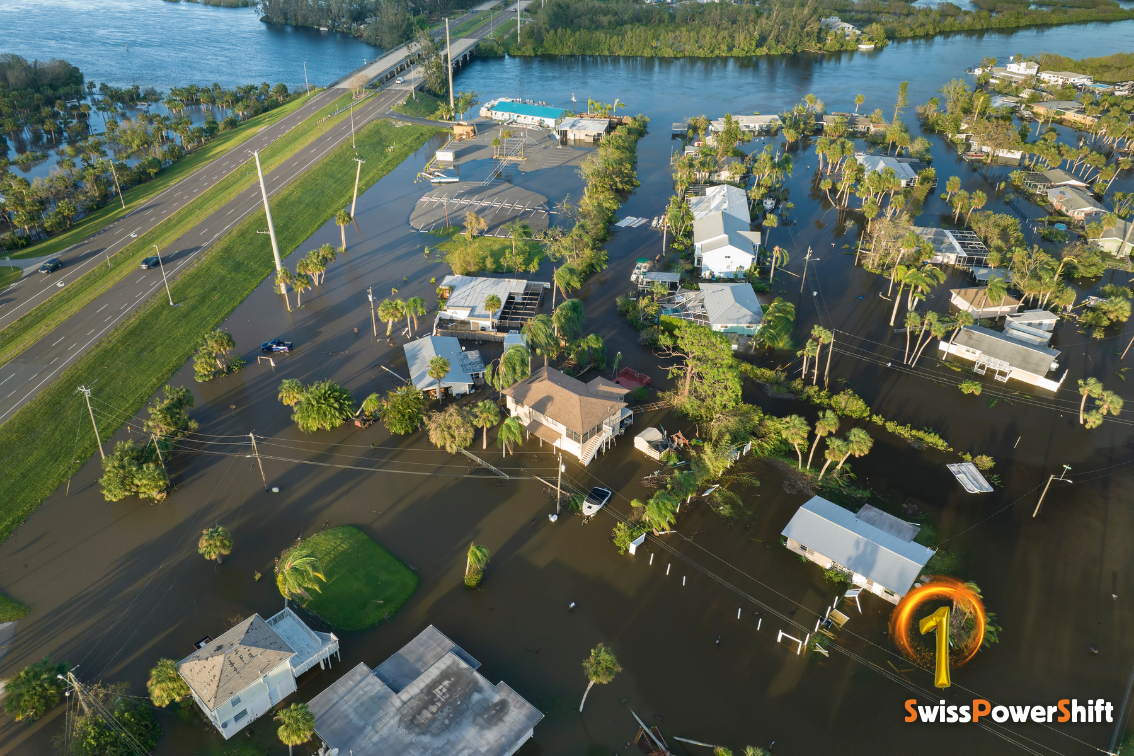
A worrying phenomenon has been growing for several years: the gradual withdrawal of insurance companies from the most at-risk areas.