"A wind farm can be perceived with pride, as a contribution to our security of supply, a milestone toward greater autonomy," says René Longet, a member of the committee of the association ProEole Geneva and author of « Planète Etat d'urgence : Les réponses de la durabilité ».
"We hope this conference will put the collective implementation of more ambitious measures to protect the climate back at the forefront," explains Isolda Agazzi, head of development policy at Alliance Sud.
"The average female driver thus spent 14.90 francs on gasoline to travel 100 kilometers in 1981, compared with 16.10 francs today. In the meantime, household disposable income has, however, been multiplied by 2.85," recalls Philippe Thalmann, professor of environmental economics at EPFL.
"A wind farm can be perceived with pride, as a contribution to our security of supply, a milestone toward greater autonomy," says René Longet, a member of the committee of the association ProEole Geneva and author of « Planète Etat d'urgence : Les réponses de la durabilité ».
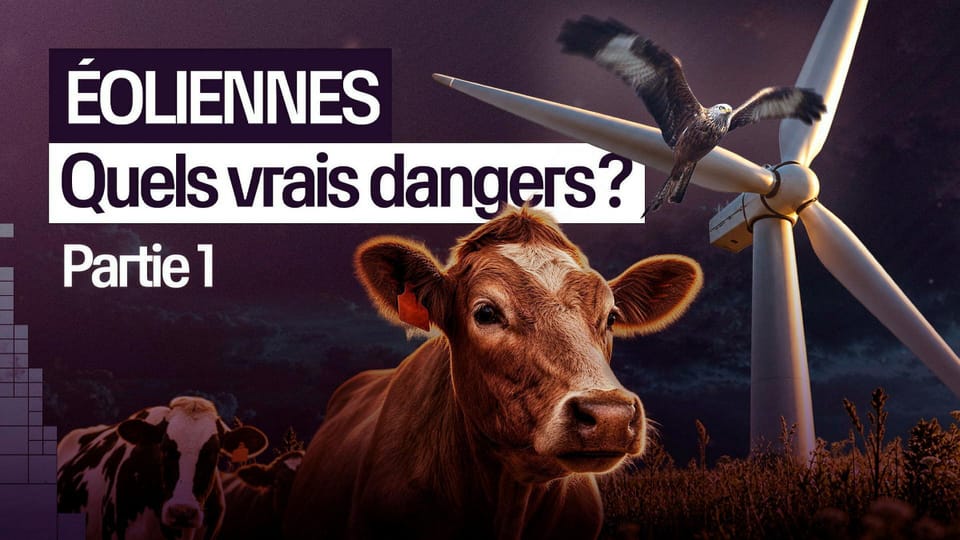
While on average, in Europe, wind provides one fifth (19%) of electricity production, wind power remains very controversial in our country and its contribution is capped at a meager 0.3%. From an environmental standpoint, the criticisms mainly cite three points: noise emissions, impacts on biodiversity and harm to landscapes.
Let us note from the outset that energy production without nuisances does not exist, but those of renewables are infinitely smaller than those of the fossil and fissile sources they are intended to replace.
Nuisances under control
Regarding noise emissions, the often-invoked question of infrasound (low frequencies not audible to the human ear) does not appear relevant from a scientific point of view, no damage to human or animal health having been proven to date. The sound of the blades corresponds to that of a dishwasher; for many people it is negligible, while others feel inconvenienced by it. Therefore minimum distances from dwellings have been laid down.
As for birds and bats, collisions are rare. For the six turbines of Sainte-Croix, it is at most a few dozen per year; moreover, many turbines are today equipped with devices that detect bird flights and stop the blades when necessary. The dangers to birds coming from our friends the cats, from glass panes and from habitat degradation are infinitely more significant.
There remains the question of the landscape. Its appreciation is eminently subjective and what is admired today often shocked at first. Thus, the Lavaux vineyard, the Eiffel Tower, the cathedrals, reservoir lakes such as Lake Gruyère, canals or railway viaducts with a strong impact on landscapes are now key elements to protect – just like Greek or Dutch windmills…
A wind farm can also be perceived, with pride, as a contribution to our supply security, a milestone towards greater autonomy. As for recycling, whereas the deconstruction of a nuclear site can take decades (cases of Brennilis or Creys-Malville in France and of Lucens in Switzerland), a wind turbine is dismantled in a few weeks. Increasingly, its components are not only recyclable, but also recycled.
Acting on demand will not be enough
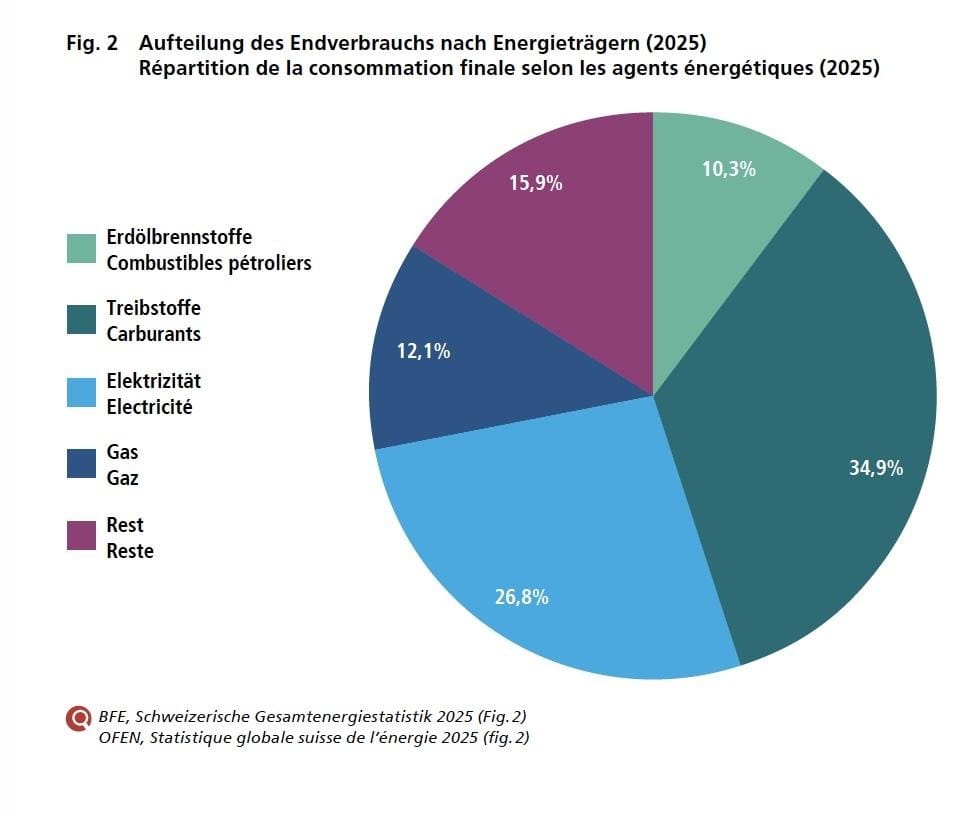
The criticisms do not stop there and one often hears “we just have to make savings.” This statement shows a lack of understanding of our energy mix and of the scale of the task, because nearly 58% of our consumption comes from oil and fossil gas, to which must be added the nuclear share of our electricity: 30% of an electricity that itself represents 27% of our energy mix. To free ourselves from these particularly polluting, non-renewable energies imported at prices we do not control at all, we would therefore have to save two thirds of our current consumption.
We must of course act on demand, through energy refurbishment of buildings, electrification of mobility and optimization of equipment, machines and engines. But also – which is more difficult, because it requires a change in behavior – through greater sobriety, by questioning our needs in terms of travel, IT and heating (each degree represents 7% of consumption), by favoring public transport and active mobility and by promoting sustainable agri-food systems. However, various trends go in the opposite direction: the use of aviation and the development of data centers, for example.
Even if we manage to significantly reduce our consumption, we will still have to produce energy, which must come exclusively from renewable sources: photovoltaics (15% of our electricity production), geothermal energy, ambient heat, biogas from biomass waste, wood and wind. All present significant potential for growth. Only hydropower (55% of our electricity) has been the subject of systematic development for more than a century. Climate change, with its long drought periods and sudden rains, now threatens this asset.
Some of these sources can replace oil and gas for heating, others will provide the electricity needed for heat pumps and mobility. This is precisely where wind potential comes in, with its winter optimum and its complementarity, in terms of seasonal cycles, with photovoltaics.
In about ten European countries, wind even covers between 20 and 45% of electricity needs.
The last in the class in Europe
The explanatory report on the Wind Energy Concept of 25.9.2020 notes that « the full development of wind energy production to 4.3 TWh/year requires the construction of approximately 400 to 600 wind installations or 40 to 60 wind farms each equipped with 10 installations ». Knowing that these 4.3 TWh/year correspond to 7.5% of electricity consumption, depending on wind strength, technically, one could go higher.
These targets are far from being reached and are themselves well behind the levels achieved by our neighbors. Take two countries of size or topographic configuration comparable to Switzerland, namely Belgium and Austria: the first, with a density of 387 inhabitants per km², has 1,754 wind turbines that provide 13.6% of its electricity production; in Austria, with 111 inhabitants per km², 1,447 wind turbines supply 16% of electricity.
In about ten European countries, wind even covers between 20 and 45% of electricity needs, namely, in descending order, Denmark, Lithuania, Ireland, Germany, Portugal, the Netherlands, Finland, Spain, Greece and Sweden… Switzerland – 226 inhabitants per km² –, with its 50 turbines, is one of the last in the class.
A new version of the Wind Energy Concept is currently under consultation. It emphasizes the quantitative and qualitative criteria guiding wind planning: no park is developed without a careful analysis of the winds and minimization of its potential nuisances. And because the production capacity of turbines has increased, the same production can be obtained with a smaller number of installations. Each new wind turbine is a precious contribution to the energy transition; refusing to use this potential is to weaken our ability to move away from fossil and fissile fuels.
This article has been automatically translated using AI. If you notice any errors, please don't hesitate to contact us.
"We hope this conference will put the collective implementation of more ambitious measures to protect the climate back at the forefront," explains Isolda Agazzi, head of development policy at Alliance Sud.
"The average female driver thus spent 14.90 francs on gasoline to travel 100 kilometers in 1981, compared with 16.10 francs today. In the meantime, household disposable income has, however, been multiplied by 2.85," recalls Philippe Thalmann, professor of environmental economics at EPFL.
While strengthening its investments in the network, the national electricity transmission system operator significantly reduced its costs in the first half of 2026.
"All installations of transmission, railway power-supply and distribution networks with a voltage exceeding 1 kV will henceforth be of national interest," says Jan Flückiger, head of public affairs at AES.