What happens when insurance companies decide to withdraw and no longer cover the most at-risk areas? That is the theme at the heart of the new report by the environmental NGO, but also of "Sigma", that of the Swiss Re Institute. Analysis
"Flexibility solutions are now essential. However, they face a structural difficulty: their costs are decreasing faster than market rules evolve," explains Xavier Blot, associate professor at emlyon business school.
By naming their first edition "Wind farms are taking shape", the industry's players want to show a certain optimism despite a context that remains complicated for the sector. A look by Benoist Guillard, president of the Groupe romand pour l’énergie éolienne (GREE).
“Thermonuclear fusion already works: it is in the sky, it is the Sun”
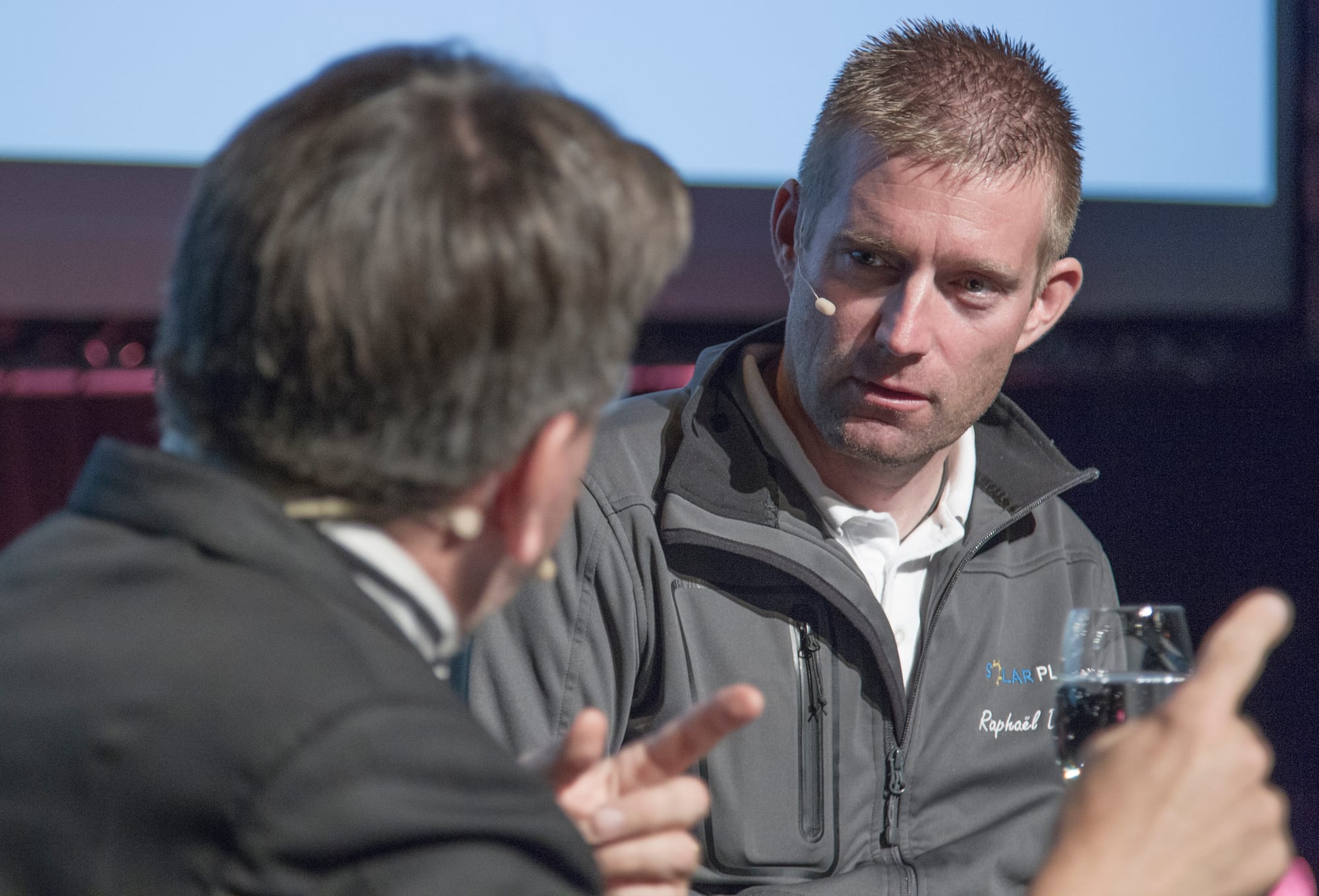
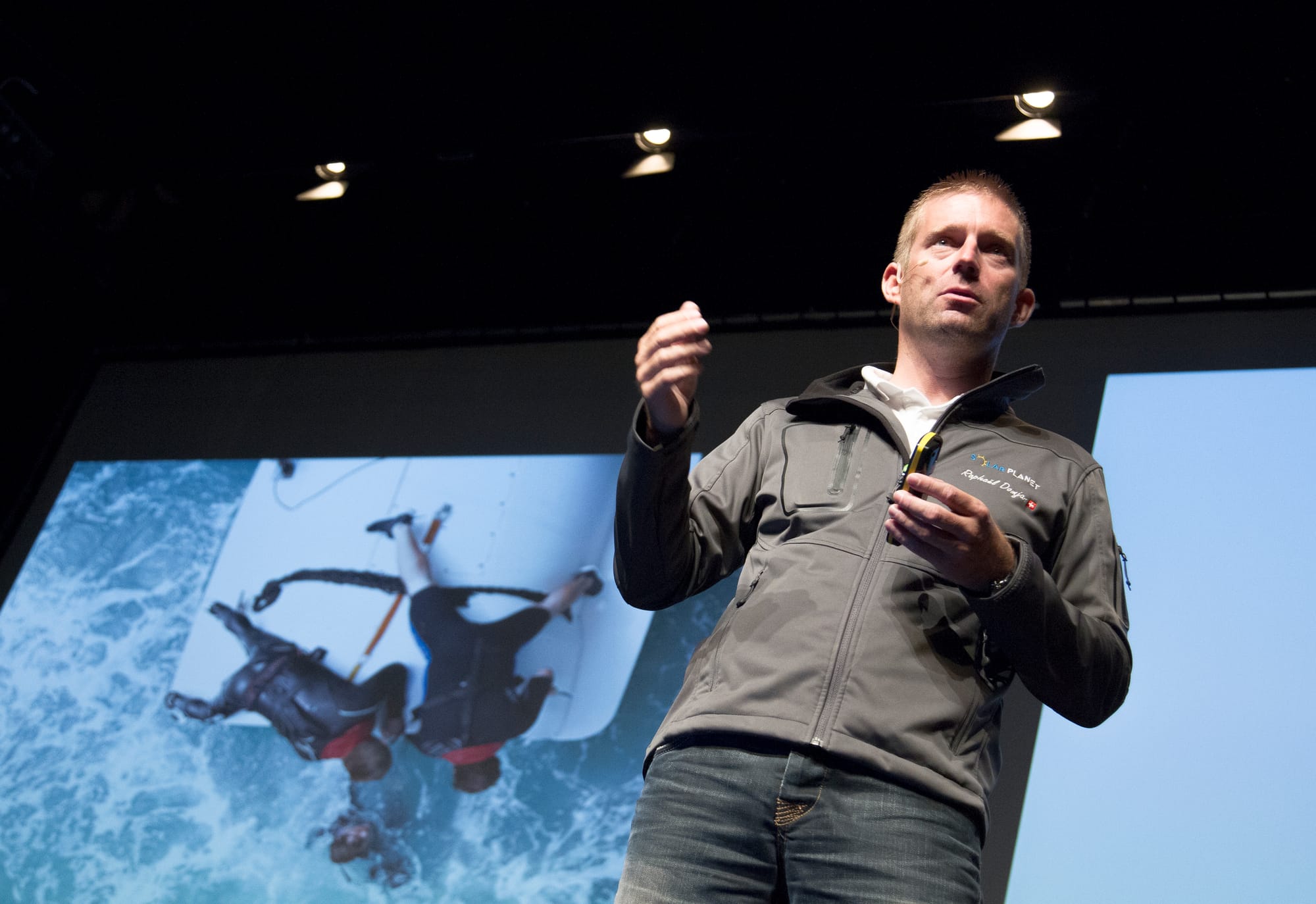
Altitude record with SolarStratos, tour of Lake Titicaca aboard PlanetSolar II: in 2025, Raphaël Domjan once again pushed the boundaries of solar energy. Interview
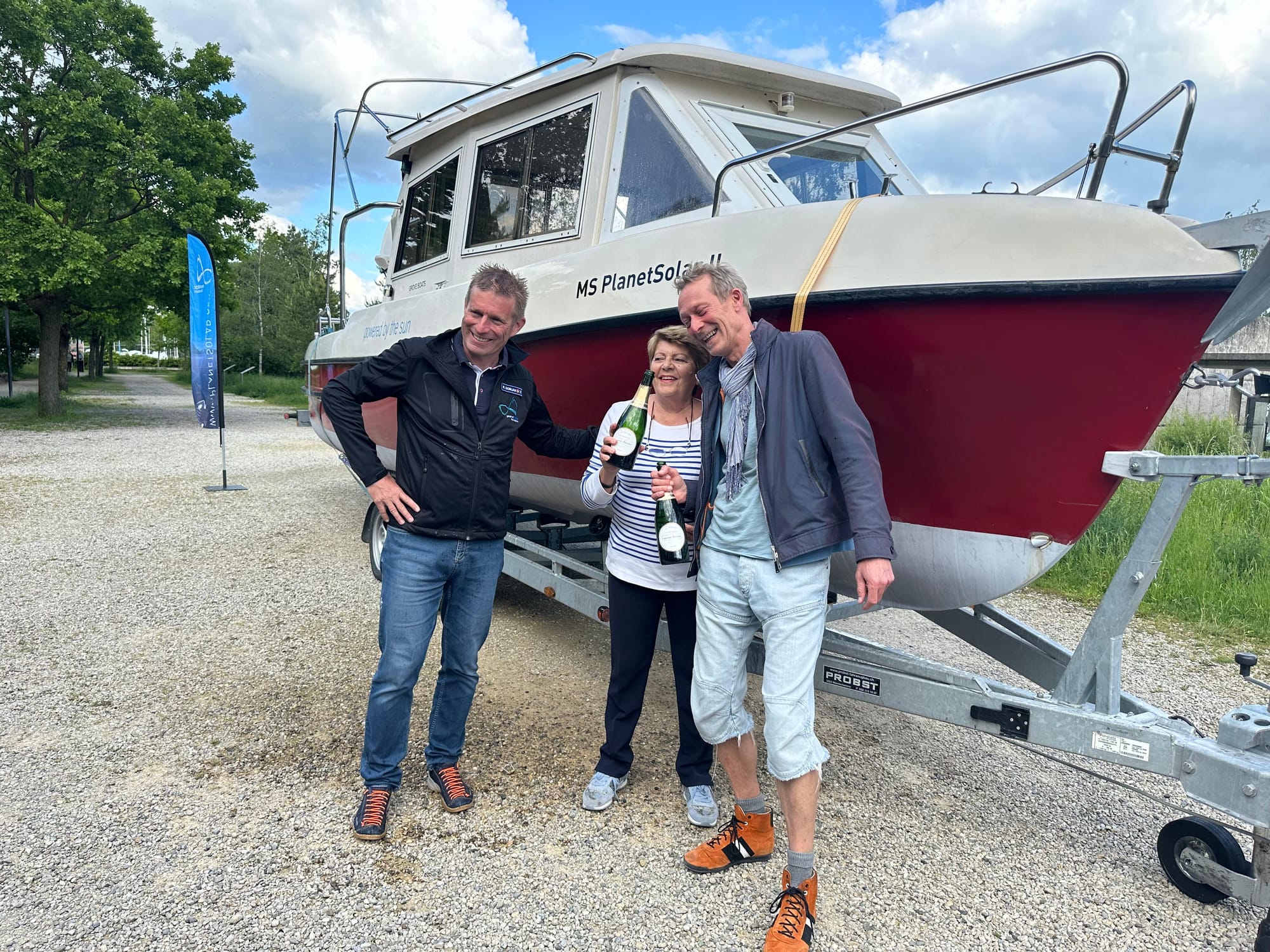
Explorer specializing in solar technologies, Raphaël Domjan experienced an exceptional year in 2025. As part of his SolarStratos project, his solar airplane, he began the year by breaking a world altitude record. A few months later, he completed a full circuit of Lake Titicaca — the highest navigable lake in the world, located at about 3,800 meters altitude — aboard a solar boat, as part of the PlanetSolar II expedition. These feats crown two decades of commitment to photovoltaics and the hope that this renewable energy source will allow humanity to gradually free itself from fossil-derived energies.
The potential of solar in transport, the role and reach of such feats, the place of exploration in human history, Switzerland’s positioning in cleantechs, the criticisms he faces — notably those accusing him of techno-solutionism — and the question of space as the next horizon: all these themes were discussed with the Swiss explorer. Interview
Let us begin with your most recent feat: your circuit of Lake Titicaca by solar boat…
Allow me a brief geographic reminder: that of the surface area of Lake Geneva. It is about 650 km², which makes it the largest lake in Western Europe certainly, but a “small basin” compared with Lake Titicaca and its 8,500 km². At the scale of the South American continent, it is a true inland sea.
Although everyone knows its name — often for amusing reasons — few people really grasp its size or, moreover, its particularities. Indeed, it is a lake without a major outlet, which means that it does not discharge into any river leading to the ocean. Water leaves mainly by evaporation and infiltration, which poses a considerable environmental problem: everything that is discharged there remains in the waters of Titicaca.
This region — which the Incas considered the birthplace of the Sun — has fascinated me since the early 1990s, when as a child I watched "The Mysterious Cities of Gold" on television. This cartoon is in fact linked to my initial interest in solar energy since it shows the "Solaris," the first solar boat, sailing, as well as the "Great Condor," the solar airplane, flying.
What were the objectives of this expedition?
It had a substantial scientific dimension. During my round-the-world trip by solar boat, carried out between 2010 and 2012, we observed that solar production was not maximal at the equator, but rather at our latitudes in summer, when days exceed twelve hours of sunshine. At Lake Titicaca, the objective was to exploit the exceptional sunlight linked to altitude, where we measured peaks close to 2,000 watts per square meter.
On this lake, which has more than 3,000 vessels, thermal engines lose about 40% of their efficiency due to altitude and lack of oxygen. They thus constitute a significant source of pollution. It was therefore relevant to demonstrate the potential of electric and solar navigation there.
Free and abundant — compared with expensive and scarce gasoline in Bolivia — solar energy appears all the more promising as most trips are tourist and last no more than twenty minutes, leaving plenty of time to recharge the batteries. Our model is therefore replicable, provided that existing boats are electrified rather than importing new ones.
Is this a simple prototype or, on the contrary, a solar vessel replicable on a larger scale?
Let’s be clear: for large ships, such as container ships or giant cruise liners, solar energy will not be sufficient. It is a matter of physics: when you increase the size of an object, its volume grows faster than its surface. Solar energy depends precisely on the available surface. At large scale, this constraint makes the model insufficient. On the other hand, for fishing boats, island shuttles, or diving vessels, between 65 and 80% of units could be electrified.
What notable progress has been made in solar energy since Planet Solar?
If we had to rebuild the same boat today, it would be profoundly different, mainly thanks to advances in batteries. At the time, to have about one megawatt-hour of capacity, we had to carry nearly 13 tonnes of lithium-ion batteries. Today, for an equivalent capacity, 3 to 4 tonnes would suffice.
Such a weight reduction changes everything: the boat's structure can be lightened, performance improved, and speed increased. With the same platform, instead of sailing at 5–6 knots as during the world tour, we could probably reach 8–9 knots.
But that is not the only change. When developing our solar boat, almost nothing existed on the market. We had to develop everything ourselves: propulsion systems, energy architecture, electronic management. That represented very high costs and required custom engineering. Solar panels did exist, admittedly, but electric motors adapted to a large ship were not yet available. We even used batteries from the aerospace sector.
Today, the situation is radically different. Many manufacturers offer complete and integrated solutions: marine electric motors, energy management systems, MPPT regulators, certified battery packs. Everything is now available “off the shelf”: components are guaranteed, certified and ready to be installed.
“At Lake Titicaca, the goal was to exploit the exceptional sunlight due to altitude, where we measured peaks close to 2,000 watts per square meter.” @Fondation PlanetSolar
Your other feat last year concerns SolarStratos, your solar airplane…
Regarding SolarStratos, we probably broke the altitude record, with a flight peaking at about 9,300 meters. I say “probably” because we are still awaiting official confirmation from the competent authorities to validate this feat. In any case, it is only a step since the ultimate objective remains to reach the stratosphere.
Why the stratosphere — and above all, to prove what there?
In reality, there is no major scientific finality — and that is precisely what makes the adventure interesting. Of course, we will carry scientific instruments on board to perform various measurements. But that is not the deeper reason for our approach. The main engine is the dream of flying — probably one of humanity’s oldest dreams.
Today, some discourses claim that tomorrow we will no longer be able to fly, because it will be complicated to decarbonize aviation. Movements like “Les Ailes de la Honte” in France and Switzerland go so far as to present flying as a moral wrong. These ideologues now assert that mobilizing energy for an activity that does not meet a primary need is no longer acceptable.
But if you push this reasoning to its end, why stop at aviation? Why not eliminate everything that exceeds strict vital needs? Take the example of operas in Switzerland: there are them in almost every major city, while a relatively small number of people attend them regularly. These buildings consume energy and require travel — sometimes by plane — for artists as well as the public. Their energy cost is considerable.
Following this logic, shouldn't we also standardize our housing, limit our lives to public health, food and reproduction? We would probably obtain an extremely frugal world… but profoundly impoverished. That is obviously not the vision I wish to defend for humanity. The ambition, with Planet Solar or SolarStratos, is to show that in the world of tomorrow we can continue to accomplish inspiring things — but with greater responsibility. Renouncing the dream cannot be the only response.
We will have to rethink our relationship to energy and more carefully measure the impact of our choices.
Shouldn't we set limits to our dreams based on planetary resources?
No, of course. We will have to rethink our relationship to energy and more carefully measure the impact of our choices. We should, for example, give up taking a plane to go to the other side of the world for a single day, then return as if nothing happened. The idea is not to give up all mobility, but to make it more coherent, more responsible and more conscious.
That is the paradox of some extreme environmentalist discourses: by wanting to ban everything, to stop everything, they sometimes produce the opposite effect. The world is evolving today in another direction. Young generations travel the most, fly the most and consume products from the other side of the world. Simply telling them “stop” does not work.
What is needed is to show them that another model is possible: continue to travel, discover, dream — but differently. Better organize journeys, reduce their frequency, extend stays and prioritize cleaner energy solutions. It is neither about denying planetary limits nor abandoning the dream, but about reconciling ambition and responsibility.
Think tank Ember showed earlier this year the growing role of solar in Europe. In your view, does the sun represent the energy resource of the future par excellence (far ahead of wind, nuclear, hydrogen…)?
The question is not whether to bet everything on solar or oppose it to other sources. The answer is clear: a diversified energy mix is essential. No single technology, taken in isolation, can meet all needs.
That said, solar today has an absolutely considerable potential. A study from the University of Gothenburg (dating from 2012) estimated its theoretical potential at about 600 TWh in continuous power, compared with about 2.4 TWh for wind, 12 TWh for geothermal, 1 TWh for hydro, and 5 to 7 TWh for biomass. Even if these figures should be updated, the order of magnitude shows how massive the solar potential is.
In Switzerland, solar represents about 15% of the annual electricity mix. But with what is called the “rule of five,” that means that in high summer at noon, solar can account for up to 75% of instantaneous production. Meanwhile, other production means — hydro, nuclear, thermal — continue to operate. We hesitate to stop them for economic or strategic reasons. The real issue is thus systemic.
On a solar boat, for example, there is no choice: one must smooth production to cover consumption twenty-four hours a day. The boat does not progress only at noon: we cook in the evening, we desalinate water at night. Energy is thus stored in batteries, and production and use are continuously balanced.
At the scale of a country, the logic should be comparable: adapt storage capacities, use hydro as seasonal reserve, turbine less in summer when solar is abundant, or conserve water for winter, when energy becomes scarcer and more expensive. The electrical grid is not the main problem: technically, it functions. The real subject lies in the organization of the market, economic incentives and the way peaks of production are valued — or penalized.
The problem of solar energy arises mainly during the famous production peaks in summer…
I repeat: we have the technical capacity to manage these peaks. I studied these issues at the École polytechnique fédérale de Lausanne (EPFL), and I can affirm that the electrical grid, as infrastructure, can be adapted. The real problem is not really technical; it is above all economic.
When, in high summer, solar production reaches its maximum and other production means — like nuclear or hydro — operate simultaneously, the market is in a surplus electricity situation. Prices can then become very low, even negative. This imbalance does not come from an inability of the grid to transport energy, but from a market system still poorly adapted to these new realities. The challenge is therefore to rethink the articulation between these different sources, rather than to slow the development of solar.
We must also adapt our habits to production capacities. If electricity is abundant during the day, particularly in summer, it becomes logical to concentrate certain consumptions then: charging electric vehicles, producing cold, thermal or chemical storage. With global warming, our needs will evolve. Today, in a dwelling, the majority of energy is still devoted to heating. But by 2050, the share for cooling could become dominant. We will then need more electricity in summer — precisely when solar produces the most.
Storage also plays a central role, and its cost is falling rapidly: in just a few years, battery prices have been divided by five. This evolution profoundly transforms prospects. It allows effective smoothing between production and consumption, at the scale of a building, a neighborhood, or even a country.
“In the long run, Switzerland could become both autonomous and CO₂ neutral, while remaining interconnected with its neighbors. Autonomy does not mean isolation.” @Fondation PlanetSolar
This figure can be impressive. Yet, spread over time, it becomes more understandable: if we consider that about one billion francs per month leaves the country to import fossil energies, then in 240 months — that is twenty years — the investment would be offset. It would even have a major economic impact. Even if solar panels are manufactured and imported from China, their installation, maintenance, grid adaptation and the development of storage capacities are carried out locally. That represents thousands of non-relocatable jobs.
In the long term, Switzerland could become both autonomous and CO₂ neutral, while remaining interconnected with its neighbors. Autonomy does not mean isolation. In a system dominated by renewables, intelligence is precisely to remain connected. When there is a solar surplus in Switzerland but a deficit in France, it makes sense to export. Conversely, when another country has an excess, it is pertinent to benefit from it. An interconnected grid is more efficient than a juxtaposition of closed national systems.
Does the current inertia therefore seem even more incomprehensible to you?
Put yourself for a moment in the place of a future historian. I am convinced that they will have difficulty understanding such a lack of action in Switzerland. They will look at our time and say: they knew. They did not have, or had very little, oil on their territory. They already had the necessary technologies. Serious scenarios, developed by competent experts, showed that the energy transition was technically feasible and financially bearable.
They will also note that, to save a bank, we were able to mobilize some 160 billion francs in a few days. In contrast, for a slightly larger amount — which would have allowed Switzerland to reach energy autonomy, reduce its geopolitical dependence and produce cheaper energy in the long term —, that was Mission Impossible.
One must however recognize that the situation was not always so favorable. When the first solar installations appeared, the kilowatt-hour cost nearly one franc. Even I would never have imagined such a rapid fall in prices. Today, in large solar plants, the cost can drop below two cents per kilowatt-hour, in optimal conditions. Some experts even estimate that it could reach one cent in the coming years. At that level, energy becomes almost free to produce.
A kilowatt-hour represents, in physical terms, the capacity to lift one ton of water about 350 meters. Obtaining it for one cent is almost unimaginable in historical terms. Of course, the final price for the consumer will never be one cent, because storage, grid and balancing with other sources must be integrated. But the trend is clear: the marginal production cost of solar is collapsing.
The question is no longer whether the transition is possible, but whether we will have the lucidity and the will to accomplish it in time.
From what you say, are we close to accessing an almost unlimited energy?
At the global scale, installations are multiplying at an unprecedented pace. The dynamic is such that some indeed speak of the advent of an almost unlimited energy. In reality, thermonuclear fusion already works: it is in the sky, it is the Sun. We now know how to capture that energy at an extremely low cost.
There remains an almost philosophical question: what will happen if energy becomes abundant and very cheap? It would be a major economic and societal revolution. The issue is therefore not only technical or financial; it is also political and civilizational. The question is no longer whether the transition is possible, but whether we will have the lucidity and the will to accomplish it in time.
Do you think Switzerland is up to the challenges posed by the energy transition?
Today, in Switzerland as in the rest of Europe, we are paralyzed. Every project provokes opposition: solar panels contested for landscape reasons, dams attacked for environmental motives, biomass installations blocked in court due to local nuisances. By wanting to regulate everything, anticipate everything, make everything perfect, we end up doing nothing.
The history of civilizations also shows that excessive complexity can become a factor of decline. The Roman Empire, for example, developed an administrative and legal system of remarkable sophistication, which ultimately became too heavy to steer and contributed to its fall. When a system becomes too complex, it loses agility and adaptability.
Major transformations have never been achieved with excessive caution. Take the example of the Trente Glorieuses, a period during which Switzerland launched gigantic projects like the Grande-Dixence Dam. At the time, there were not even modern roads to reach some valleys. Villages still lived by kerosene lamp. And yet, the country invested, took risks, mobilized considerable human and financial resources. It was a pioneering spirit: build, move forward, transform.
We would need to regain that state of mind today, accepting that not everything will be optimal from the start, that some decisions will have to be adjusted, but that it is essential to move forward despite uncertainty.
I do not recognize myself in an ideological or dogmatic ecology. I define myself more as a utilitarian and pragmatic environmentalist.
What do you answer those who criticize the carbon footprint of your adventures and also accuse you of techno-solutionism?
I answer them that these criticisms are not justified. I claim to be a “techno-humanist,” for whom the question of limits is central. Can one be an explorer and an environmentalist at the same time? It all depends on what one puts behind the word “environmentalist.” For my part, I do not identify with an ideological or dogmatic ecology. I define myself more as a utilitarian and pragmatic environmentalist. What interests me are concrete, effective and measurable solutions — not postures.
Humanity permanently engages in activities that do not meet primary needs: competitions, records, feats, entertainment. Social networks themselves mobilize a considerable amount of energy for often trivial uses, whereas exploration, on the contrary, has always been a powerful engine of inspiration.
The challenge is to give my adventures a meaning consistent with contemporary challenges. That is why we favor projects that carry a clear philosophy: flying with a solar airplane, circling Lake Titicaca or demonstrating the performance of an electric vehicle.
By opposing it to a thermal-engine helicopter…
We live in an age where buzz matters. And yes, this operation generated it: nearly ten million views, mainly among a young audience. But reducing this to a mere publicity operation would be a mistake. The usefulness exists precisely because the message touched an audience who otherwise might not have been interested in these issues.
Reading the comments, one notes the surprise of many young people: “An electric car can go faster than a helicopter?” Many still associate the electric car with something slow, boring, restrictive — even a symbol of “anti-pleasure.” Yet in the collective imagination, especially among young people, the car remains associated with power, performance and dream. On social networks, it is still noisy large-displacement thermal vehicles that fascinate.
One can take a philosophical stance and argue that we must transform this imaginary, get out of the cult of speed and reduce consumption. The debate is legitimate. But this is not the fight I lead. My objective is clear and pragmatic: decarbonize and promote solar energy. The rest — degrowth or questioning the desire for power — belongs to another field, more philosophical or societal.
If energy becomes extremely cheap, we will simply be likely to consume more.
After twenty years fighting for solar energy, how do you observe the current mindset?
In the early 2000s, when I embarked on these projects, I imagined the 2020–2030 years as a period of profound transformation: rapid reduction of CO₂ emissions, collective awareness, rarer but more intense travels, more authentic relationships, more thoughtful consumption. I thought that the energy transition would lead to a true cultural transition.
What I observe today, however, is that we remain in a deeply capitalist system, capable of absorbing almost any innovation without transforming itself in depth. If energy becomes extremely cheap, we are simply likely to consume more. More abundant energy could mean more production, more mobility, more consumption — without real cultural change. I therefore fear that I was clearly mistaken.
Similarly to projects like yours, does Switzerland have a role to play in cleantechs, even an international reputation to consolidate?
Yes, clearly. We have unique assets: world-class universities, a solid industrial fabric, political stability and a dense innovation ecosystem. There are about 600 startups active in clean technologies in Switzerland. This is not marginal; it is strategic.
I have in mind the example of Ecorobotix. This company developed an ultra-targeted spraying technology that can reduce pesticide and phytosanitary product usage in agriculture by up to twenty times. Concretely, its robots identify weeds plant by plant and apply treatment only where strictly necessary.
If this company crosses the threshold of sustainable profitability, it could become one of the rare new Swiss industrial companies to reach a valuation of one billion francs. A true unicorn — but an industrial unicorn, anchored in the real economy. Provided we assume it, are proud of it, communicate about it and, above all, mobilize the means necessary to accompany its growth.
To conclude, what will your next challenge be?
Regarding SolarStratos, the next step will be to reach the stratosphere. But this still implies overcoming several technical challenges, notably at the battery level, while finding new supporters for an adventure that started a decade earlier. That is why we will continue to organize remarkable events. One upcoming project could consist of inviting a major personality on board — ideally a Hollywood star — and giving them a flight in a solar airplane.
“Today, if I had to go into space, it would certainly not be for tourism. It would be only as part of a mission with meaning, aligned with my current commitment.” @Fondation PlanetSolar
What about space, which probably tickles your explorer's soul?
Regarding space, I have a double view on this question. On the one hand, there is a deeply anthropological dimension in this desire for conquest. Homo sapiens is a species of hunter-gatherers. We have always moved forward, explored, crossed borders. Exploration is part of our DNA. Some scientists — and even Albert Einstein, in his way — suggested that a totally frozen, entirely sedentary humanity could end up declining.
There is something vital in movement, curiosity, in the conquest of new horizons. My teenage dream was, moreover, to become an astronaut. At that time, however, I had not yet developed the climatic sensitivity that drives me today. Space represented the ultimate adventure, absolute exploration, human surpassing.
This leads me to my second viewpoint. When we observe history, we see that exploration has not always been a simple surge of curiosity; it has sometimes resulted from environmental pressure or local overexploitation. The example of Easter Island is particularly striking. Its inhabitants would have overexploited their forest resources to the point of no longer being able to build canoes. Once isolated, unable to leave, the system eventually collapsed. It is a brutal lesson: if you destroy your environment and have no way out, you are trapped.
So yes, space exploration is fascinating. Yes, it stimulates innovation, opens perspectives and makes people dream. But today, we have an immediate responsibility: preserve Earth, our only habitable base camp. Before investing billions to go to Mars or beyond, we should first mobilize our technical, financial and intellectual resources to decarbonize our economy, restore our ecosystems and stabilize the climate. Only then can exploration continue — not as a headlong flight, but as a controlled extension.
An exploration you would like to take part in?
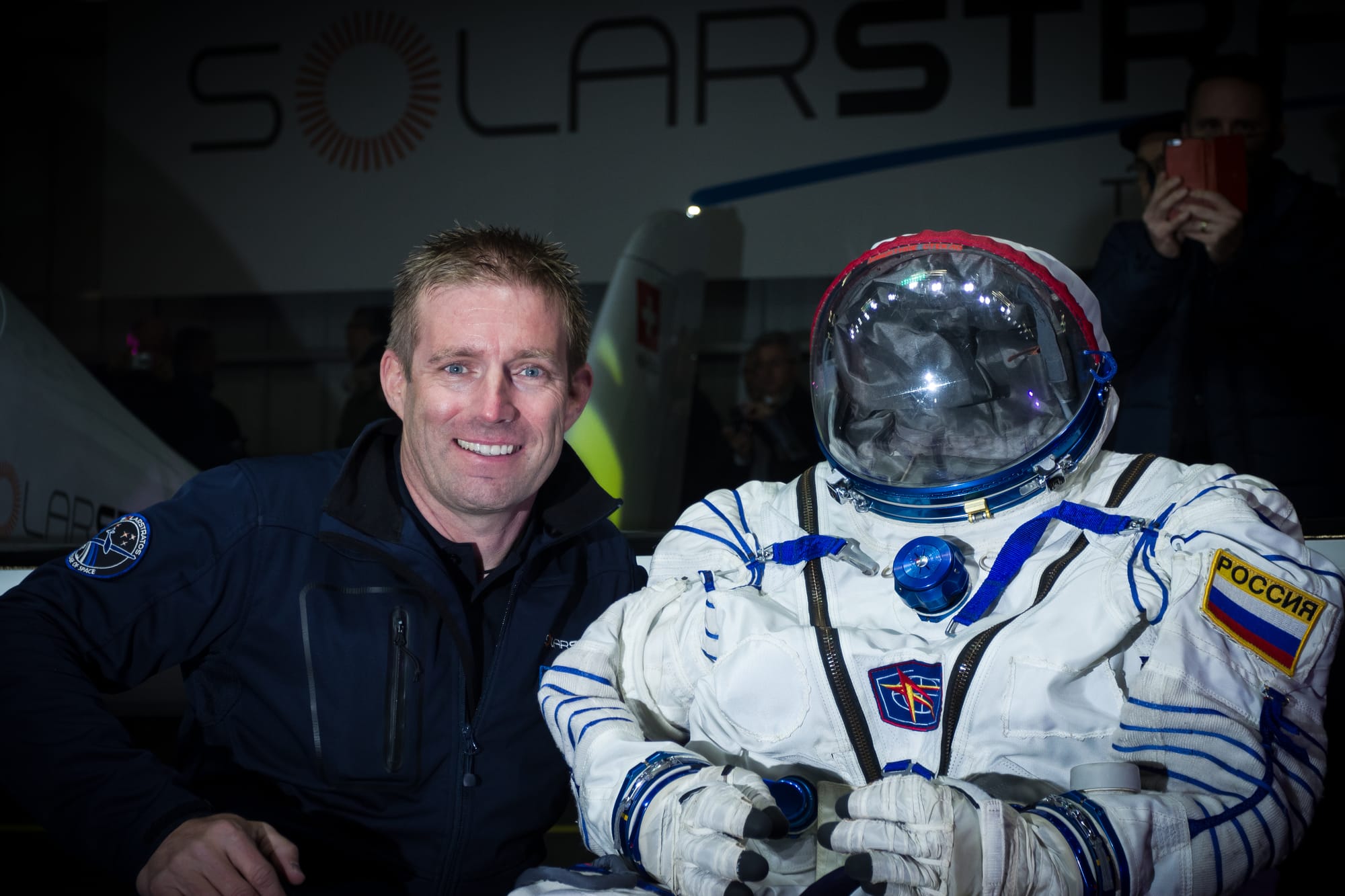
Today, if I had to go into space, it would certainly not be for tourism. It would be only as part of a mission with meaning, aligned with my current commitment — for example to develop or test a solar technology likely to have a concrete impact on Earth. But, to be honest, I do not see at this stage a space mission that corresponds to this logic.
This article has been automatically translated using AI. If you notice any errors, please don't hesitate to contact us.
What happens when insurance companies decide to withdraw and no longer cover the most at-risk areas? That is the theme at the heart of the new report by the environmental NGO, but also of "Sigma", that of the Swiss Re Institute. Analysis
"Flexibility solutions are now essential. However, they face a structural difficulty: their costs are decreasing faster than market rules evolve," explains Xavier Blot, associate professor at emlyon business school.
By naming their first edition "Wind farms are taking shape", the industry's players want to show a certain optimism despite a context that remains complicated for the sector. A look by Benoist Guillard, president of the Groupe romand pour l’énergie éolienne (GREE).
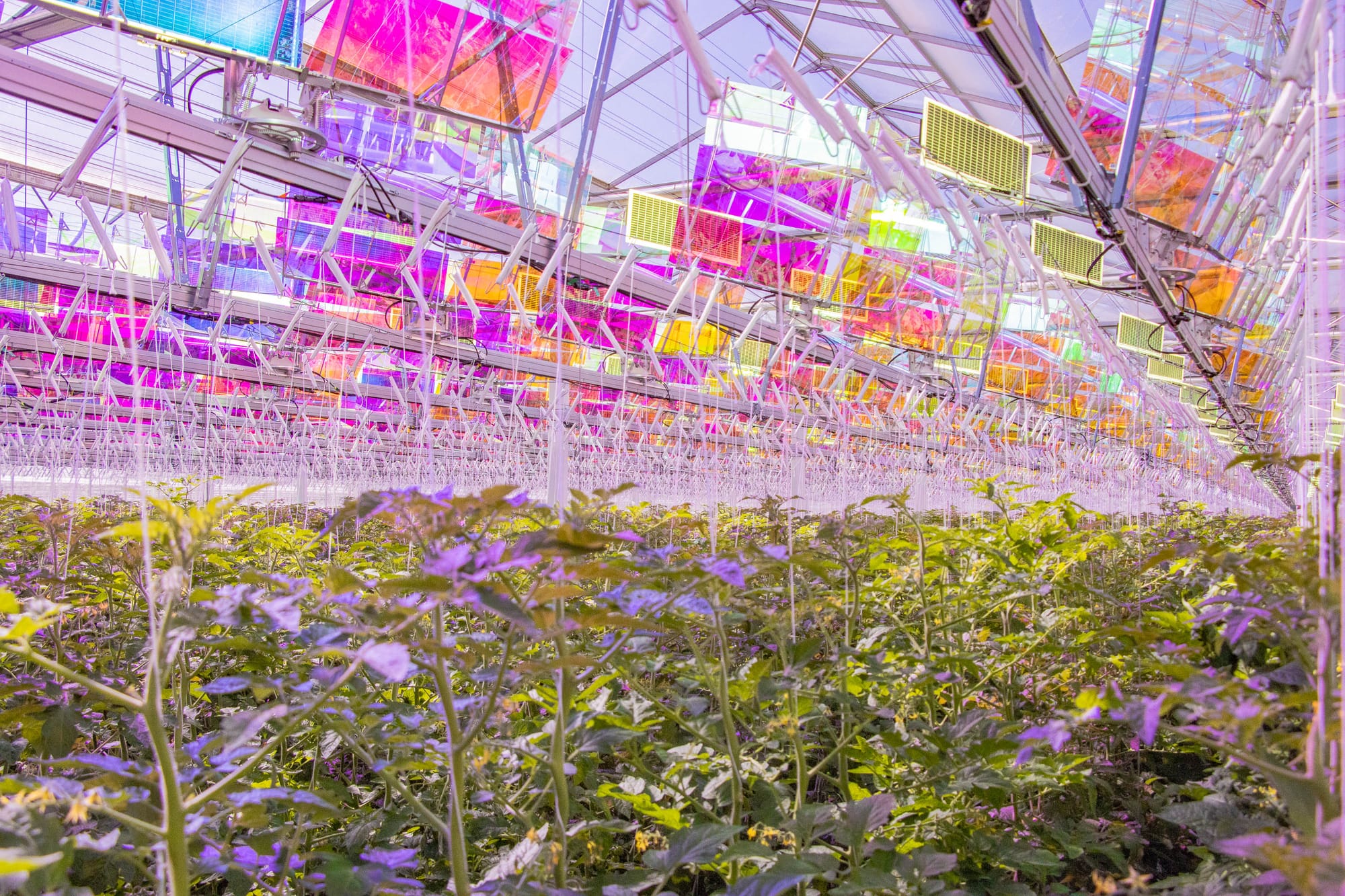
Since its founding in 2021, the young startup has made it its mission to find a good compromise between energy production and plant growth. The solution is called "spectral filtering".