"Members of the 'Swiss Electricity Agreement Alliance' will closely monitor parliamentary debates and provide factual information about the agreement," summarizes Annalisa Job, communications manager for the Association of Swiss Electricity Companies (AES).
"By constantly looking at the surfaces that could still accommodate solar installations, we may be overlooking one possibility: roofs that are already equipped," points out Alban Bitz, director of SI-REN.
The ambition to continue the development of green, reliable and cost-effective energy sources gave rise to new and numerous discussions at the seventh edition of Building Bridges in Geneva.
Coal, the big winner of the blockade of the Strait of Hormuz
Faced with soaring gas prices, several countries — including China and India — have substituted coal for gas to produce their electricity, as highlighted by the latest semiannual report of the International Energy Agency (IEA).
Faced with a surge in LNG prices, several countries have therefore turned to coal at the expense of gas to produce their electricity. @Getty images/CanvaPro
Coal! It’s one of those materials we would rather not hear much about these days. In a world where the urgent priority is to massively reduce our carbon emissions into the atmosphere, phasing out coal should logically seem obvious. Among fossil fuels, this mineral is indeed the one that emits the most CO₂ to produce electricity.
But while the trajectory appears obvious, reality remains far from the goals. “The Strait of Hormuz crisis caused a surge in LNG prices, leading to higher production costs for gas-fired power plants and, from March onwards, an increase in wholesale electricity prices in several regions of the world,” reads the latest report from the International Energy Agency (IEA) devoted to electricity. A situation that benefits coal, which has experienced a real resurgence in several regions of the world in recent months, notably in China and India.
1️⃣
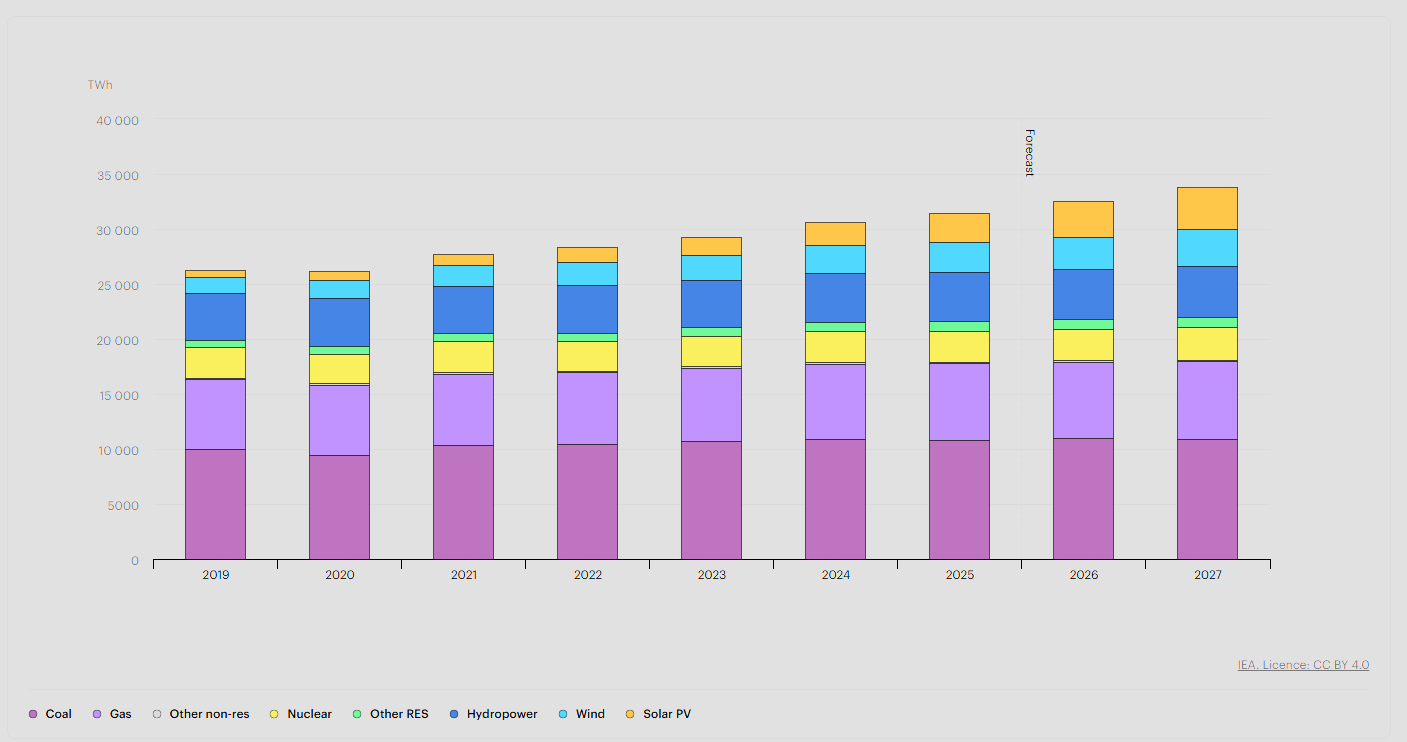
Acceleration of electricity demand. Global consumption is expected to continue growing, with an increase of 3.6% in 2026 and then 3.8% in 2027, compared with 3% in 2025. It would thus reach about 30,700 TWh in 2027, compared with 28,600 TWh in 2025. This acceleration is structural: industrial development, electrification of transport and heating, increased use of air conditioning, multiplication of electrical appliances and, above all, the boom in data centers.
China (+5.5% in 2026) and India (+7%) are expected to remain the main drivers of this rise in electricity needs. On the side of Western economies, demand should also grow at a sustained pace, both in the United States and in Europe, with an increase of nearly 2% this year in both regions.
Spectacular rise of renewables. The year 2026 marks a historic turning point: renewable electricity generation is expected to exceed that from coal, after having almost equaled it in 2025. It would increase by more than 8% this year, while its share in the global power mix would rise from 33% in 2025 to 37% in 2027. Solar plays a decisive role in this progress: its generation is expected to increase by about 600 TWh in 2026, which would allow it to surpass wind power and become the second renewable source of electricity, behind hydroelectricity.
A few days ago, in a new analysis, the Energy Foundation precisely placed Switzerland among the most advanced European countries in terms of renewable electricity production and degree of electrification. It was thus ranked fifth in 2025, behind several Nordic countries and Austria.
An important caveat is nevertheless required: a large part of this success relies on one particular resource, hydroelectricity, which represents more than half of the country's electricity generation. In solar and, above all, in wind, the room for progress therefore remains significant. As the experts of the Energy Foundation remind us, it will be “necessary to act at all levels to fully decarbonize energy supply.”
Source: Energy Foundation
3️⃣
Coal's resilience. The crisis in the Middle East and disruptions in the Strait of Hormuz temporarily removed nearly 20% of the world's LNG supply from the market, causing a sharp rise in gas prices in Europe and Asia. Faced with this surge, several countries therefore turned to coal at the expense of gas to produce their electricity.
In China in particular, coal-fired electricity generation rebounded by about 3% in the first half, despite an increase of more than 20% in solar generation. The same trend is seen in India, where coal-based electricity generation increased by 3.5% in the first half of 2026, after an unusual decline in 2025, in a context marked by an early monsoon and a strong increase in renewables.
The IEA thus highlights a paradox: “deploying ever more renewable capacity is not enough.” Network congestions and curtailment of production can prevent these new capacities from fully translating into a reduction in coal use.
4️⃣
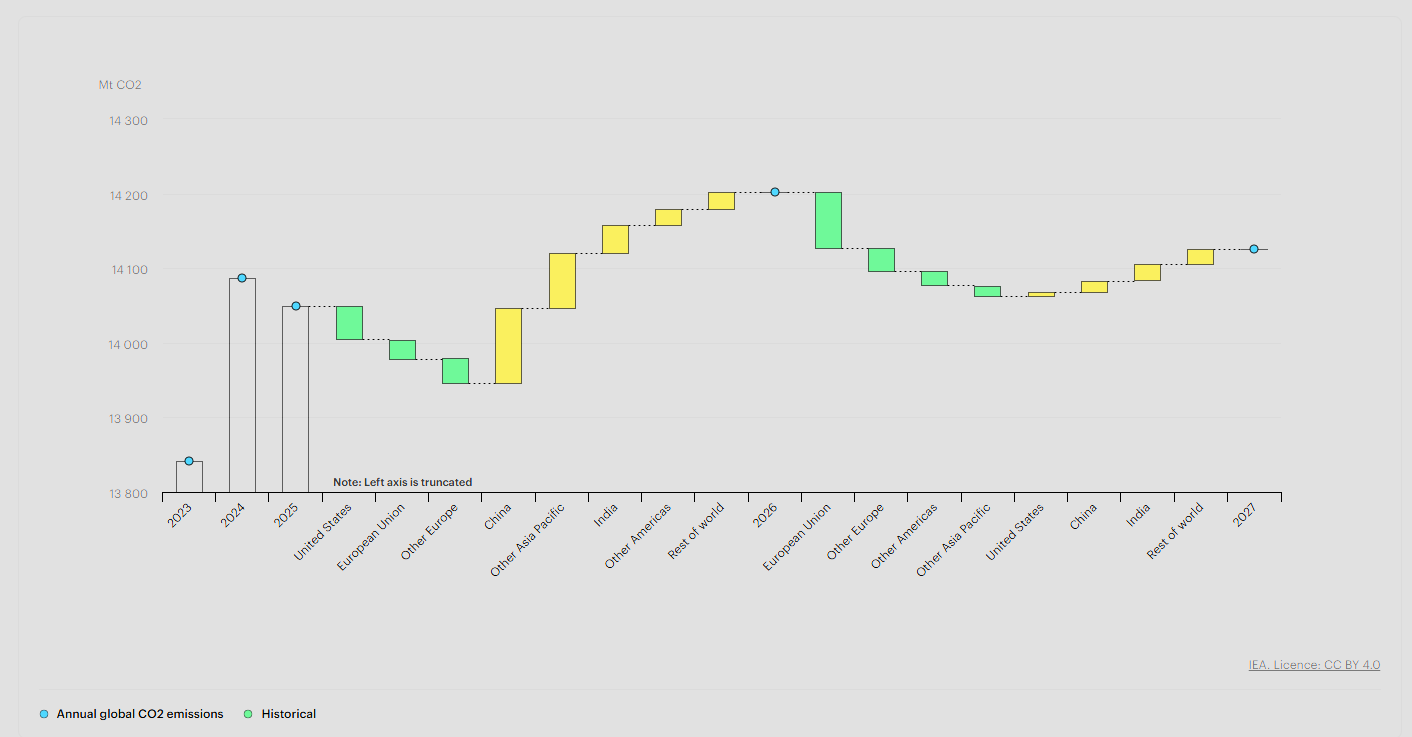
New record in carbon emissions. Despite the historic shift toward renewables, global CO₂ emissions from electricity generation are expected to increase by more than 1% in 2026, after having almost stagnated in 2025. The rise in demand, the comeback of coal in certain regions and weather conditions favoring the use of fossil fuels explain this increase.
Emissions from the power sector should thus reach a new global peak this year. The International Energy Agency nevertheless forecasts a stabilization from 2027, when the growth of renewables, nuclear and gas should absorb the rise in demand while reducing reliance on coal.
The imperative of flexibility. The rise of solar and wind is causing increasingly dramatic price swings within a single day. In Spain, wholesale prices were negative for 17% of hours in the first half of 2026, compared with 10% a year earlier. During the European heat waves in June, the gap between the very low mid-day prices and the evening peaks even reached $600/MWh on some markets.
For IEA experts, “these episodes generally indicate a lack of system flexibility, related to technical, regulatory or contractual constraints.” The next stage of the electricity transition will therefore no longer consist solely of installing ever more renewable capacity, but also of adapting networks and developing storage solutions, demand-side management and other sources of flexibility. The objective: to better align production and consumption over time.
This article has been automatically translated using AI. If you notice any errors, please don't hesitate to contact us.
"Members of the 'Swiss Electricity Agreement Alliance' will closely monitor parliamentary debates and provide factual information about the agreement," summarizes Annalisa Job, communications manager for the Association of Swiss Electricity Companies (AES).
"By constantly looking at the surfaces that could still accommodate solar installations, we may be overlooking one possibility: roofs that are already equipped," points out Alban Bitz, director of SI-REN.
The ambition to continue the development of green, reliable and cost-effective energy sources gave rise to new and numerous discussions at the seventh edition of Building Bridges in Geneva.