"While our economic systems are remarkably sophisticated when it comes to measuring certain forms of value, that generated by a healthy ecosystem remains largely absent from ordinary mechanisms," regrets David French, CEO of My Drop In The Oceans.
Inspired by the Spanish example, a recent study by HES-SO Valais has sought to assess the impact of new nuclear capacities in an electricity market with a high share of renewables.
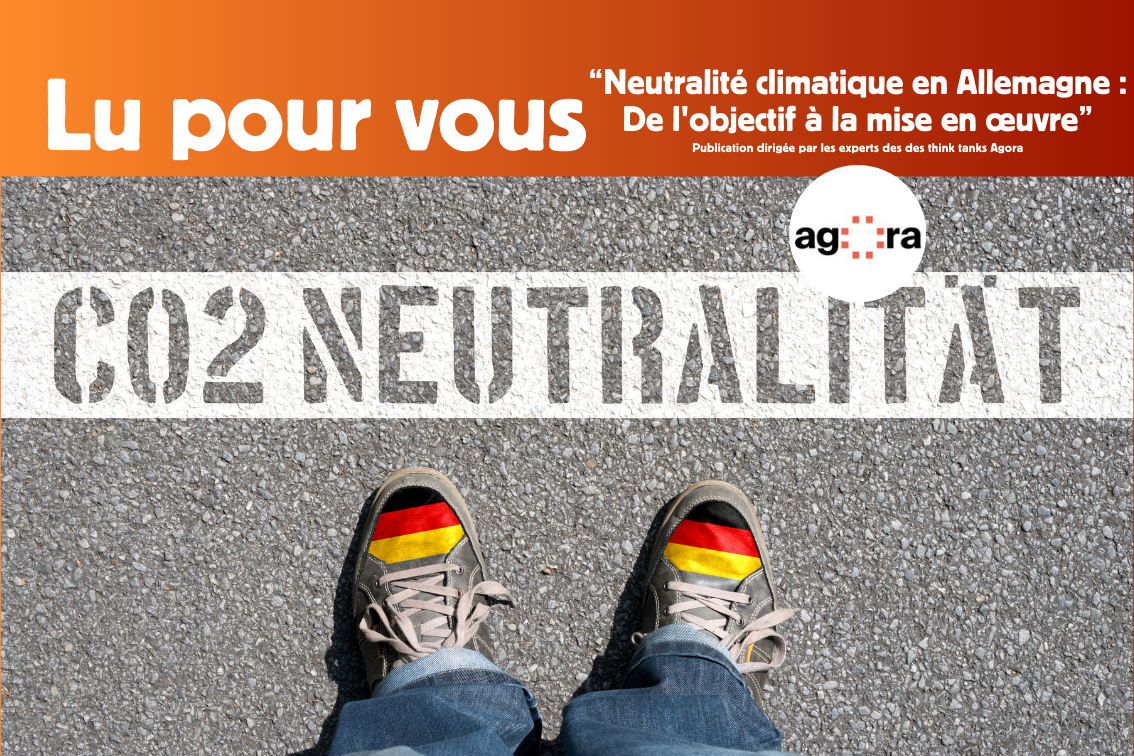
Germany has committed to being climate neutral by 2045. Despite some early successes such as the development of renewable energies, the challenges remain colossal to reach this goal. A new study carried out by the Agora think tanks presents a whole series of measures aimed at enabling the leading European power to reach its goal.
Using scenario modeling, Agora's experts provide for the first time a detailed calculation of financing needs for each sector as well as the means to make these investments not only profitable but also socially fair. "The path to climate neutrality will require a collective effort of society," however notes Simon Müller, director of Agora Energiewende, adding that all sectors will eventually benefit.
Let's start with the issue of mobility and its necessary transformation. "Investment incentives to switch to electric powertrains will be essential for the competitiveness of the German automotive industry," recalls Dr Wiebke Zimmer, deputy director of Agora Verkehrswende. To succeed in this mobility transformation, the scenario recommends a balanced and socially fair tax reform, notably through taxation aligned with CO₂ emissions. Contrary to current ideas, the think tank believes that instead of "raising tariffs on electric cars imported from China, the EU and the German industry should prioritize cooperation with Chinese companies."
2️⃣
Among other measures mentioned, unsurprisingly the issue of money arises. To remain competitive and regain a leading position in the technologies of the future, Germany will have to invest. And massively, since Agora's experts speak of an annual need equivalent to 11% of gross domestic product (GDP) until 2045. Important clarification: the majority of these funds go beyond the climate issue alone. According to Agora, the additional investments required for climate protection from 2025 to 2045 would amount to 3% of GDP, i.e. 147 billion euros per year (three quarters of which would be borne by the private sector).
3️⃣
The path toward decarbonized electricity looks inevitable. The good news is that the study shows that renewable electricity will be affordable economically, despite the necessary costs of expanding and adapting grids in Germany. "In our scenario, electricity will not become more expensive, even though consumption will increase sharply," said Simon Müller, director of Agora Energiewende. At the same time, Germany's dependence on energy imports will decrease by nearly 85%.
4️⃣
To mobilize the necessary investments, Agora's study recommends a combination of complementary policy instruments. Price-based incentives, such as CO₂ pricing, will make fossil fuels more expensive and climate-friendly technologies more attractive. Market regulation also allows limiting harmful technologies and supporting climate-neutral technologies. But these two solutions alone will be insufficient, Agora's experts believe. "To enable households and businesses without sufficient financial means to switch to carbon-neutral alternatives, financial support, in the form of subsidies or low-interest financing, will be necessary."
"The path laid out will certainly not become reality in all its details, conclude the authors of the study. But the study offers a coherent picture of the future and can thus create a basis for the necessary, solution-oriented discussion."
This article has been automatically translated using AI. If you notice any errors, please don't hesitate to contact us.
"While our economic systems are remarkably sophisticated when it comes to measuring certain forms of value, that generated by a healthy ecosystem remains largely absent from ordinary mechanisms," regrets David French, CEO of My Drop In The Oceans.
Inspired by the Spanish example, a recent study by HES-SO Valais has sought to assess the impact of new nuclear capacities in an electricity market with a high share of renewables.
New subsidiary of the AquaNest Group, based at the Daval Ecopark in Sierre, RemeO aims to become the reference partner in Switzerland for public authorities, industrial companies and managers of contaminated sites.