"One should not expect the energy transition to progress in a linear way"
Interview with Mélanie Beyeler, Global Head of Sustainable Investing at EFG.
Since 2020, the Swiss start-up has pursued a clear ambition: to transform passenger transport on the water through a new generation of foils. Behind this technology lies an enticing promise of fast, quiet, comfortable, and electric vessels.
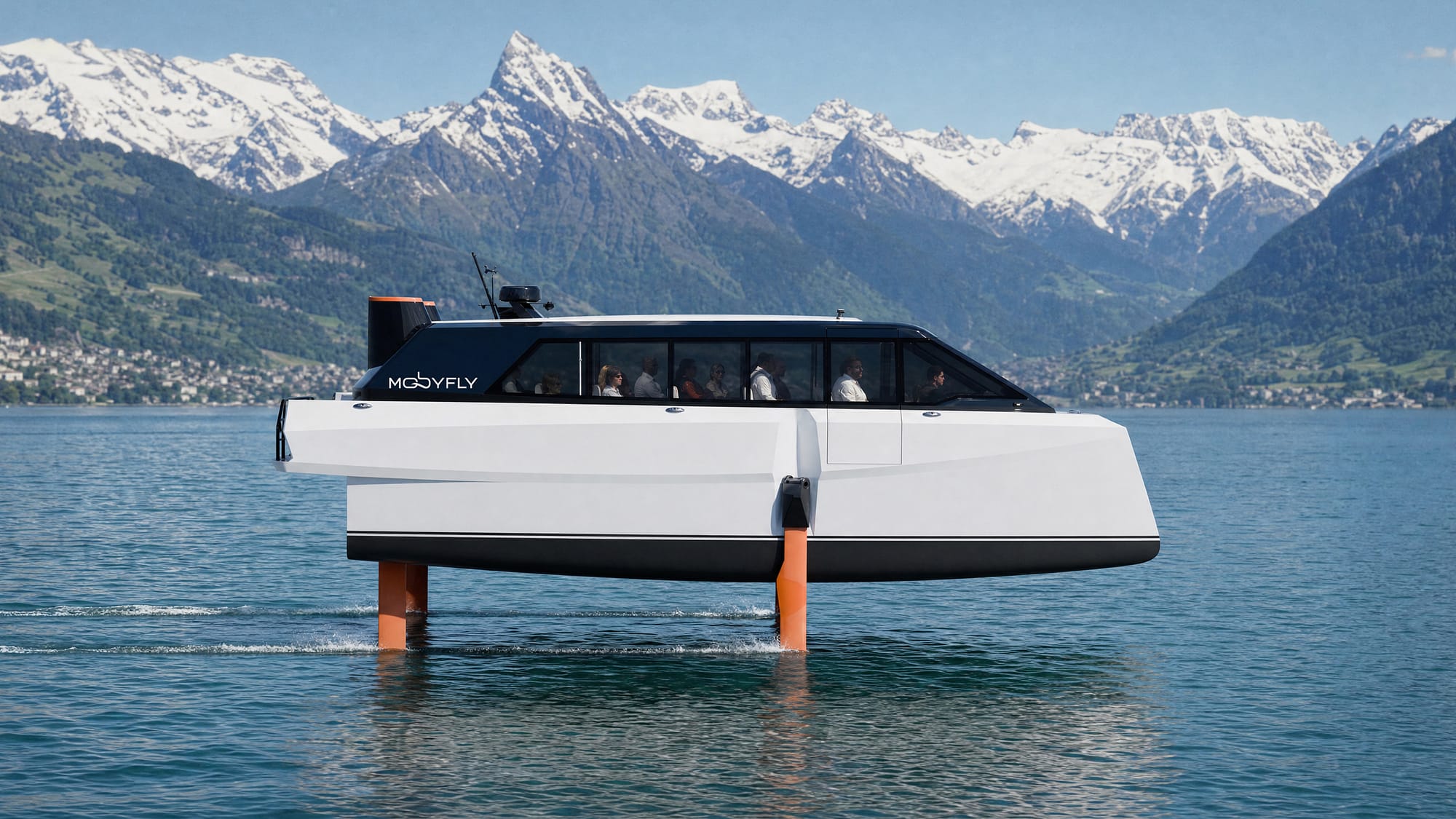
Imagine the scene: a multitude of shuttles cutting through the waters to connect the various ports of Lake Geneva. Able to carry up to 300 passengers, MobyFly's could well revolutionize regional mobility on the lake. "Studies are currently being conducted with the Swiss and French authorities to assess the potential of new fast shuttle lines," says Sue Putallaz, CEO of a young startup she co-founded with Anders Bringdal, Thomas Putallaz and Ricardo Bencatel.
With travel times potentially cut in half, the solution developed by MobyFly appears particularly relevant in the Upper Lake region, on the Chablais side, given the current shortage of public transport and frequently congested road arteries. "Our goal is not to replace rail or road, but to complement existing infrastructure with a solution that is faster to implement and less costly than a new rail or highway project," assures the entrepreneur.
The market targeted by the startup is furthermore far from being limited to the borders of Lake Geneva. More than two billion people use maritime or river transport each year, and countries like Norway or Japan have big ambitions in the field of "fast ferries." The opportunities for the young Swiss company are therefore potentially enormous. They in any case far exceed the current production capacities of the three most advanced players in the field of electric foiling shuttles: Candela in Sweden, Artemis in the United Kingdom and MobyFly in Switzerland.
The startup's story begins in 2020 with an ambitious vision: to demonstrate that a boat can combine speed and energy efficiency without compromising on comfort. After six years of work, the young company now has a revolutionary prototype. Behind its sleek, modern design, its shuttle stands out notably for its dynamic foils, a technology developed in-house by MobyFly.
"Where traditional fast boats often cause jolts, passengers here describe a 'flying carpet' sensation," explains Sue Putallaz, CEO of MobyFly.
These "foils," placed at the front, are fully retractable and compatible with all types of ports, regardless of water depth. Once in motion, thanks to these submerged wings electronically controlled, the shuttle rises above the surface and eliminates a large part of the friction with the water. "By producing very little wake, the boat consumes up to 80% less energy than a conventional vessel of comparable size while increasing its speed," explains Sue Putallaz.
This near absence of contact with the water surface also greatly reduces noise pollution and noticeably improves onboard comfort. "Where traditional fast boats often cause jolts, passengers here describe a "flying carpet" sensation," details the CEO of MobyFly. Whether for public transport or for certain tourist operators — another market segment targeted by the startup — this combination of speed and comfort constitutes a major competitive advantage.
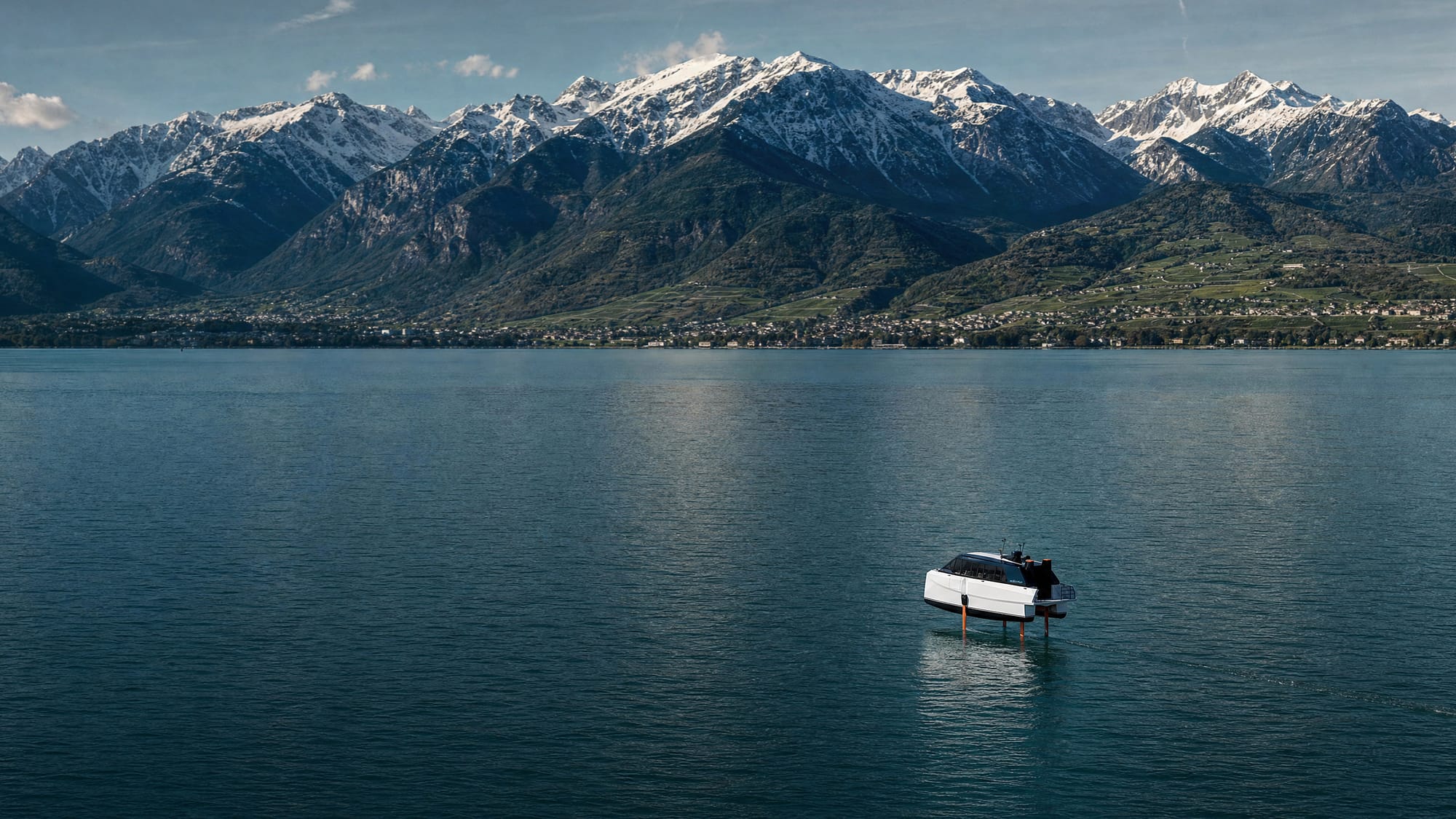
To achieve these performances, MobyFly had to design its own boat. The founders quickly realized that no existing hull on the market would allow them to fully exploit their technology. The company therefore chose to develop a model specifically optimized to be light, aerodynamic and perfectly suited to its foils. "If we had installed our technology on a non-optimized boat, we would never have achieved the same energy gains," assures Sue Putallaz.
That said, MobyFly is not a shipbuilder in the classic sense. Its core business lies in the development of the foils, the electric propulsion chain and the control software. The company relies on an international industrial network for manufacturing. The hulls are produced in Portugal, while the engines and propulsion chain are developed in Switzerland. The proprietary software, for its part, is designed between Switzerland and Portugal. The foils are designed by MobyFly's teams, then manufactured by specialized partners before being integrated into the whole.
Today, the company employs 26 employees spread across Switzerland, France and Portugal. This organization allows it to combine industrial know-how, software expertise and proximity to its future customers. After six years of research and development, the startup is entering a new phase of its development: the transition from prototype to a marketable version.
A first boat could begin to ply Lake Geneva as early as next year. However it will first be tested in Portugal, where it is assembled. "Even if our foils have already been tried on the waters of Lake Geneva, tests in ocean conditions allow us to validate their behavior in situations more demanding than those encountered on lakes," explains the CEO of MobyFly.
While foils have existed for several decades, those developed by MobyFly have little in common with historical models. The latter have given way to dynamic systems electronically controlled, capable of continuously adjusting their behavior to navigation conditions. This onboard intelligence today constitutes one of the company's main technological advantages.
"Investors are today much more reserved towards cleantech, even when the business models are solid," laments Sue Putallaz.
As is often the case for a startup, MobyFly's journey has been far from smooth. The company has had to deal with political reversals in recent years as well as the reallocation of capital toward other sectors considered more attractive, such as the current enthusiasm for large language models (LLMs) and artificial intelligence. "Investors are today much more reserved towards cleantech, even when the business models are solid," laments Sue Putallaz.
This reality did not, however, prevent the startup from completing, in 2025, a fundraising of 10.1 million francs from several investors, including a significant contribution from Crédit Mutuel Impact. "This investment fits perfectly within the framework of our commitment to promote efficient and scalable solutions in the transport sector. We are proud to support MobyFly in the commercialization of its zero-emission transport technology," said Sabine Schimel, CEO of Crédit Mutuel Impact, in a press release.
The outbreak of the war in Ukraine in 2022, followed by the turbulence around the Strait of Hormuz, have reminded us of our persistent dependence on fossil fuels. Events that play in MobyFly's favor, even if the environmental argument seems to carry little weight in the balance. "Maritime operators primarily look at return on investment. Long before environmental considerations, what interests them are energy savings, reduced operating costs and the quality of service offered to passengers," explains the entrepreneur.
The flip side of the current geopolitical instability lies in global supply chains. Some electronic components come exclusively from Asia and are directly affected by geopolitical tensions as well as international logistical difficulties. The company indicates that it has already accumulated several weeks of delay on the delivery of certain critical components and is actively working with its partners to secure its supplies.
For the months ahead, MobyFly will have to face another major challenge: the certification of its boat. No electric dynamic-foil model intended for commercial passenger transport has yet obtained all the necessary approvals. The company is therefore engaged in a pioneering process that could allow it to become the first company in the world to certify this type of vessel.
On this issue, Sue Putallaz regrets that approval procedures in Switzerland do not allow for certification before 2027. According to her, these administrative procedures are less complex and less time-consuming in France, where they rely in particular on independent certification bodies such as Bureau Veritas. In this context, MobyFly's first commercial boat could be certified under the French flag rather than the Swiss.
This article has been automatically translated using AI. If you notice any errors, please don't hesitate to contact us.

Interview with Mélanie Beyeler, Global Head of Sustainable Investing at EFG.

A recent Harvard study highlights close links between the rise of data centers and clean energy. Behind the algorithms lies a purely material reality: a demand for electricity that is skyrocketing and disrupting grids and the energy transition.

"While nuclear power is necessarily part of the long term, photovoltaics and batteries fall into a different timescale: that of the needs we must meet today," says Richard Mesple, CEO of Local Energy.

Interview with Marie-Laure Chapatte, CSR Manager at the Neuchâtel Cantonal Bank (BCN).
Already a member or subscriber? Simply enter your email address to receive instant access to the article. Enjoy!