"We no longer have any choice but to adapt to climate change"
Interview with Vincent Kaufmann, director of the Ethos Foundation.
In its latest report, the Energy Commission of the Swiss Academies of Sciences wished to "provide policymakers and industrial decision-makers as well as the general public with well-founded information, to allow a debate that is as rational as possible" on the future of nuclear power in Switzerland.
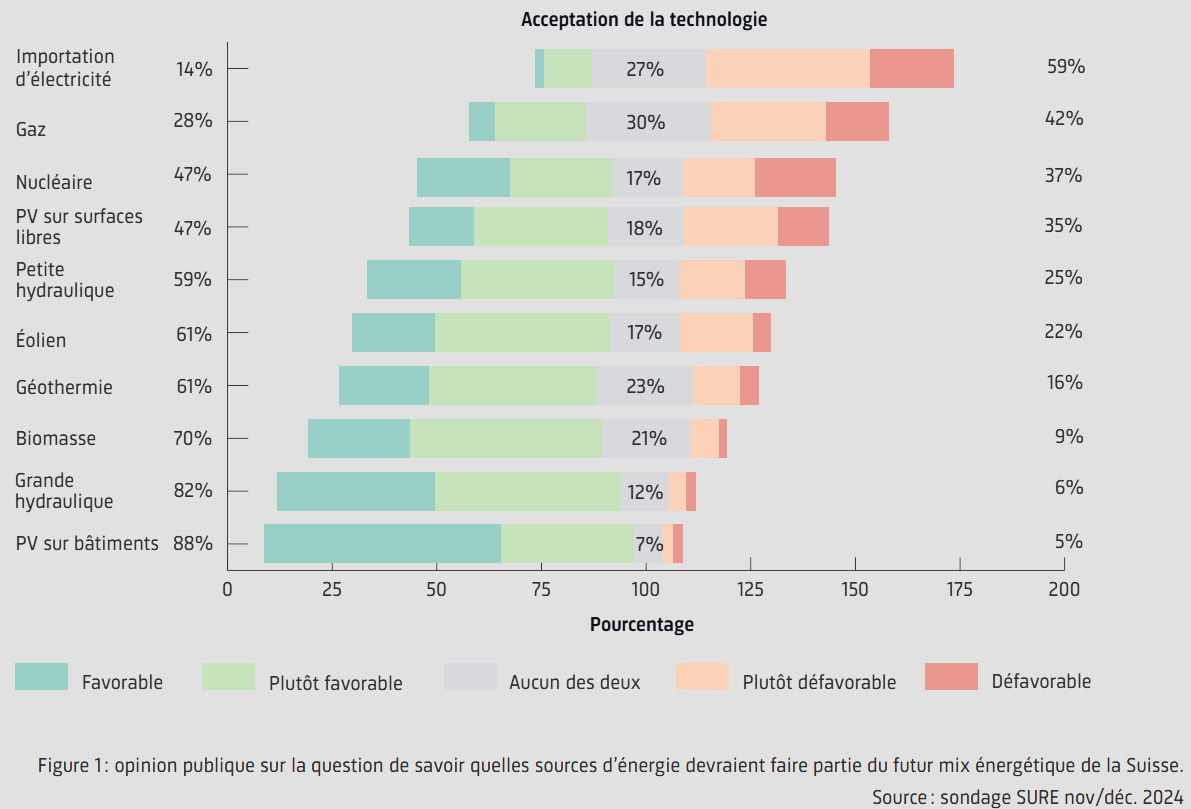
The debate over nuclear power continues in Switzerland, and attitudes are changing rapidly, as demonstrated by a recent AES poll, carried out by the gfs.bern institute. For the first time in many years, a narrow majority of citizens (56%) declare themselves in favor, or rather in favor, of considering the construction of new nuclear power plants.
In Switzerland, as elsewhere, the atom is again perceived by some as a kind of Holy Grail: the miracle solution to decarbonize our energy supply, complementing the development of renewable energies. But is this path really conceivable in a country that has officially decided to turn the page on nuclear power once its last plant is permanently closed?
In a report published a few days ago, the Energy Commission of the Swiss Academies of Sciences wanted to (re)lay the foundations of the debate, in order to assess whether nuclear power can truly constitute a serious option for Switzerland in its transition to carbon neutrality. "It provides policymakers and industry actors as well as the general public with evidence-based information, to allow as rational a debate as possible," the document emphasizes.
Here are the three key points to take away from this report, led by Urs Neu, president of the extended Energy Commission of the Swiss Academies of Sciences.
This article has been automatically translated using AI. If you notice any errors, please don't hesitate to contact us.

Interview with Vincent Kaufmann, director of the Ethos Foundation.

"The summer of 2026 showed what inaction costs; the courts, for their part, have begun to say who must be held responsible for it," emphasize François de Cambiaire and Lydia Méziani, lawyers at de Cambiaire & Méziani Associates.

Interview with Mélanie Beyeler, Global Head of Sustainable Investing at EFG.

A recent Harvard study highlights close links between the rise of data centers and clean energy. Behind the algorithms lies a purely material reality: a demand for electricity that is skyrocketing and disrupting grids and the energy transition.
Already a member or subscriber? Simply enter your email address to receive instant access to the article. Enjoy!