"We no longer have any choice but to adapt to climate change"
Interview with Vincent Kaufmann, director of the Ethos Foundation.
With the recent opening of the Ressourcerie Matériuum Lausanne, French-speaking Switzerland strengthens a key link in the reuse chain: that of storage, repurposing and awareness-raising around construction materials.
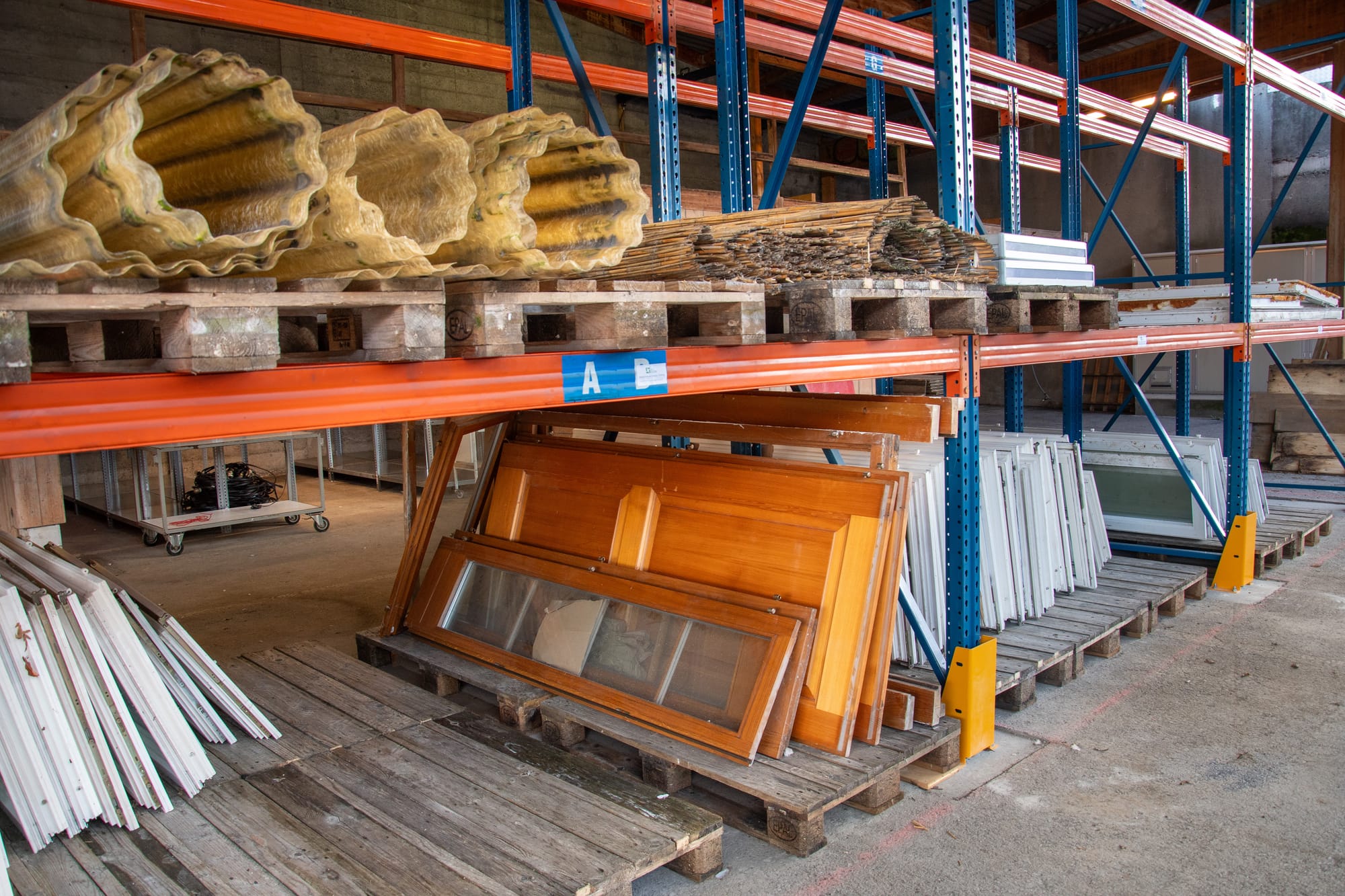
The reuse of construction materials is not limited to carefully removing elements from a "donor building" to reintegrate them into a "recipient building". For the practice to become widespread and truly circular, it is necessary to be able to sort, inventory, store and valorize the recovered materials — a logistical challenge that is often underestimated. This is precisely where material reuse centers make sense, offering a concrete and sustainable solution.
The Matériuum Lausanne Resource Center, inaugurated in October 2024, meets this need by providing a 700 m² space to collect, classify and return many construction materials to circulation: metal or wooden frames, façade elements, outdoor pavers, concrete slabs, etc. The project is based on a strong public-private partnership (City of Lausanne, Beaulieu SA, association Materiuum Lausanne) and is anchored in the objectives of the Lausanne Climate Plan and the Energy retrofit strategy for the built heritage of the city of Lausanne.
To coordinate this dynamic, a materials valorisation specialist was hired on 1 April 2025. His role? To identify and valorize reusable materials while facilitating their integration into new projects. This role is filled by Vincent Luetto, an architect specializing in geo- and bio-based materials and the manager of this "second-hand materials" space. Moreover, the placement of such a venue within IMPACT HUB Beaulieu, where various change actors meet, is far from accidental. Vincent Luetto welcomes this proximity. "It stimulates synergies, it's a true hive of ideas and partnerships. We are fortunate to be near these actors of change." He also adds, for those who still doubt, that reuse is "possible, current and it works! You must not be afraid. Diverting material opens the doors to creativity and spontaneity."
The reuse of construction materials still faces obstacles to becoming widespread, notably a lack of space to store deconstructed materials, or when construction schedules do not coincide and materials must be stored for weeks or even months before reuse. In the meantime, materials need to be identified, sorted, stored (properly to avoid losses), valorized and made available for new projects.
"Reuse is possible, current and it works! You must not be afraid. Diverting material opens the doors to creativity and spontaneity," explains Vincent Luetto, an architect specializing in geo- and bio-based materials and manager of the Matériuum Lausanne Resource Center.
It is precisely in this context that reuse centers prove their usefulness. Often run by construction professionals — project owners, architects, craftsmen — and committed volunteers, these structures constitute real hubs for reuse. They also offer advice, support and expertise to project owners in their deconstruction and material reuse processes.
In Fribourg, La Ressourcerie, which describes itself as a Competence Center for reuse, notably played a key role in the pilot project POLYNORM. That project demonstrated the feasibility of reusing metallic load-bearing structures from an old industrial hall. Additionally, during the renovation of the Sacré-Cœur school in Estavayer, a meticulous inventory of reusable elements was carried out, resulting in a public sale of materials and thus giving many building components a second life.
For its part, the Matériuum association has distinguished itself in several emblematic projects. For example, during the demolition of an old industrial building on Rue de Lyon in Geneva, Matériuum was commissioned to carry out an inventory of reusable materials and develop an action plan to valorize them.

The development of reuse centers is part of a broader dynamic: that of achieving "net zero carbon" by 2050, a goal set by the Confederation as part of its energy strategy. This ambition is implemented at the cantonal level through various climate plans that encourage the reduction of greenhouse gas emissions. In this context, reusing materials helps reduce embodied energy as well as associated emissions, all of which are essential levers in a building sector that remains a major emitter.
Reuse centers play an important role in material economy and in the growth of circular construction. As real catalysts for change, they help evolve sector practices. However, it would be naïve to believe they alone can deeply transform the construction sector. These initiatives, as useful and relevant as they are, do not replace the structural reforms needed: evolution of building standards, training of professionals, adaptation of public procurement and, above all, a change in mindset towards accepting a mix of traditional techniques and innovations.
This article has been automatically translated using AI. If you notice any errors, please don't hesitate to contact us.

Interview with Vincent Kaufmann, director of the Ethos Foundation.

"The summer of 2026 showed what inaction costs; the courts, for their part, have begun to say who must be held responsible for it," emphasize François de Cambiaire and Lydia Méziani, lawyers at de Cambiaire & Méziani Associates.

Interview with Mélanie Beyeler, Global Head of Sustainable Investing at EFG.

By combining energy management systems, decentralized generation and storage solutions, facility managers have a strategic opportunity: to transform their buildings according to the "building as a grid" model, says Kamal Mehta, Product & Offer Manager EMEA at Eaton.
Already a member or subscriber? Simply enter your email address to receive instant access to the article. Enjoy!