"One should not expect the energy transition to progress in a linear way"
Interview with Mélanie Beyeler, Global Head of Sustainable Investing at EFG.
"Despite the development of renewable energies, our country does not produce more electricity in winter than it did ten years ago. It's a wake-up call to be taken seriously," says Lukas Federer, head of the Energy, Environment, Infrastructure and Digitization department at Economiesuisse.

At first glance, the promotion of renewable energies in Switzerland is delivering good results: in 2024 they produced around 8.3 terawatt-hours of electricity, almost six times more than in 2010 (around 1.4 terawatt-hours). That corresponds roughly to the annual electricity consumption of the canton of Zurich. Almost three quarters of this increase is explained by the development of solar energy. Overall, installed generation capacity has increased by 40% over the past fifteen years.
So far, so good. But is Switzerland on the right track to guarantee a secure, clean and cheap electricity supply? Unfortunately, the answer is no. Our country already has a surplus of electricity in summer. And under current policy, this summer surplus will continue to grow. At the same time, the phase-out of existing nuclear power plants means that in the future we will mainly need more electricity in winter.
On closer inspection, the data on recent developments paint a less positive picture than it seems. Indeed, winter production has not increased in Switzerland in recent years. Whether one considers the whole winter semester (October to March) or the "critical phase" from December to February, the development of renewable energies has remained, so to speak, without effect. The gap between installed generation capacity and actual production continues to widen. As for demand, it is expected to increase by about one third by 2050. Thus, nearly 60% of the winter electricity production needed by that time still does not exist.
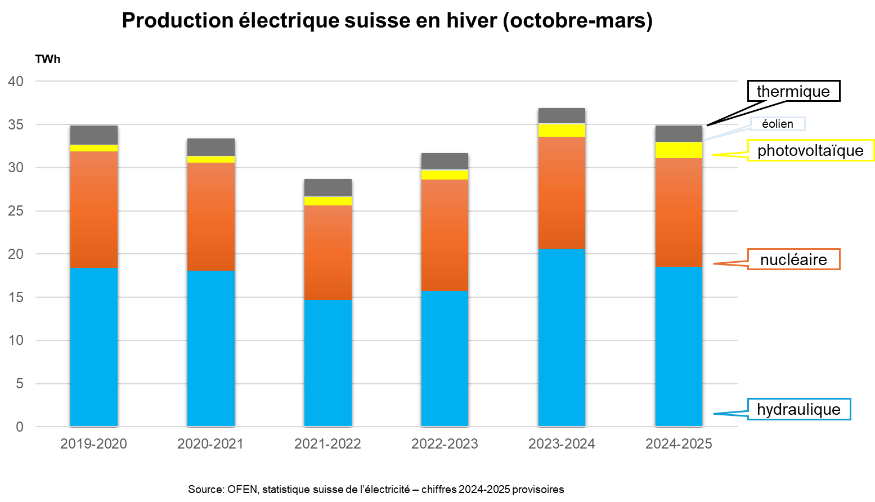
Following the shutdown of the Mühleberg nuclear power plant in 2019, Beznau, Gösgen and Leibstadt have become even more important, managing to meet needs thanks to increased availability of their units. However, during last winter Switzerland heavily relied on electricity imports. With the overhaul of the Gösgen site having been extended, there have been only three days since mid-October when Switzerland was not a net importer of electricity. At times, nearly half of our daily consumption was covered by imports of molecules. In terms of energy sovereignty and security of supply, that is clearly not acceptable.
Among the different renewable energies, it is above all hydroelectric power that can reliably produce electricity in winter. But it is reaching its limits. Given the current trajectory, its contribution will not be sufficient to maintain stable winter production, let alone to offset the increase in consumption caused by the proliferation of heat pumps, electric vehicles or by rising prosperity.
The Beznau nuclear power plant will be taken out of service in 2033: that is decided. Gösgen and Leibstadt could follow in 2039 and 2044 respectively. Under these conditions, we will face a massive shortage of winter electricity in the medium term. To fill this gap solely with wind and solar would require about 1,300 wind turbines or nearly 200 alpine solar installations, each with an area comparable to that of the Gösgen nuclear plant. At this stage, the only response from the political world to this medium-term supply problem consists of emergency measures related to building up electricity reserves, notably through the costly provisioning of hydraulic reserves and gas-fired plants in case of shortage.
Total dependence on imports as well as autarky are extreme solutions that make no sense.
To avoid a crisis, Switzerland must adjust its strategy and diversify its supply. We cannot afford an energy monoculture, because in the future we will need every decarbonized kilowatt-hour we can get. To this end, three lines of action are required:
This article has been automatically translated using AI. If you notice any errors, please don't hesitate to contact us.

Interview with Mélanie Beyeler, Global Head of Sustainable Investing at EFG.

By combining energy management systems, decentralized generation and storage solutions, facility managers have a strategic opportunity: to transform their buildings according to the "building as a grid" model, says Kamal Mehta, Product & Offer Manager EMEA at Eaton.
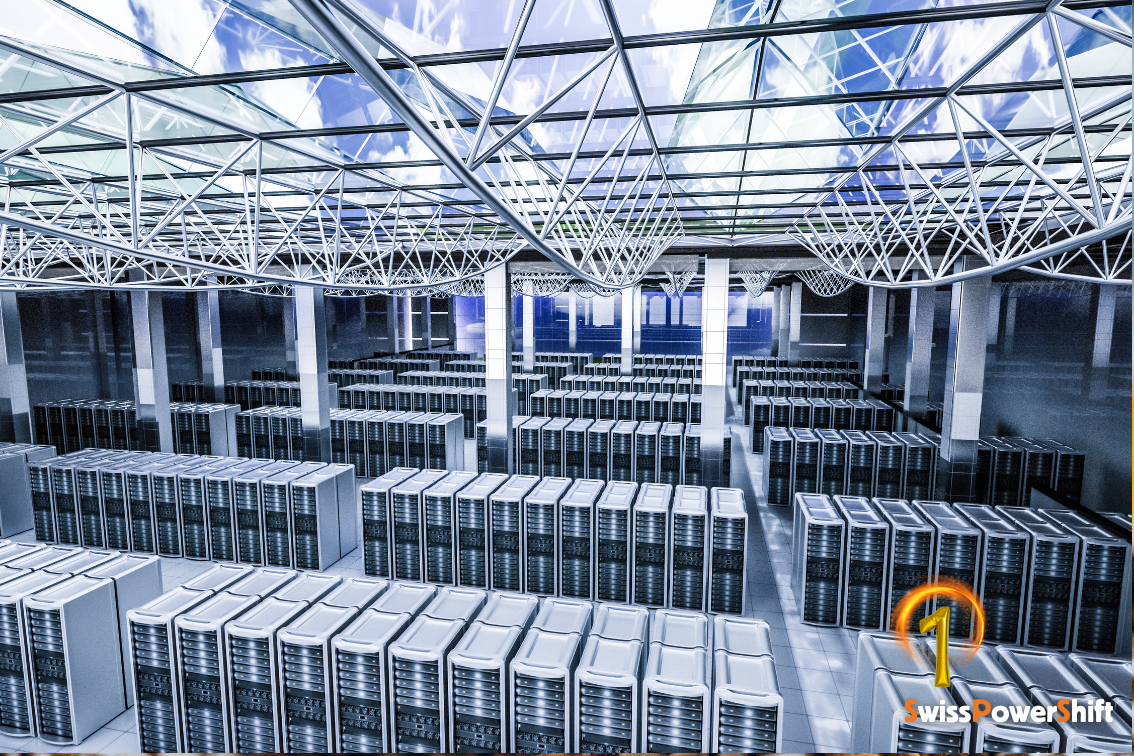
A recent Harvard study highlights close links between the rise of data centers and clean energy. Behind the algorithms lies a purely material reality: a demand for electricity that is skyrocketing and disrupting grids and the energy transition.

"While nuclear power is necessarily part of the long term, photovoltaics and batteries fall into a different timescale: that of the needs we must meet today," says Richard Mesple, CEO of Local Energy.
Already a member or subscriber? Simply enter your email address to receive instant access to the article. Enjoy!