"One should not expect the energy transition to progress in a linear way"
Interview with Mélanie Beyeler, Global Head of Sustainable Investing at EFG.
An Environmental Alliance (WWF, Greenpeace, Birdlife, etc) rejects the two proposals put forward by Paysage Libre. Paysage Libre describes this as a “political maneuver” linked to the current debates on nuclear energy.
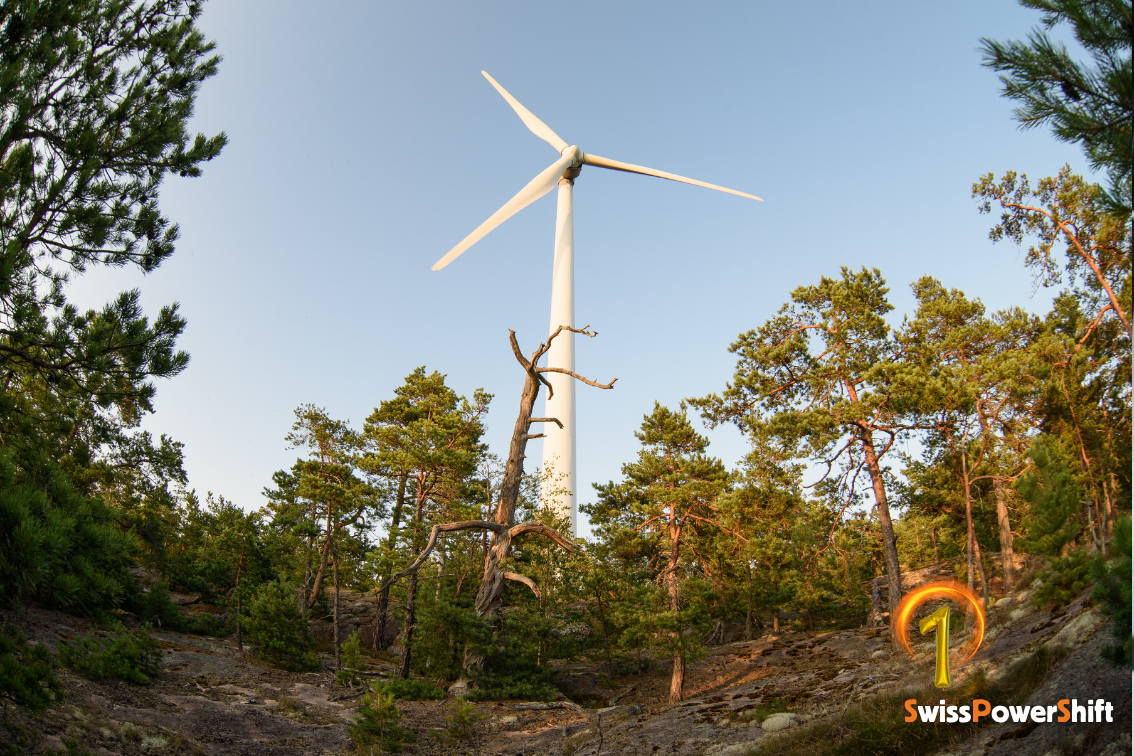
They could represent a new thorn in the side of defenders and promoters of wind energy in Switzerland. Filed on July 25, 2025, and then validated at the end of September, the federal popular initiatives “Against the destruction of our forests by wind turbines (initiative for the protection of forests)” and “For the protection of direct democracy against wind farms (initiative for the protection of municipalities)” seek to further strictly regulate the possibility of installing wind turbines in Switzerland.
Arguing that the development of future large parks threatens nature, the first initiative requests that wind turbines may not be installed either in forests or on wooded pastures. The second initiative, for its part, intends to strengthen democratic participation by providing for a mandatory vote not only in the municipality hosting an installation, but also in all municipalities directly affected.
Politically, the reaction was relatively swift. Since October, the Federal Council has been calling for the outright rejection of the initiatives (without proposing a counter-proposal), arguing that they compromise the country’s energy supply security and that they, moreover, run counter to Parliament’s intention to strengthen the position of municipalities in approval procedures.
Because part of the argumentation of Paysage Libre Switzerland, the federation behind the two initiatives, rests on nature protection, the position of the main NGOs involved in environmental protection was particularly awaited. It was released at the beginning of June, following the publication of a press release from the Alliance-Environment. This organization, which brings together ATE, BirdLife Switzerland, Fondation Énergie, Greenpeace Switzerland, Pro Natura and WWF Switzerland, in turn announced its opposition to both texts.
Regarding the forest initiative, the alliance believes that a generalized exclusion of wind energy from forest zones goes too far, excessively limiting the cantons’ room for maneuver as well as the development potential of this energy source. “Instead of blanket bans, suitable zones and installation sites should be carefully defined, rigorous environmental impact studies carried out and effective protection and compensation measures implemented,” the members of the alliance recommend. As for the other initiative, the one on the protection of municipalities, the collective considers that it would affect above all “the functioning of public institutions and political rights, rather than environmental issues.”
In their statement, the NGOs specify, however, that they are not entirely satisfied with the current situation either. They notably call on the authorities to show greater rigor in the surveys intended to identify future areas likely to host wind turbines. “It is imperative to carry out comprehensive local-scale assessments. This involves cataloguing the species present and taking their protection into account. At present, the carrying out of these surveys remains insufficient,” the members of Alliance-Environment regret.
Will this coalition of actors engaged in nature protection and its unfavorable stance on the two initiatives succeed in changing the views of opponents of wind power in Switzerland? That does not seem to be the case, judging by the remarks made by Jean-Marc Blanc, secretary-general of Paysage Libre for SwissPowerShift.
He notably denounces a regrettable form of political opportunism behind this position, which he judges premature and linked to the ongoing discussions about nuclear energy. “By evoking a loss of 2 TWh per year without wind power, the Alliance redirects attention to other energy sources, notably nuclear power, whose future will be debated in Parliament over the coming weeks. And this Alliance does not want nuclear power,” he explains.
Describing a patchwork coalition lacking serious representativeness due to the absence of other environmental organizations, the representative of the opponents of wind power clearly does not intend to soften his position. “We are only at the beginning of a debate that is not about to end. And it is not this ‘political stunt,’ which comes at just the right time just before the session of the Federal Chambers, that will change our position,” the secretary-general asserts. A position that remains unchanged: for the members of Paysage Libre, wind power is still perceived as a costly and ineffective solution.
As the battle between proponents and opponents of wind power is only just beginning, both camps are already sharpening their arguments and communication strategies. This promises an animated campaign in a Switzerland where citizens say they are in favor of wind turbines… at least as long as they are not installed in their own garden (“Not In My Backyard”).
This article has been automatically translated using AI. If you notice any errors, please don't hesitate to contact us.

Interview with Mélanie Beyeler, Global Head of Sustainable Investing at EFG.

A recent Harvard study highlights close links between the rise of data centers and clean energy. Behind the algorithms lies a purely material reality: a demand for electricity that is skyrocketing and disrupting grids and the energy transition.

"While nuclear power is necessarily part of the long term, photovoltaics and batteries fall into a different timescale: that of the needs we must meet today," says Richard Mesple, CEO of Local Energy.

Interview with Marie-Laure Chapatte, CSR Manager at the Neuchâtel Cantonal Bank (BCN).
Already a member or subscriber? Simply enter your email address to receive instant access to the article. Enjoy!